Benjamin Law★, (1773-1837)
Circa 1813 Benjamin Law
developed a material called shoddy that
revolutionized the woolen fabric industry in England and in the world.
William Law, the son of Benjamin Law by his second wife, Lydia Sheard, was the father of Lydia Law.
Lydia Law married John Land. They had Law Land born in Batley, England in 1858. Law Land and his wife Elizabeth Sykes immigrated to Canada where their son,
Percy, was born in 1885. The family later moved to the USA. My father Edgar (Bud) Land was the youngest child of
Percy Land and his wife, Meta Peterman.
Benjamin Law married twice. The first time at age 17. Two children survived from that marriage.
His second marriage, after the death of his first wife,
was to Lydia Sheard. Twelve children survived from that marriage.
Benjamin Law (1773-1837) birth
Benjamin Law,
the son of George Law and Mary Wilby, was born in Gomersall in
Birstall parish and baptized
on November 8, 1773 in Birstall Parish Church.
Benjamin Law, Early Years
Benjamin's parents
lived in Great Gomersall, Gomersal Hilltop, and Popeley Gate in Birstall Parish.
Benjamin was the 5th of 8 children of the union. Three children
are known to have survived long enough to have children of their own. They were Benjamin (1771), Isaiah (1775),
and Thomas (1782).
Benjamin's father, George, died in 1788 when Benjamin was 15 years old. His mother survived until 1801.
George Law was a clothier and Benjamin probably learned the trade from his father.
However, since his father died when Benjamin was so young he most
likely had to apprentice himself to another clothier. This may have happened earlier
if George Law had been ill for some time before his death.
In any event, sometime around the death of George Law, Benjamin moved to Batley parish where the first
record for him was his marriage at the tender age of 17+ in 1791 . His bride, Rachael Stubley,
who was several years older than Benjamin had a "bastard" baptized in the Batley parish church 7 and a half
months before the marriage.
See below.
Benjamin's brother, Isaiah, married in Birstall parish in 1796.
He had several children born in Birstall parish who later settled in Huddersfield.
Brother, John, moved to Batley where he died unmarried at age 21. Brother, Thomas, also moved to Batley.
However, the records for Thomas Law are very sparse.
Benjamin's mother "the widow Lawes" died in Batley in 1801.
Popeley Gate was described as "a hamlet in Gomersal township, Birstall parish.
(Trade Tokens Issued in the Seventeenth Century in England, Wales, and ..., 1891
By William Boyne) and in (Gazetteer of the British isles: statistical and
topographical, 1887
edited by John Bartholomew). It is listed under Thomas Harrice and English Seventeenth Century
Tradesmen's tokens in Yorkshire in several numismatic catalogues
.
Rachael Stubley
Rachael Stubley Birth
Rachael Stubley was the daughter of Abraham Stubley and his wife Noe (or Noah)
of Batley parish. Rachael's parents, Abraham Stubley and Noah Eastwood were
married on December 19, 1757 and had at least the following children:
Sarah (1760), Hannah (1763), Nancy (1765), Elizabeth (1766), Martha (1768),
Abraham and Rachael (1769), Joseph (1771), Benjamin (1775), Mary (1777),
and Hephzabah (1779). Noe, the wife of Abraham Stubby was buried on July 17, 1792.
For more information on the Stubleys go to, Abraham and Noah Stubley
Rachael Stubley Bastard Child Baptized in 1790
Rachael Stubley had a "bastard" baptized in Batley parish in November 1790. The Batley parish
register listed the following:
"November 14, Charles, son of Rachael Stubley of Batley, a bastard, born October 24."
Bastardy was relatively common and more often than not the parents of the bastard
went on to marry one another. Having a "bastard" was frequently a way of "arranging" a
marriage when the parents of one or both parties did not approve of the union.
In most of the listings for bastards, the "reputed father" was listed. The parish expected
that the father of a bastard would support the child, even if he did not marry the mother.
No "reputed father" was listed for Rachael's bastard.
Benjamin, born in 1773, was only 17 years old and was several years younger than
Rachael when Charles was
baptized in 1790.
However,
Benjamin Law married
Rachael Stubley seven and a half months later
making it
highly likely that Benjamin Law was the father of Charles.
His youth was
probably the reason that:
- No "reputed" father was listed
at the baptism of Charles Stubley
- Rachael and Benjamin were not married sooner. The legal age of marriage was 21. To marry
before the age of 21
parental consent was required.
Charles went under the surname Stubley.
Charles Stubley (1790-1873) and Hannah Mason
Marriage: Charles Stubley married Hannah
Mason of Silkstone on March 30, 1812 in Batley parish, he signed she x'ed,
witnesses Geoe Law and Mark Sykes both signed.
Note: George Law was the first son born after the marriage of Rachael Stubley and Benjamin Law.
The signature is similar to that of his own wedding in 1815.
Children:
- George Stubley (1813-) and Martha Marsden
Birth: George of Charles and Hannah Stubley, Batley clothier, April 11, 1813
See Stubley for more information on George Stubley.
- Abraham of Charles and Hannah Stubley, Batley clothier, February 26, 1815
Death: Another Abraham was baptized in 1831.
- Mark Stubley (1816-) and Sarah _______
Birth:
Mark Sykes Stubley of Charles and Hannah Stubley, Batley clothier,
September 19, 1816
Note: Mark Sykes was a witness to the marriage of Charles Stubley
Note: The censuses show two Mark Stublesy born around the same time. Both married
with children.
Marriage:
Children:
- Margaret of Mark and Sarah Stubley Batley clothier, 16 Feb. 1840 born 10 September
- Harper (?) of Mark and "Mary" Stubley 11 July 1841 born May 26, 1841, Batley clothier
- Joseph of Mark and Sarah Stubley, Batley clothier,
26 May 1844, born 30 April 1844
- Baptized same day, Elizabeth of Mark and Sarah Stubley Batley clothier, born 16 April 1843
- Matthew of Charles and Hannah Stubley, Batley clothier January 17, 1819
- Rachael of Charles and Hannah Stubley, Batley clothier,
September 19, 1820
- Mary of Charles and Hannah Stubley, Batley clothier, on May 23, 1824
- Ruth Stubley (1826) and Thomas Ineson
Birth:
Ruth, of Charles and Hannah Stubley Morley clothier, on September 17, 1826
Marriage: Batley, Thomas Ineson, clothier, son of Benjamin Ineson, clothier, to Rachale Stubley
"full age" daughter of Charles Stubley clothier
7 Sept 1843, both made thier mark.
- Elizabeth, of Charles and Hannah Stubley, Batley clothier, on July 20, 1828
Death: Another Elizabeth was baptized in 1833.
- Abraham, of Charles and Hannah Stubley, Batley clothier, on April 3, 1831
- Elizabeth of Charles and Hannah Stubley, Batley clothier, on June 30, 1833
- Hannah of George and Martah Stubley, Batley clothier,
23 Feb 1840 born 19 Feb 1840
- Charles Stubley listed in the 1851 census born circa 1841
For more information on Charles Stubley see Stubley
Death of Hannah Stubley:
1851, Hannah Stubley Havercroft age 64 Mar 29.
Marriage of Benjamin Law and Rachael Stubley
Benjamin Law of Batley Parish married Rachael Stubley of Batley Parish
on June 13, 1791. Benjamin signed his name "Ben Law".
Note: Ben Law was 17+ years old at the time of the marriage. Rachael was about 22 years old.
Children of Benjamin Law and Rachael Stubley
Benjamin Law and Rachael Stubley lived in the village of Batley in Batley parish and
had the following children:
- George Law (1792-1864) Martha Hall and Sarah ____
Birth: George, "son of Benjamin Law of Batley, clothier, son of George, by Rachael his wife,
daughter of Abraham Stubley" was born on April 10, 1792 and baptized on May 6, 1792.
Residence: Batley
Occupation: Clothier
Education: "Mr. George Law was educated partly at Batley Grammar School
and partly at Aberford." Letters to Editor Batley Reporter 20th November 1880, Benjamin Law (Benjamin Law was the son of John Law,
grandson of George Law and great grandson of Benjamin Law)
Marriage:
George married Martha Hall on August 15, 1815 in Batley parish. He signed. She x'ed.
Witnesses Jeremiah Chadwick and Ann Law who signed her own name.
Ann Law was most likely George's sister born in 1794.
Children:
- Lydia Law (1816-1855) and Benjamin Fox
Birth: Lydia of George and Martha Law, Batley clothier baptized August 25, 1816.
I do not know if it is meaningful, but Lydia was the name of George's step mother,
Benjamin Law's second wife.
Marriage: Lydia Law married Benjamin Fox son
of James Fox and Jane Castle, 17 September 1835 at Dewsbury (Vivien Thomlinson)
Children: John (1837), Joseph (1840), James (1842), Edwin (1845) & Martha Jane 16 February 1850, Batley(1850)
1841: Havercroft, Benjamine Fox 25, woolen weaver,
Lydia Fox 20,
John Fox 4,
Joseph Fox 1
1851 Census: Havercroft, Batley,
Benjamin Fox 36, cloth weaver,
Lydia Fox 32,
John W Fox 14, piecer in wll fac,
Joseph Fox 11, " " "
James Fox 9, " " ",
Edwin Fox 6,
Martha I Fox 1
Death: Lydia Fox, age 38, 6 July 1855 Batley.
- Joseph Law (1818-?) and Ann Bolton
Birth: Joseph, the son of George and Martha Law Batley clothier, baptized
March 22, 1818.
Occupation: Woolen Manufacturer, 1861 Census. Listed in the 1861 Leed's directory
with his brother John as "Shoddy and Rag Grinders" and alone under "Flushing, Paddin,
Drugget, Pilot and cloth" Note: He was not listed in the 1863 and 1866 Leed's Directories.
Marriage: 1838 by banns Tong, September 17, Joseph Law full age bachelor, clothier,
Parish of Birstall son of George Law clothier to
Ann Bolton full age spinster daughter of,
Charles Bolton, labourer. He signed. She made her mark.
Witnesses Emanuel Field and Mark Stubley his mark.
Children:-
Martha circa 1844
1841 Census: In Batley with his wife Ann
1851 Census: Joseph Law was listed with his wife, Ann, and his brother, Jeremiah,
in the 1851 Census in Dewsbury
1861 Census:
Joseph Law was listed with his wife, Ann, in the 1861 census, see Laws in the Censuses
1871: Sunderland, Durham County, England,
38 1/2 Flag Lane, Joseph Law, head, mar, age 53, rag merchant
born Bartley Yorkshire, Ann Law age 52 rag merchants wife, born Batley Yorkshire
Death:
- John Law (1820-1885), Susannah Talbot, and Jane Smith
Rainforth
Birth: John, of George and Martha Law, Batley clothier, baptized May 28, 1820.
Occupation: Architect, 1861 Census. Listed in the 1861 Leed's directory
with his brother Joseph as "Shoddy and Rag Grinders" Note: He was the
only John Law of an appropriate age in the 1861 census.
Marriage: 1844 May 12, John Law bachelor of Halifax and
Susan Talbot spinster of Halifax, entered by Joseph Law, Halifax Holy Trinity.
Note : One of their children was Mary Talbot Law born 1850,
another child was George Edward Talbot Law born 1854.
Children:
- Benjamin Law (1844) married Frances Mary Hornley
Birth: Benjamin, son of John Law and Susanna, schoolmaster, Batley,
born August 26, baptized October 20, 1844 (BT)
1861: At boarding school in Sedbergh
Marriage: 1887 February 22, Parish Church Leeds, Benjamin Law age 42 bachelor barrister at law
Batley, son of John Law, architect to Francis Mary Harnley age 27 spinster, Warwick Place
daughter of William Hornley, tobacco and manufacturer. Both signed.
Children:-
John circa 1891
1881 Census: Benjamin age 36 , barrister, brother
born Batley was listed with Mary T Law, head age 30 on Taylor Street in Batley
1891 census at Cliff Road Woodhouse as follows:
-
Benjamin Law age 46 barrister born Batley
- Frances wife age 31, born Leeds
- John L age 1 born Heatenley (?)
- Fanny Heritage age 41 servant
1901 Census: None of them were listed
- Joseph, of John and Susanna Law, bookkeeper, Batley, born May 9, baptized,
June 27, 1847 (BT)
Death: Joseph Law, New Street, age 2, buried January 7, 1850 (LDS film #1542210)
- Mary Talbot of John and Susanna Law of Batley, clothier, born
October 24, baptized December 1, 1850 (BT)
1881 Census: Listed with her brother Benjamin see above
- Anne Law (1852-) and Henry (Harry) Spedding
Birth:
Anne of John and Susanna Law, Batley bookkeeper, born May 12, baptized
June 13, 1852 (BT).
Marriage: "Henry" Spedding, from 1996 Batley News Article.
1881, October 25, Harry Spedding 27 bachelor designer Batley son of William Spedding, (can't read)
Anne Law 28 spinster, Batley, daughter of JOhn Law architect, Batley Parish.
1891 Census: Harry Spedding, age 38, Ann age 38, William age 7 and John R age 2
1901 Census: Surrey St Batley, Harry Spedding, 46, woolen mill manager, worker,
Ann age 48, wife, William son age 14, John R, son, age 12, all born Batley.
1996 Batley News: Descendant: Mrs. Clarice Anne Johnson of Batley, Soothill Lane Batley.
- George Edward Talbot Law of John and Susanna, Batley bookkeeper, born April 16,
baptized May 4, 1854 (BT)
Death: George Edward Law Havercroft buried May 1855 age 1 year.
- John Thomas of John and Susanna Law, Batley bookkeeper,
born May 15, baptized July 27, 1856 (BT)
Later Record: In the 1871 census with his father. Not listed in later censuses.
- James Law (1858) married Ann Machill
James of John and Susanna Law, Batley bookkeeper, born January 22,
baptized April 4, 1858 (BT)
Marriage: Anne Machill, Nov 10, 1885 James Law age 27 bachelor (cannot read) Batley son of John Law, Architect
to Anne Elizabeth Machill age 29, spinster Hanging Heaton daughter of
Francis Machill (cannot read), He signed. She made her mark. Witnesses John Thomas Law
and Francis Richard Machill.
Children: - Gertrude circa 1887
- Francis R circa 1893
- Josephine circa 1894
- John M 1898
1891 Census on Oxford Road in Gomersal as follows:
- James age 33 solicitor, born Batley
- Anne E wife age 34 born Batley
- Gertrude age 4 born Batley
1901 Census: Listed in Birstall see Laws in the Censuses
Death of Susannah Law: Susanna Law, King Street, age 34, was buried January 7, 1859.
Remarriage of John Law: Jane Rainforth nee Smith, Marriages Mar 1862 Law, John,
Dewsbury, 9b 628 Rainforth, Jane, Dewsbury (Free BMD)
Jane had been married to George Rainforth born in Rainton. The were listed in the 1851 census in Rainton. George was listed as a proprietor or houses. They had one servant. Free BMD lists two deaths for George Rainforth Mar
quarter 1854 and Sept quarter 1857.
Jane Rainforth was listed in the 1861 census in Batley as a widowed head of
household teacher at Wesleyan Day School. Her children John, age 16, Mary Jane age 13, Alfred
age 8
and Annie L age 7 and Mary Ann Clarton lodger unmarried age 21
teacher in Wesleyan Day school were also listed with her.
Children of James Law and Jane Smith Rainsforth:
- Florence Law (c. 1863) and Benjamin Longfellow
Birth: Florence Law circa 1863
Marriage: Benjamin Longfellow, July 31, 1890 Benjamin James Longfellow age 37
bachelor flock Manufacturer, Batley son of William Longfellow flock manufacture to
Florence Law age 28 spinster (cannot read) Batley daughter of John Law Architect.
Both signed. Witnesses James Law and Alfred Longfellow.
1891 Census: Florence Longfellow, age 28, wife was listed on Howard Street in Batley with
her husband, Benjamin Longfellow, age 36, flock manufacturer, born Horsforth,
and her sister Melua Law age 25 no occupation
1901 Census: Florence Law Longfellow was listed in Uppwe Mount Batley,
Benjamin Longfellow, head, age 46, flock manufacturer, employer, born Horsforth,
Florence Longfellow, age 38, wife, born Batley,
Ann Rainforth, niece, age 22, school teacher, born Roo---thorpe
- Malena Law circa 1866
1851 census in Batley: John Law was listed in the 1851 census as a book keeper in a
woolen mill, see Laws in the Censuses.
1861 census in Batley: John Law was listed in the 1861 census as an architect.
Two of his children were no listed with him, Benjamin born in 1844 and James born in 1858.
I don't know where Benjamin was but James wias living
with his grandfather, George Law
1871: John Law 51,
Jane Law 45,
Benjmn Law 26,
Mary J Rainforth 22,
Mary T Law 20,
Annie Law 18,
Alfred Rainforth 18,
Annie L Rainforth 16,
John Thomas Law 14,
James Law 13,
Florence Law 8,
Malena Law 5,
George Rainforth, 4.
1881 Census: Taylor Street Batley,
Jno Law 61, architect, Batley,
Jane Law 55, Plompton,
Mary J. Rainforth 33, stepdaughter, Rainton (?),
Annie Law 28, daughter, Batley,
Jno. T. Law 24, son,
James Law 23, son,
Florence Law 18, daughter,
Melenia Law 15, daughter,
George Rainforth 14, grandson, Next door to Mary T Law 30, and her brother Benjamin
36 barrister in practice.
See Laws in the Census
Batley New 1996:
According to an article in the
Batley News dated Tuesday, May 16, 1996, about the descendants of Benjamin Law:
-
John Law was the architect for the Britannia Building at the bottom of Taylor street
(now demolished).
- John Law's daughter, Anne, married Henry Spelling.
Their son, John R Spelling
had a son (name not listed). He in turn had a daughter, Clarice Spelling Johnson.
Clarice Spelling Johnson provided a picture of her grandmother Ann Law Spelling.
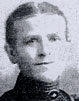 Ann Law Spelling, the daughter of John Law and the great-granddaughter of Benjamin Law.
- Clarice Spelling Johnson said "Her grandfather, John, was carried on Benjamin
Law's shoulders to work in his mill in Clerk Green.This
story has come down through the family, but he was obviously not impressed with mill work
because he became an architect."
Deaths:- John Law, architect, age 65, of Taylor Street, was buried in the Batley Cemetery on
March 6, 1885.
- Jane Law, age 60, widow of the late
John Law of Taylor Street,
was buried in Batley cemetery on February 11, 1886.
- Jeremiah Law (1822-?) and Emma Sheard
Birth: Jeremiah, the son of George and Martha Law, Morley clothier, was
baptized April 7, 1822.
Marriage: June 15, 1843, Jeremiah Law, age 21, bachelor, Batley, clothier, the son of George
Law, clothier,
married Emma Sheard, 18, Carlinghow, daughter of Charles Sheard.
Both signed. Witnesses: John Mitchel and J W Jenkins
Civil Record: LAW, Jeremiah, SHEARD, Emma, Dewsbury, 22, 3, June 1843 (Free BMD)
1841 Census in Batley:
Jeremiah Law was listed in the 1841 census in Batley.
Children:- Ann Milnes circa 1847
Death of Emma Sheard Law: Nothing obvious on Free BMD
1851 Census: Jeremiah was listed with his brother, Joseph in the 1851 Census
See Laws in the Censuses
- Thomas, the son of George and Martha Law, was baptized April 18, 1824.
Death: Thomas Law of Batley, age 19, was buried May 18, 1843.
Death of Martha Law:
Martha Law of Batley, age 36, buried August 11, 1829.
Marriage of George Law: In the 1841, 1851, and 1861 censuses George's wife was listed as
"Sarah".
1841, 1851 and 1861 Censuses in Batley:
George Law was listed in the 1841 census as a rag dealer, in the 1851 census as clothweaver,
and in the 1861 census as a "hawker of house cloth". See
Laws in the English Censuses
Death of George Law: George Law of Batley, age 72, was buried September 22, 1864 (Batley Parish Record)
Death of Sarah Law: Unknown
John✟, "son of Benjamin Law, clothier, son of George, by Rachael his wife,
daughter of Abraham Stubley " was born on November 11, 1793 and baptized January
of 1794.
Death :
John "Lawes" buried July 7, 1800. There is no other information, but this is most likely
the death record for John, the son of Benjamin and Rachael.
Ann Law (1793-)
Birth:
Ann, "daughter of Benjamin Law, clothier, son of George, by Rachael his wife,
daughter of Abraham Stubley" was born November 11, 1793 and baptized February 2, 1794.
Further Records: I am not sure what happened to Ann. However, she was probably the Ann Law that was
a witness at her brother, George's wedding in 1815.
Sarah✟, "daughter of Benjamin Law, clothier, son of George, by Rachael his wife,
daughter of Abraham Stubley" was born on December 22, 1796 and baptized April 2, 1797.
Death: Sarah died as an infant and was buried with her mother, Rachael. See below.
Death of Rachel Stubley Law
Rachel died in 1797. Her burial was not listed in the parish records. However,
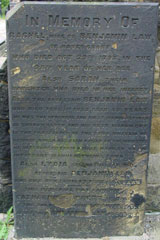
her death on October 22, 1797, at age 28, was recorded on the memorial Benjamin's headstone
in the Batley Parish churchyard
which reads in part,
"In memory of Rachel the wife of Benjamin Law of Haver-croft
Who departed this life on the 22 day of October 1797
In the 28th year of her age
Also of Sarah their daughter who died in her infancy".
I checked Ancestry.com again in August 2014. No listing for Rachel Law's death.
Benjamin was 24 years old - a widow with three children:
Charles Stubley age 7, George Law age 5, Ann Law age 4. How did he manage? Who helped him with the child rearing?
In 1897 Mary Wilby Law (Benjamin's mother) was probably close to 60. (Her birth date is not known for certain.)
Mary Wilby Law, "the widow Lawes", died in Batley in
November 1801. Was it possible that she was helping with the children before Benjamin remarried?
Benjamin waited three and a half years to remarry. This was quite unusual for the times.
Most widowers married quite soon after the death of a wife.
Marriage of Benjamin Law and Lydia Sheard
Three and a half years later
Benjamin Law, clothier, of the parish of Leeds married Lydia Sheard,
spinster, of the parish of
Leeds,
by banns on April 20, 1801 in Leeds. (Leeds parish records)
He signed "Benjm Law".
Lydia made her mark. Witness Joseph Hirst (his mark).
Notes:
- Benjamin Law and Lydia Sheard were both connected to Birstall and Batley Parishes. Marriages
in parishes other than one's home parish seem to have been quite common.
Lydia Sheard's sister, Elizabeth, also married in Leeds.
She and her husband, Benjamin Parr, were also connected to Batley Parish.
Benjamin Parr was a business partner of Benjamin Law.
- Because the widower often needed someone to look after the orphans, there was a high rate
of remarriage of widowers with small children. Benjamin, who had at least two small
children still living at the time of their mother's death, waited longer than most widows to
remarry.
Signatures and Literacy of Benjamin Law

Signature from his marriage to Rachel Stubley in 1791

Signature from his marriage to Lydia Sheard in 1801
When and where did Ben Law learn to write his name? Could he read?
Children of Benjamin Law and Lydia Sheard Law
Benjamin Law and Lydia Sheard Law lived in the village of Batley in Batley parish and
had:
- John, "son of Benjamin Law, clothier, son of George, by Lydia his wife,
daughter of Michael Sheard" was born on November 1801 and baptized on December 29,
1801 in Batley. (Batley Parish Records)
Emigration: Around 1820 John Land
went to America
on business for his father and
was never heard from again.
Ancestry.com does not have any immigration information on
John Law. Not listed Castle Gardens which supposedly starts in 1820.
See below.
"Finding that he could produce more
than he could dispose of in the English market, he sent his son
John with a large consignment of goods to America, where he met with a ready
sale at a good profit. A second venture in the same direction was agreed upon,
and into this the original shoddy manufacturer put all his energy and all
his money. His son started, no doubt with high hopes of success, and Mr.
Law himself, in all likelihood, looked forward to securing the means
of extending his business. Weeks passed away, but Mr. Law heard nothing
of his son; and at length, fearing that he had died, or that some accident had
happened which prevented his writing, determined to go out in search of the
young man and his precious freight. He went to America, sought high and low,
but no trace of his son or the goods could be found, and he returned home
comparatively a ruined man."(Great industries of Great Britain By Great
Britain, 1884)
From the remembrances of Benjamin's grandson, Edwin Law circa 1880:
Mr. Law appears to have found it necessary to open out foreign markets for his manufactured goods and with this purpose in view he sent his eldest son, John, then a youth of some 17 or 18 years, to America with a quantity of goods to dispose of. The venture appears to have been very successful, for the young man, much against his inclination, was ordered by his father to undertake a second expedition. The second consignment was much larger than the previous one. Mr. Law, in the hope of reaping a rich harvest of profits had invested the greater portion of his capital in the venture. John sailed with the cargo but was never heard of again. After he had sailed, it was said to his father that he had said that if compelled to go, he would never return. Whether this was a mere idle threat, uttered in the vehemence of his displeasure and afterwards fulfilled by accident, can never be known. When this utterance of his son came to Mr. Law he followed him to New York and there heard that a youth, answering his description, had sailed for New Orleans where it was said the yellow fever was raging. He did not attempt to follow him farther but returned home, having lost his son and the greater portion of his capital. From this time the prosperity of the family declined and finally, the lucrative business from which others have reaped such a rich harvest and which has found employment for thousands of people and opened out a new era for the West Riding of Yorkshire, was abandoned and at the present time not one of his descendants, so far as the writer is aware, is in any way connected with the trade originated by their ancestor. The family left Batley and went to reside at Hyde, whence they removed to Stockport where the founder of the shoddy trade died 21st February 1837 at the age of 65 and was buried in the burial ground of Batley Parish Church.
Death of John Law: Unknown
- Hannah Law (1805-?) and John Parr
Birth: Hannah, "daughter of Benjamin Law, clothier, son of George, by Lydia his wife,
daughter of Michael Sheard" was born on December 31 1805 and baptized on February 16,
1806 in Batley (Batley Parish Records).
Marriage: Hannah Law married John Parr by license on January 23, 1825 in
Batley parish.
The witnesses were Thomas Law and Samuel Parr. Thomas Law was the brother of
Hannah's father, Benjamin Law. Samuel Parr was John Parr's brother. Hannah Law
and John Parr were cousins. Hannah's mother, Lydia, and John's mother, Elizabeth
were sisters.
Occupation of John Parr: Clothier, woolen weaver, weaver
Children:
- Elizabeth, the daughter of John and Hannah Parr, Batley clothier,
March 26, 1826
Death Elizabeth Parr, infant, August 21 1826
- Benjamin Parr (1828-?) and Mary
Baptism: Benjamin, the son of John and Hannah Parr Morley clothier, April 6, 1828
Marriage: Mary Iverson [Marriages Mar 1850, "Hineson", Mary, Parr,
Benjamin, Dewsbury, 22, 37 (Free BMD)]
Children: -
Joseph Parr (1851-?) and Elizabeth
Birth: Joseph, circa 1851
Marriage: Elizabeth
Children: -
John T circa 1870
- Mary E circa 1876
- Henry circa 1879
- Benjamin born in Germany circa 1890 see 1901 census
1871 Census: Wellington St Batley, Joseph Parr, age 20, mill hand, Elizabeth, wife, age 20 and John T "daughter" age 1
1881 Census: Colbeck Road, Batley, Joseph Parr, age 30, overlooker, Elizabeth,
wife, age 30 and John T son age 11, Mary E age 5, and Henry age 2
1901 Census: Taylor Street, Batley, Elizabeth,
widow, age 50 Mary E age 25, laundress wash worker home, and Henry age 22, woolen Card cleaner,
Sarah J daughter age 19 laundress home born Birstall, Benjamin age 11 born Germany
British subject, and Elizabeth age 5, granddaughter, born Batley
- John Parr (1855-?) Single
Birth: John 1855
1861, 1871, 1881, 1891 censuses: With his father
1901: John Parr, on Well Lane Batley age 46 head, clogger
- Frank Parr (1859-?) and Ann
Birth: Frank 1859
Marriage: Ann
Children: - John J circa 1879
- Emma circa 1881
- Frank circa 1883
- Benjamin circa 1888
- Mary E circa 1891
1881 census: Spa Street Well Lane Batley, Frank Parr, age 22, card cleaner, Ann wife, age 23, and John Parr son age 2, Emma
Parr daughter age 1 month
1891 census: Spa Street Well Lane Batley, Frank Parr, age 32, goods porter, Ann wife,
age 32 born Chesterfield,
and John Parr son age 11, Frank age 8, Benjamin age 2 and Mary E age 10 months
1901 Census: John Joseph and Benjamin Parr were living with their uncle, Thomas Holmes, age
28 in St Peter's Stanley. All weavers
- Hannah circa 1864
- Sarah J 1866
- Mary A circa 1870
1851 Censues in Upper Batley:
Benjamin Parr, age 23, woolen cloth finisher, born Morley, Mary age 22, born Batley Joseph age
8 months, born Batley
1861 Censues on Commercial Street Batley:
Benjamin Parr, age 33, woolen cloth finisher, Mary age 32, Joseph age 10 John age 6 and
Frank age 2
1871 Censues at Ward's Hill, Batley:
Benjamin Parr, age 43, cloth dresser, Mary age 42, John age 16 clogger,
Frank age 13, mill operative, Sarah I daughter age 5, Hannah E daughter age 7 and Mary
A daughter age 1
1881 Censues at Well Lane, Batley:
Benjamin Parr, age 53, cloth finisher, Mary age 42, John age 26 clogger, Hannah E age 17 woolen weaver,
Sarah J age 15, woolen weaver, and Mary Iverson mother-in-law age 69
1891 Censues at Well Lane, Batley:
Benjamin Parr, age 63, waste dealer woolen cloth, John age 36 clog maker,
Hannah E age 27 woolen weaver,
Sarah J age 12, woolen weaver
- James, the son of John and Hannah Parr Morley clothier, May 30, 1830
Death: Another James born in 1848
- Rebecca, the daughter of John and Hannah Parr Batley clothier, February 12, 1832.
Death: Rebekah Parr, Batley 1 year April 7, 1833
- Rachel Parr (1834- ) and Samuel Burnley
Birth:
Rachel of John and Hannah, Batley clothier, 26 Jan 1834
Marriage:
Samuel Burnley Dewsbury June 1859 (Free MMF)
Additional Info: Gary Riley informed me of the marriage of
Rachel Parr to Samuel Brunsley, and the existence of their daughter, Hannah E., who
was the beneficiary of her great aunt, Catherine Law Barrett's will, July 2009
Children:
- Hannah Elizabeth Burnley circa 1860
More on Hannah Burnley:
Hannah was a servant of her great aunt, Catherine
Law Barrat. Catharine had no children of her own and left all her money, furniture etc to
Hannah. Hannah built "Rose Lea"
on Branford Road Birstall near Oakwell Hall. (Information provided by Alan and Gary S Riley, July 2009)
1891 Census: With Catherine Law Barrett in Salford, Lancashire
- George, June quarter, 1861 Dewsbury 9b, 438 (Free BMD)
- Oscar, June quarter 1865, Dewsbury, 9b, 542 (Free BMD)
- Henry June quarter 1867, Dewsbury, 9b, 559 (Free BMD)
- Fred circa 1868
-
Mary Ellen Burnley (1876-) and Godfrey Sykes
Birth:
Mary Ellen December quarter 1876, Dewsbury 9b 634 (Free BMD)
Marriage: Mary Ellen Burnley and Godfrey Sykes Dewsbury 9b 983, Dec 1897 (Free BMD)
Children:
- Edwin circa 1899
- May Sykes, 1901, married Thomas William Riley (Alan and Gary Riley July 2009)
1901 Census: Batley, Princess Street, Godfrey Sykes age 30, wollen spinner,
worker born Yorkshire, Mary E wife age 25 Edwin son age 2, May 1 mo, Fred Burnley boarder age 31, cloth finisher,
all born Yorkshire, Batley.
1861 Census: Benj Sheard Fold, Batley, Samuel Burnley, age 30,
cloth tenterer, born Batley,
Rachel wife age 29, born Batley,
Hannah Eliz age 1 born Batley, George son age 6 mo born Batley
1871: Wards Hill, Batley, Samuel "Burnly" age 40, stone sawer,
Rachel,wife 37,
Hannah E, 12,
George, 11,
Oscar, 6,
Henry, 4
Fred, 1
1881 Census: Park Road Batley:
Samuel Burnely, stone setter quarry,
"Rachiel", wife,
Hannah, 21 cloth weaver,
George, 20, cloth raiser,
Oscar, 17, factory worker,
Henry,14,
Fred, 13,
Mary Ann, 5 all born Batley
1891 Census: 9 Cross Market, Batley, Rachel Burnely,
widow age 58, born Batley,
George son age 30 stone guarry man born Batley,
Henry son age 23, clothe finisher, born Batley,
Fred son age 21 cloth finisher, born Barley,
Mary E daughter as 15 woolen weaver, born Batley
1891: Hannah E Burnley, niece age 30 was living with her great aunt
Catherine (Law) Barrett, 71 and Ann E Law age 42, teacher in Salford, Lancashire.
See Catherine Law Barrett below.
Death of Rachel Burnley: Mar 1897 Dewsbury (Free BMD)
- Esther Parr (1835-?) and John Fozard
Birth: Esther of John Parr and Hannah Batley clothier 28 June 1835
1861 Census: Smithies Lane Gomersal, John Fozard, head, age 30, corn miller, born Howley Mill
Esther, wife, age 26, born Howley Mill, Mary daughter age 3 born Hartshead, Sam son age 2 born Howley MIll,
Arthur son age 6 mo born Birstall
Death of John Fozard:
1871 census: Batley Mayman Lane, Esther Fozard, head age 35, widow, woolen warper, born Batley,
Sam son age 13 blacksmith,
Arthur son age 10 scholar, both born Batley
1881 Census: See Hannah Parr below
1891: Providence street Batley, Esther Fozard, head widow age 60, Arthur son age 30 brewery nightman
- Hepseba circa 1836
- Lydia Parr (1828-) and William Wood
Birth:
Lydia of John and Hannah Parr Batley clothier 12 Aug 1838 born 27 June 1838 (BatPR)
1841: With her parents
1851: Lydia Parr, age 12, servent, Clark Green Batley with Grace Smith age 70, and Elizabeth Stubley her grandaughter age 27.
Marriage: Charles William Wood 1856, September (listed Free BMD)
Children:
1861: Listed with her parents and husband, William Wood.
- John Parr (c 1840-) and Martha
Birth: John circa 1841. After the 1841 census.
1861: Cross Street Batley John age 21 labourer in dye house, bor Morley, Martha age 24
woolen power loom weaver, born NK (not known?)
Alice daughter age 8 mo. born Batley.
1871 Census: See John and Hannah Parr below
1881 Census: Batley, Howley Beck, John Parr, head age 41, dyer, born Howley
Martha, wife age 43,
Alice daughter age 20 cotton weaver,
Thomas son age 18 cloth miller rest born Batley
1891 Census: Back Street Hanging Heaton, Soothill, John Parr, widower age 52 woolen cloth dyer
- Thomas Parr (1843-?) and Susannah
John and Hannah Parr in the 1861 census.
Birth: Thomas circa 1843
Marriage: Susannah
Children:
- Herbert circa 1896
1851 and 1861 Censuses: Listed in the 1851 and 1861 censuses with his parents.
1871 Census: Thomas Parr dyer age 28 and his wife Susannah were listed in Morley with William Wood.
Susannah was listed as the sister in law of
William Wood. William Wood and his wife Lydia were listed as boarders with
1891 Census on Upton Street in Batley: Thomas Parr, head age 59 wool dyer cloth dyer,
Susannah, wife, age 57, Herbert age 5
1901 Census on Cresent Street in Batley: Thomas Parr, head age 7 wooled dyer,
Susannah, wife, age 45, Herbert age 15, (?) Rug maker
- James Parr (1848-?) and Mary J
Birth:
James circa 1848
Marriage: Mary J
Children:
- Sarah J circa 1877
- Henry circa 1879
- Edward circa 1882
1881 Census on Cross Park Street in Batley: James Parr, head age 32, dyer,
Mary J, wife, age 31, Sarah J. age 4 scholar and Henry age 2
1891 Census near Howley Hall Farm Morley : James Parr, head age 42, dyer labourer,
Jane, wife, age 41, Sarah J. age 14 woolen weaver and Henry age 12, scholar, and Edward, age 9 scholar
1901 Census Cross Bank Road Batley : James Parr, head widower, age 52, cloth dyer
1841 Census in Norris Heaton, Stockport, Manchester, Lancashire County: With Lydia Law, see below.
1851 Census in Morley at Howley Beck: John Parr, head, age 51, clothier,
Hannah, wife, age 45, Rachael daughter age 17 burler, Hepseba daughter age 15, burler,
John age 11 scholar, Thomas age 8 scholar and James
age 3 scholar.
1861 Census in Morley at Howley Beck: John Parr, head, age 61, woolen weaver,
Hannah, wife, age 54, Thomas age 18 dyer, James
age 13 labourer, William Wood, boarder, married age 23, farmer, Lydia, boarder age 2? and
Rachel daughter age 2
1871 Census in Morley at Howley Beck: John Parr, head, age 71, weaver,
Hannah, wife, age 65, John Parr, age 31 widower, cloth dyer, James Parr, son unmarried, age
23, overlooker at mill, Alice Parr, granddaughter age 10 scholar,
Thomas, grandson age 7 scholar
Death of John Parr: Between 1871 and 1881.
1881 Census at Cross Park Street Batley: Esther Fozard, age 46 widow head,
Samuel Fozard, son age 22, married, cloth finisher, Arthur Fozard, son unmarried, age 20,
tallowchandler, Martha Fozard, daughter-in-law married, age 25 cloth sorter,
Mary Fozard, granddaughter age 2, John Fozard, grandson age 7 months, and Hannah Parr, mother
widow age 75
Death: Unknown. Before 1887, see Death of Catherine Law Barrett below.
Joseph Law (1807-?) and Sarah ________
Birth: Joseph, "son of Benjamin Law, clothier, son of George, by Lydia his wife,
daughter of Michael Sheard" was born on August 20, 1807 and baptized on September
17, 1807 in Batley. (Batley Parish Records)
Marriage: Sarah
According to the census Sarah was born in Batley.
??? Joseph Law, weaver, and Sarah Law, banns, both of the parish of Tong, 19 May 1833, both signed,
witnesses can't read and John Parr.
Occupation: clothier, bookkeeper, school master, rent and dept collector
Children:
- Thomas Law (1833-?) and Jane Heppleston
Birth: Thomas, son of Joseph Law and Sarah, clothier, was baptized
November 24, 1833 (Batley Parish Records)
Occupation: Plumber (Vivien Thompson, November 2004), Apprentice plumber 1851 census. Listed in the
1861 Leeds directory
as a plumber. Not listed in later directories.
Marriage: Jane Heppleston in 1855 in Batley,
daughter of John Heppleson and Ellen Preston
(Vivien Tomlinson, November 2004)
Children- Mary Blakeley Law, born 1855 in Batley
(Vivien Tomlinson, November 2004)
1861 and 1871 censuses in Batley: Mary Law, age 5, was listed as the granddaughter of
John Heppleston, age 56 cloth and fuller at Heppleston building Providence Street Batley in
the 1861 census and as Mary B Law, age 15, dressmaker granddaughter of John Hepplestone age 66 cloth
fuller (unem) in the 1871 census
Marriage: Phineas Fox in 1878 in Batley
(Vivien Tomlinson, November 2004)
Occupation of Phineas Fox: Clerk to woolen manufacturer in 1881 and 1891 Censuses
1881 Census: On Talbot Street Batley
Children: - Nellie circa 1881
- Cecil circa 1883
1881 Census: Talbot Street Batley: Phineas Fox, head age 25, clerk to woolen
manufacturer,
and Mary B Fox age age 25.
1891 Census: Talbot Street Batley: Phineas, head, age 35 clerk, Mary, age 35 wife,
Nelli daughter, age 10, Cecil son age 8
Death of Thomas Law:
Death of Jane Heppleston Law:
- Samuel Law (1836-?) and Priscilla Pickergill
Birth: Samuel, the son of Joseph and Sarah Law, Batley clothier, baptized, July 3, 1836
(Batley Parish Records).
Occupation: Cloth drapper in 1851 listed with his parents and brother.
Butcher, in all censuses. Listed at the Whitte Hart Inn, Batley in the 1866
Leeds directory.
Marriage: Priscilla Pickersgill December 24, 1860 Samuel
Law age 24, bachelor butcher Batley son of Joseph Law bookkeeper, to
Priscilla Pickersgill age 24 spinster Almondbury daughter of John Pickersgill, slubber, Both signed. By banns.
Parish Church Almondsbury.
Children:
- Henry Wilson Law (1867-) and Susan Hepworth
Birth:
Henry Dec 30 1867 Henry of Samuel and Priscilla Law born Dec 6th, Batley rag merchant.
Marriage: Susan born Batley
Marriages Dec 1889 Henry Wilson Law and Susan Hepworth Dewsbury 9b 1159 FreeBMD
Children:- James circa 1891.
Died in WWI per Linda Russell July 28, 2011
- Alfred circa 1893 Harwick, Essex per 1901 census:
Alfred went to Singapore in the 20's or 30's and he was the manager of
an ice storage company. He was married and
had one daughter, Joy (no known details) and got out of Singapore before WW2.
I am in possession of a number of brass
objects that Alfred would bring home for his mother, Susan, on his leave in England.
I believe after being very wealthy, he
ended up selling newspapers on the streets!!,
per Linda Russell July 28, 2011
-
Annie Law (1895-) and Clarence Ewart Sparrow
Birth: Annie circa 1895, per 1901 census
Marriage: Clarence Ewart Sparrow, per Linda Russell July 28, 2011
Children: - Alfred Law Sparrow circa 1925
-
Ronald
- John
- per Linda Russell July 28, 2011
1891 Census: Henry
W Law born Batley was listed at 20 West Street Harwick, age 24, butcher,
his wife, Susan age 23 and James H son age 6 mo. all born Batley
1901 Census: Butcher, worker, on Highfield Road in Horbury
- Sarah Law (1868- ) and Robert Senior Hargreaves
Birth: Sarah October 11, 1868 of Samuel And Priscilla Law Batley butcher born Sept 20 1868
Marriage: 1884 March -- Robert Senior Hargraves age 20 bachelor (cannot read) son of
Christopher Hargreaves, manager to Sarah Anne Law age 19 spinster weaver Batley daughter of Samuel Law, butcher,
Both signed. Witnesses Samuel Law and Robert Hirst.
Children:
- Christopher circa 1885. Listed in the 1881 census. Not listed in the 1891 census.
-
Laura circa 1888
1891 Census: Listed with Samuel as married in the 1891 census.
1901 Census: Listed with her parents in the 1901 census in
Wortley
1911 Census: Sarah Ann Hargraves daughter age 46, married with her parents Samuel and Pricilla Law. See Samuel Law
- Hannah circa 1871
- Mary Jane circa 1871
- Susan W circa 1874
-
John Edward, circa 1878
1901 Census: Listed with his parents in the 1901 census in
Wortley
- James circa 1881
Further Records: No listed in the 1891 or 1901 census
1871, 1881, 1891 and 1901 Censuses: Samuel Law was listed in the 1871, 1881 and 1891 censuses.
See Laws in the Censuses
1911 Census: 39 Hope Terrace, Batley, Samuel Law 74, retired butcher,
Pridcilla Law 71, wife,
Sarah Ann Hargreves 46, daughter,
Laure Hargreves 23, grandaughter,
1841, 1851, 1861 and 1871 Censuses: Joseph was listed in Batley in the 1841
as a "woolen bookkeeper", in 1851
as a bookkeeper, and in the 1861 census as a School master, and in the 1871 census as a rent and dept collector, see
Laws in the Censuses
Death of Joseph Law: Unknown
Death of Sarah Law: Sarah Law of Batley, age 67 buried April 16, 1865
William Law★ (1809-1861) and Mary Worth★
Birth: William, "son of Benjamin Law, clothier, son of George, by Lydia his wife,
daughter of Michael Sheard" was born on March 12, 1809 and baptized on April 2, 1809 in
Batley (Batley Parish Records).
Marriage: William Law married Mary Worth most likely in Cheshire.
Occupation: clothier, hand loom weaver
Children:- Lydia Law★ (1835) married John Land★
Birth: Lydia Law,
Baptism Date: 4 Oct 1835,
Baptism Place: St Mary's, Stockport, Cheshire, England,
Father: William Law,
Mother: Maria,
FHL Film Number: 2146001
Church Record: Lydia, the daughter of William and Maria Law, St Petersgate, Stockport, spinner, was baptized on October 4, 1835 in St Mary's Church, Stockport, Cheshire.
Marriage: John Land in 1857. Lydia was the second wife of John Land
who had 6 children by his first wife, Mary Dyson.
Children: 8 children including Law the eldest of the marriage born in 1858. Law Land married
Elizabeth Sykes in Batley in 1880. They had one child born in Batley and then immigrated to Canada and
later to the United States. They had nine children including Percy born in Toronto Canada in 1885.
Percy married Meta Petermann in Smithtown Long Island, New
York in 1908. They had 4 children including
Edgar (Bud) born in 1915. Bud married Agnes Goehle in 1942. They had 8 children including Maggie who married Tom Blanck.
See John Land
Emma Law (1838) married
Thomas Pickering
Birth:
Emma 1838
Marriage: Thomas Pickering. See William Law
now or at the bottom of the page.
Littice 1840
Isabella Law (1842) married
Thomas Wailes
Birth:
Isabelle 1842
Mary Ann Law (1845) married
Samuel Land
Birth:
Mary Ann 1845
Marriage: Samuel Land 1863. Lands in Philadelphia
now or at the bottom of the page.
Hannah 1849
For more information on William Law and Mary Worth and their children, see William Law
now or at the bottom of the page.
Benjamin, "son of Benjamin Law, clothier, son of George, by Lydia his wife,
daughter of Michael Sheard" was born on April 12, 1810 and baptized May 17, 1810 in Batley
(Batley Parish Records).
Further Records: I do not know what happened to Benjamin Law.
Possible Records: 1835 19 July,
Marriage Huddersfield, Benjamin Law Huddersfield clothier to Mary Pearson, by banns, he signed, she exed,
witness Samuel Law. No ages given.
In 1861 census this Benjamin said he was born in Bristal.
Death: Unknown
Sarah Law (1812-?) and Benjamin Horn
Birth: Sarah, "daughter of Benjamin Law, clothier, son of George, by Lydia his wife,
daughter of Michael Sheard" was born on February 11, 1812 in Batley and baptized at the
Gildersome Chapel on March 29, 1812 (Gildersome Chapel Records).
Marriage:
Sarah Law, full age, spinster, of St Peter's Gate, daughter of Benjamin Law, manufacturer,
married Benjamin Horn, full age, bachelor, spinner, of Chestergate, son of Ralph Horn, band maker,
on May 17, 1838 in the Parish Church in Stockport in the County of Chester. They both signed.
Witnesses were Ralph Horn and Rebecca Carrington.
Marriage Civil Record: LAW, Sarah to HORN Benjamin
Stockport, St Mary, Stockport
ST16/1/221 1838
Not listed North & East Cheshire Marriage Index 1854-1837
Occupation of Benjamin Horn: spinner, rope maker
Children:
- Thomas Horn (1839-) and
Caroline _________
Thomas Law Horn
Birth: Thomas Law Horn
Date of Registration: Jan-Feb-Mar 1839
Registration district: Stockport
Inferred County: Cheshire, Lancashire
Volume: 19
Page: 248
Cheshire Birth indexes for the years: 1837 to 1839
Surname Forename(s) Sub-District Registers At Mother's Maiden Name Reference
HORN Thomas Law Heaton Norris Stockport LAW HEA/2/97, Cheshire BMD
1861: Heaton Noris Distric 1, Thomas Horn head, age 22 rope maker,
Caroline wife age 26,
Annie, daughter age 1,
Sarah Smith, mother in law
Children: Annie, Sarah, Eliza, Thomas, John B, William per 18671
and 1871 censuses. George and Caroline per 1891 census
More: 1871, 1891, and 1901
- Benjamin
Cheshire Birth indexes for the years: 1840 to 1845
Surname Forename(s) Sub-District Registers At Mother's Maiden Name Reference
HORN Benn Heaton Norris Stockport LAW HEA/5/7
Death:
Cheshire Death indexes for the years: 1848
Surname Forename(s) Age Sub-District Registers At Reference
HORN Benjamin 7 Heaton Norris Stockport HEA/10/14
1841 Census: New Mills Lancashire Heaton Norris, District 2, Sandy Lane??,
Benjamin Horn spinner age 39
Sarah age 30, Thomas age 2,
Benjamin age 6 months
1861 Census: 26 Lancashire Hill Heaton Norris Stockport District 1,
Benjamin Horn, head age 49, roper employing 1 man and 8 children, provisions dealer,
born Derbyshire New Mills,
Sarah wife age 39, born Derbyshire New Mills,
Ralph, father age 77,
Yorkshire Cumberworth??, rope maker, Mary ---shaw, niece, age 8, Derbyshire New MIlls
Census 1871: Heaton Norris, Wooley Lane, Lancashire,
Benjamin Horn, head age 60,
twine spinner and provisions dealer,
Sarah Horn, wife age 50, both born Castleton, Derbyshire
Death: Unknown. Before 1887, see Death of Catherine Law Barrett below.
James✟, "son of Benjamin and Lydia Law" was baptized on June 27, 1813
in Batley (Batley Parish Records).
Death:
James Law "of Ashton" in Batley parish, age 16, was buried April 6, 1829 (Batley parish records)
Samuel Law (1815-?) and ??
Birth: Samuel, "son of Benjamin and Lydia Law, Batley clothier", was baptized on
September 18, 1815 in Batley (Batley Parish Records).
Marriage: Unknown
1861 census: Samuel Law was listed in the
1861 census in Manchester as a 45 year old lodger with
William Norberty on Barnston Street,
unmarried, overlooker, born Batley Yorkshire.
Child:
- Sarah Law (1835-1908) and William Crossland
Birth: Circa 1835, Stockport, Cheshire
Marriage: William Crossland, (4 February 1856, per
Robert Crossland, 2005, see below).
Mar 1856,
Law, Sarah, Dewsbury, 9b, 452 Free BMD
February 4, 1856 Batley Parish, William Crosslands age 24 bachelor, clothier Batley son of Robert
Crosslands clothier to Sarah Law spinster age 21 Batley daughter of Samuel Law, overlooker. Both signed.
Children:
- Robert Crossland (c 1857-) and Ann Deatnley
Birth: Robert circa 1856
Marriage: Batley, All Saints, 20 Nov 1875 Robert Crossland age 19, rag grinder, father,
William, clothier, Robert Crossland his mark, to Ann Dearnley, age 19, weaver, daughter of George, Dearnley,
coal miner
1881 Census: Bradford Rd, Robert age 24, rag grinder woolen,
Ann age 24, George H D age 5, and Mary J age 3.
1891 Census: Towngate Rd, Batley, Robert age 34, coal miner, Ann age 34, George H Dearnely
age 15, minors assistant,
Mary J age 13,
Harriet age 9
Albert age 6
Sarah E, age 1.
1901 Census: Cross Park St, Batley, Robert age 44 coal miner,
Ann wife age 44, Harriet A woolen weaver age 19,
Albert son piecner age 16,
Sarah E age 14,
Esther age 8
Emma age 8 mo.
1911:
1996 Batley Newspaper: His descendants were the granddaughters of Emma: Mrs. Maureen Sellers,
Miss Sheila
Higgins and Mrs. Kathleen Sugden.
- Rebecca circa 1859
-
John Shaw Crossland (1861-1935) and Abby Haley
Birth: John Shaw Crossland circa 1861 Batley
Marriage: Abby Haley, Batley parish 1885, Dec 26, John Shaw Crossland , 24, miner, son of William weaver,
to Abbey Haley, 20, weaver, daughter of Thomas, "cobler", both made their mark. Witness Hannah Crossland her mark.
Children: - Lilian
- Rebecca circa 1892
- James circa 1894
- Gilbert circa 1897
- Allen circa 1899
1891 census: In Heatons yard Batley, John S Crossland, head age 30, coal miner, Abby wife age 25
Lilian daughter age 2 and Ada Haley boarder age 20 woolen weaver all born Batley.
1901 Census: Jno Shaw Crossland 2 yd Wards Hill Batley head age 40, coal miner, Abby wife, age
36, Lillian daughter age 12, Rebecca daughter age 9, James son age 7, Gilbert, son age 4, Allen son
age 2
1911: 33 Hanover street, John Shaw Crossland 50, coal miner,
Abbey Crossland 46,
Lilian Crossland 22, woolen cloth weaver,
Rebecca Crossland 19, coolen cloth weaver,
James Crossland 17, coal hurrier,
Gilbert Crossland 14, coal hurrier,
Allen Crossland 12,
Shaw Crossland 9,
Sally Crossland 7
- Harriett Crosslands and Arthur John Farrar Farrar
Birth:
Harriett Crossland circa 1865 Batley
Marriage: Arthur John Farrar 13/3/1891 (David Foster, February 18, 2010).
Children: -
James E circa 1889
- Elsie Emma born 14/6/1891 (David Foster, February 18, 2010)
Death of Arthur Johan Farrar: 25/1/1891 (David Foster, February 18, 2010)
1901 Census: With her parents
Death of Hariett Crossland Farrar: 1950 (David Foster, February 18, 2010)
- Samuel Law Crossland (1867-?) and Ada _______
Samuel Law Crossland circa 1867 Batley
Marriage: Ada
Children: - Doris circa 1896
1891 Census: #33 Albion Street Batley Samuel law Crossland, head, age 34, woolen ____ ner, Ada wife, age 30, Doris, daughter age 5
- James Crossland (1871-?) and Ann _______
Birth:
James Crossland circa 1871 Batley
Marriage: Ann
Children: -
Alice, circa 1896
- Sarah, 1898
- Hilda, 1901
1901 Census: Back Holland Street Batley, James Crossland, age 29, beamer in woolen mill worker, Ann wife, age 30, Alice d. age 5,
Sarah d. age 3, Hildea, d. age 8 mo.
1861 Census; Spring Garden Batley , William Crosslands, age 29, woolen weaver, born Horbury,
Sarah, wife, age 27, born Stockport,
Robert son age 5
Rebecca daughter age 2
and John S son age 3 mos. all born Batley.
1871 Census: William Crosslands at Spring Garden Street Batley:
William Crossland, head age 39, clothier, Born Batley,
Sarah wife age 36, born lancashire, Stockport, Robert son age 14, clothier,
John son age 10
Harriett, daughter age 6
Samuel L son age 4. Children all born Batley.
1881 Census: Not listed
1891 censuses: In Batley. See Laws in the Censuses
1901 Census: On Queen Street Batley, St Thomas, William Crossland, head age 69, retired
woolen mill hand, born Holmebottom,
Sarah wife age 66, born Stockport,
Harriett Farrar widow, age 36, woolen weaver, born Batley,
James E Farrar, grandson age 12, born Batley,
Elsie Emma Farar grand daughter age 9, born Batley,
Batley News 1996- According to the Batley News, Tuesday May 16, 1996, Samuel Law married and had a daughter,
Sarah, born in Stockport in 1835.
Samuel was an "overlooker" in one of the mills (It does not say where). Sarah Law
married William Crossland in Batley Parish Church in February 1856. Crossland descendants of
Benjamin Law still live in the Batley area. The picture of Sarah Law Crossland is from the
Batley News, June 6, 1996.

Death: Unknown
Further Information: Robert Crossland a descendant of Benjamin Law emailed the
following information in January 2005:
-
My father was Harry Crossland (1925-1984)
- Harry's father was Gilbert Crossland (1896-1956)
- Gilbert's father was John Shaw Crossland (1861-1935)
- John Shaw's father was William Crosland (1831-1906)(Crossland's back from
this date appear with only one "s")
- William of course married Sarah Law (4 February 1856)
- William's father was Robert Crosland (1811-1884)
- Robert's father is not known but his mother was Alice Crosland (b 1789)
- Alice's father was John Crosland (m. 1786 South Kirkby)
- One of Gilbert's sisters was Sally Crossland (1904-1995). Sally married
Harry Haigh. Their son is Malcolm H Haigh who wrote the book History of
Batley.
Abraham Law 1817-?) and Ann Parr
Birth:
Abraham, "son of Benjamin and Lydia Law, Batley clothier" was baptized on
September 17, 1817 (Batley Parish Records).
Marriage:
Ann Parr in 1844. They are on the same page of the Yorkshire Marriage index -
only person named Ann listed on that page. Listed as wife by Vivien Thomlinson. Ann Parr was the daughter of
Benjamin Parr
and Elizabeth Sheard born 1817.
Note: Yorkshire BMD lists Benjamin Parr, Sarah Ann Archer, Abraham Law and Ann Par in Vol. 22
page 49 1844 BMD Marriages July, Aug and Sept. Benjamin
Parr married Sarah Ann Archer (born 1811 Ossett) on 14 July 1844 at Rehoboth Chapel Morley (Vivien Thomlinson)
Occupation: Rag merchant, commercial traveler
Children:
- Edwin Law (1845-1899) and Elizabeth Parr
Birth: Edwin, of Abraham and Ann Law, Leith rag merchant, born July 27, 1845
and baptized September 24, 1849 in Batley parish (Batley Parish Records).
Marriage: Elizabeth Parr, daughter of Sarah and Benjamin Parr born circa
1845. Elizabeth and Edwin were second cousins. Elizabeth's father, Benjamin, was the son of
Benjamin Parr and Elizabeth Sheard. See Michael Sheard (1742-1811)
Child: Alfred✟ listed 1881 census age 2, born Lancaster
Death: Jan 1882, Barton Upon Irwell age 1.
1871 Census: Salford, Lancashire, Edwin Law, lodger, unmarried,
age 25, corporation clerk born Batley Yorkshire.
1881 Census: 16 Shakespeare Crescent, Barton Upon Irwell, Lancashire, England:
- Edwin Law, head, age 35, corporation (can't read), born Batley
- Elizabeth, wife, age 36,
- Alfred son age 2 months born Lancashire
- Sarah Parr, married, mother-in-law, age 69, retired woolen manufacturers wife
1880 Batley Newspaper: In 1880 Edwin Law wrote an article and several letters to the
Barley News defending his grandfather, Benjamin Law, as the inventor of shoddy.
See
1880 Batley Reporter Article About Benjamin Law
1891 Census: Edwin Law, age 45, corporative clerk born Batley, wife, Elizabeth, age 46
and Benjamin
Parr, father-in-law age, widower, 81, retired woolen manufacturer, all born Batley, were listed in
Barton, Lancashire
Death of Edwin Law 1899:
Edwin Law,
Estimated birth year: abt 1846,
Registration Year: 1899,
Registration Quarter: Jan-Feb-Mar,
Age at Death: 53,
Registration district: Barton Upon Irwell
Lancashire,
Volume: 8c,
Page: 443
1911: 29 Hampden Grove Patricroft Lancs, Barton upon Irwell,
Elizabeth Law 66, head, widow, private means, children who have died, born Morley,
parish of Batley,
Ann Elizabeth Law, "cousin" 62, Leith Edenborough
Death of Elizabeth Law: Elizabeth Law,
Birth Date: abt 1845,
Date of Registration: Mar 1934,
Age at Death: 89,
Lancashire,
Volume: 8c,
Page: 720
- Ann of Abraham and Ann Law Leith rag merchant born January
1849 and baptized September 24, 1849 in Batley (Batley Parish Records)
1891 Census: 1891: Salford, Lancashire, Regent Road, with her aunt Catherine Barrett 71, Hannah E Burnley 30, niece, Elizabeth Smith 20, servant, Ann E Law 42, niece, teacher, school.
See Catherine Law below.
1911 See Elizabeth above
Death of Ann E Law 1925: Ann E Law,
Birth Date: abt 1849,
Date of Registration: Mar 1925,
Age at Death: 76,
Lancashire,
Volume: 8c,
Page: 759
- Alfred✟ of Abraham and Ann Law, Batley rag merchant, born May 22, 1855
and baptized August 10, 1856 in Batley (Batley Parish Records)
Death :
Alfred Law, New Road, age 2 yrs, Jan 25, 1858
1841 Census in Norris Heaton, Stockport Lancashire: With Lydia Law, see below.
1861 Census: Abraham Law was listed in Batley in 1861 census as a
commercial traveler. See Laws in the Censuses
1851: 1851 head of household at 13 Baltic Street, Louth, Midlothian, Scotland, rag merchant, Ann wife. (VT)
1854: Polling Law, Abraham, New Road site, Freehold House, Batley
1857 - 1858: Same
1859 - 1860 - 1861 to 1864: Birstal Polling: Law, Abraham New Road Side, Batley.
1861 Census: Abraham Law was listed in Batley in 1861 census
as a commercial traveler. Law Street, Abraham Law 43, Ann Law 43, Edwin Law 15, Ann E Law
12, Scotland, Leith
Death of Ann Law: Ann Law "Stanford near Manchester" September 10, 1865, age 47.
Death of Abraham Law: Unknown
Catherine Law (1819-?) and Robert Barrett
Birth:
Catherine, "daughter of Benjamin, Batley clothier, and Lydia Law" was baptized
on October 3, 1819 (Batley Parish Records).
Marriage: Catherine Law, full age, spinster, of Heaton Norris,
daughter of Benjamin Law, Labourer married Robert Barrett, full age bachelor, warehouseman, of Heaton Norris,
son of Isaac Barrett, bookkeeper on
February 17, 1842 in the (can't read) Parish Church, Parish of Manchester, County of Lancaster.
Witnesses were Ed Hough and William Alred. Robert signed. Catherine made her mark.
Note: Benjamin died in 1837.
Occupation of Robert Barrett: Yeast merchant
The Barretts owned a "business importing
yeast from Germany and selling it on Manchester Railway Stations" (Alan and Gary Riley July 2009)
Children: None. She left her estate to her grand niece, Hannah E. Burnley.
Residence: "They lived at Rose Cottage Broughton Road" (Alan and Gary Riley, July 2009)
1861 Census: Catherine Law Barett was listed with her husband Robert Barett, age 39, German
yeast merchant, born Stockport Cheshire and Catherine wife, age 42 born Batley Yorkshire, at Haworth St Salford Lancashire.
1871 Census: At Rose Cottage Salford, Lancashire, Robert Barrett, age 48, yeast dealer employing 1 man, and
Catherine Barrett, wife, age 51, with one domestic servant
1881 Census: Catherine Law and her husband, Robert Barrett, were listed in the
1881 Census (LDS film #1341947 Piece 3968, folio, 96, page 1) at 83 High Street, Salford,
Lancashire as follows:
-
Robert Barrett, head, married, age 59, yeast dealer, born Cheshire, Stockport
- Catherine Barrett, wife, married, age 58, born Yorkshire, Batley
- Ann E Wright, servant, unmarried, age 24, general domestic servant, born Lincolnshire,
Althrop
Death of Robert: Robert Barrett age 68, Little Bolton, Bolton,
Lancashire 1888 (Lancashire BMD)
1891 Census: At Rose Cottage, Salford, Lancashire:
- Catherine Barrett, head, widow, living on her own means, born Batley, Yorkshire
- Hannah E Burnley, niece, single, age 30, living on her own means, born, Batley,
Yorkshire
- Elizabeth Smith servant, age 20, domestic servant
- Ann E Law, niece, age 42 school teacher, born Leith, Edinburgh
Notes:- Hannah
Elizabeth Burnley was the daughter of Samuel Burnely and Rachel Parr Burnley
born in Batley in 1860.
Rachel Burnley nee Parr born 1834 was the daughter of Hannah Law and
John Parr. Hannah Law the wife of John Parr, born 1805 was the daughter of Benjamin Law and Lydia
Sheard Law. She was a sister to Catherine Law Barrett. Gary Riley informed me
of this connection
in July 2009.
- Ann E Law was the daughter of Catherine Law Barrett's brother Abraham Law, see child
number 9 above.
Later Records: Catherine erected a memorial stone to
Benjamin and his wives, Rachael Stubley and Lydia Sheard, in Batley parish in 1887, 50 years after
Benjamin's death. At that time she listed herself as the only surviving daughter of Benjamin Law.
See below.
1901 Census: At Rose Cottage, Salford, Lancashire:
- Catherine Barrett, head, widow, living on own means, born Batley Yorkshire
- Hannah Burnley, servant, age 40, general serv. domestic born Batley, Yorkshire
Note: The difference in Hannah's status from 1891 to 1901.
Death of Catherine: Catherine was still alive in 1901 when she was listed in the 1901 census. I did
not find her death in the Lancashire BMD, Nov. 2005.
Isaac Law (1822-1879) Ann Milner and Eunice
Harrap
Birth: Isaac, a twin of Rebecca was baptized January 13, 1822.
Marriage: Isaac Law, full age bachelor, clothier dryer, son
of Benjamin Law, manufacturer, married
Ann Milner, full age, spinster, Dewsbury, daughter of Robert Milner, clothier on
July 28, 1845.
He signed his name. Ann signed with her mark. (Batley Parish Records)
Occupation: cloth dresser, painter
Death of Ann Milner Law:
Marriage of Isaac Law 2:
1851 August 28, Isaac Land age 29 widower cloth dresser Batley son of Benjamin Law,
manufacturer to Eunice Harrap age 27 spinster Dewsbery daughter of John Harrap farmer.
Both signed. Dewsbury Parish.
Children:
-
Joseph Henry of Isaac and Ernice Law, Batley clothier born October 23, and baptized
October 28, 1851 in Batley parish.(Batley Parish Records)
Death: Joseph Henry Law, age 10 months, buried September 3, 1852 (LDS film #1542210)
Later Records: Isaac Law reported the death of his mother, Lydia,
in 1849.
1851 Census in Batley: Isaac Law was listed in the 1851 census
as a 29 year old widower.
There was no one else listed with him.
Death of Eunice Law: Eunice Law
Date of Registration: Oct-Nov-Dec 1851
Registration district: Dewsbury
Inferred County: Yorkshire West Riding
Volume: 22
Page: 28
1861 Census in Batley: Isaac Law was listed in the 1861 census as a 39 year
old widower woolen cloth dresser.
There was no one else listed with him.
1871 Census Batley: Isaac was listed age 49, lodger, painter, born Batley living with Ann Hobson and family on New Street Batley
Death of Isaac Law:
Isaac Law
Estimated Birth Year: abt 1822
Date of Registration: Jan-Feb-Mar 1879
Age at Death: 57
Registration district: Dewsbury
Inferred County: Yorkshire West Riding
Volume: 9b
Page: 453
Rebecca of Benjamin and Lydia Law, clothier,
Batley baptized on January 13, 1822 in Batley (Batley Parish Records).
Later Records:
I do not know what happened to Rebecca Law. She was listed with her mother in the 1841 census in Heaton Norris.
Death: Before 1887, see Catherine, above.
Note: It is interesting that none of the children were named, Michael, after Lydia's father.
1840 Sampler by Catherine Law
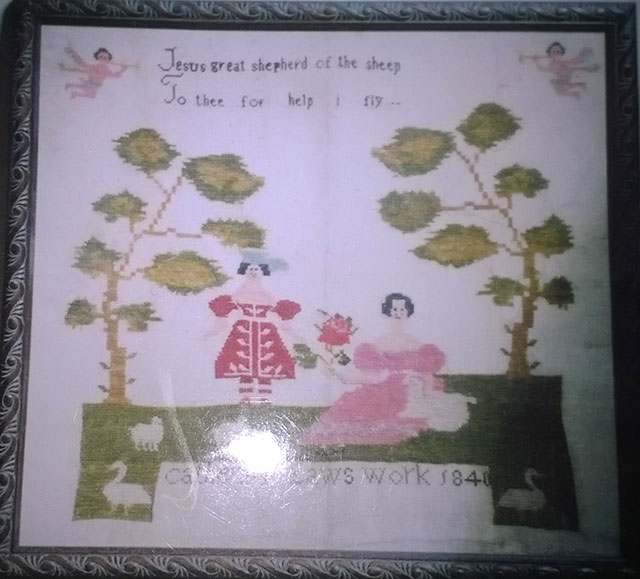
Jesus great shepherd of the sheep
To thee for Help I fly..."
Catherine Laws work 1840
This very endearing embroidery work was shared in December 2015 by
Benjamin Law's decedent Gary Riley. Gary says that it depicts Catherine as the young woman
standing and her mother,
Lydia, as the seated lady with the lamb in her lap.
Samples were made by ladies to display their needlework skills and frequently included
mottos. The words on this sample are from a hymn by Charles Wesley (1707-1788) a famous Methodist hymn writer and brother of
Methodist founder, John Wesley.
Jesus, great shepherd of the sheep,
To Thee for help we fly;
Thy little flock in safety keep,
For O! the wolf is nigh.
He comes of hellish malice full,
To scatter, tear and slay;
He seizes every straggling soul,
As his own lawful prey.
Us into Thy protection take,
And gather with Thine arm;
Unless the fold we first forsake,
The wolf can never harm.
We laugh to scorn his cruel power,
While by our shepherdÕs side;
The sheep he never can devour
Unless he first divide.
O do not suffer him to part
The souls that here agree;
But make us of one mind and heart,
And keep us one in Thee!
Together let us sweetly live,
Together let us die;
And each a starry crown receive,
And reign above the sky.
Keep us till then in perfect peace,
And call us each to prove
An endless age of heavenly bliss,
An endless age of love.
Catherine Law was 21 in 1840.
The Children of Benjamin Law
Benjamin had 17 children if one counts the child born to Rachael Stubley seven months before
Benjamin married her. There is, of course, the possibility that this child was not Benjamin's.
However, I believe that it is highly likely that it was Benjamin's child.
Benjamin had his first legitimate child, George, in 1792 and his last children, TWINS, Isaacs and Rebecca,
baptized in 1822 - a period of 30 years.
Rachel's bastard, Charles Stubley, married and raised a family in Batley.
Rachael and Benjamin had four children: George (1792), John (1793), Ann (1794) and Sarah (1797).
John and Sarah died as infants. George married and had children. Ann's fate is unknown.
Between 1801 and 1822 there were twelve children born to Benjamin and his second wife, Lydia Sheard.
The eldest John (1801) went to America and never returned.
James (1813) died at age 16.
The fates of Benjamin (1810) and Rebecca (1822) are not known.
Hannah (1805), Joseph (1807), William (1809), Sarah (1812), Abraham (1818), Catherine (1819), and
Isaac (1822) married.
Hannah, Joseph, William, Abraham had children in Batley parish.
Isaac lived in Batley but does not appear to have had any children who lived.
Sarah (1812) married in Cheshire and Catherine (1819) married in Lancashire. Sarah had at least on son who married and had children.
Catherine did not have any children.
Samuel (1815) according to the Batley News of 1996 married and had a daughter, Sarah,
born Stockport circa 1835. Unfortunately this is before the civil records start.
There is no marriage for Samuel listed on the IGI. There is no baptism for Sarah on the IGI.
The only record I have found for Samuel is the 1861 census in Manchester when he is
listed as age 45 born Batley overlooker unmarried. Sarah was listed age 5 with her grandmother
in the 1841 census in Heaton Noris. I did not find her in the 1851 censuses.
With some children marrying at the same time as others were being born there was about eight children living in the Law household for many years.
Benjamin Law as a witness
Benjamin Law was the witness to the marriage of Joseph Preston and Ann Brook August 2?, 1799 in Batley Parish.
According to the 1851 census Joseph Preston was a woolen cloth weaver born in Batley circa 1776.
Place of Residence
Benjamin Law and/or his family was listed in Havercroft in Batley from 1797 to the 1830s.
Havercroft is listed on the 1742 map of "certain Lands in Batley" surveyed by Ter. Shepley
for John Copley, Squire.
In 1829 at the death of his son, James, Benjamin Law was listed in "Ashton" in Batley.
His house was still standing in 1880.
"The house occupied by Mr. Law still stands in what is now a kind of fold or court off Wellington St. It is a stone fronted house and at the time he resided there it was one of the best houses in Batley. It had four rooms on the ground floor and a detached kitchen or wash house at the back. It had a garden in front and at the back was a field some 2 acres in extent used by Mr. Law as a tenter field where he dried and stretched his cloth. There were stalls for 2 cows. A pear tree grew against the house. There was nothing but hay and corn growing in the vicinity. All around was the open country and the house had all the appearance of the
residence of a well-to-do family."
The discovery and early history of the shoddy and mungo trades.
Article by Edwin Law BR 13/11/1880, Batley Reporter, Transcribed by Wendy Rose, 2006
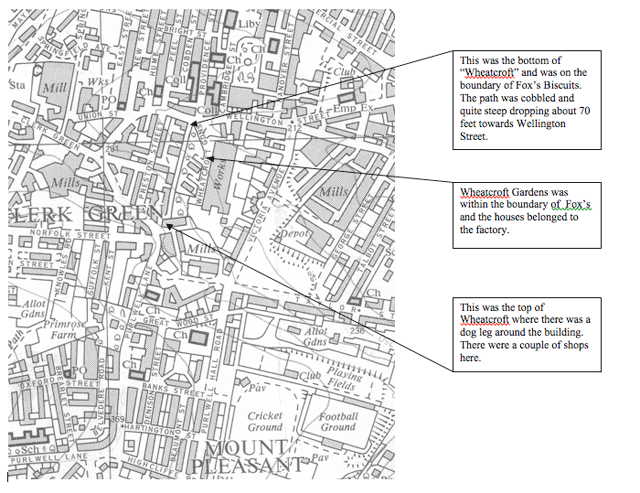
Map and notations courtesy Richard Sykes, September 2008
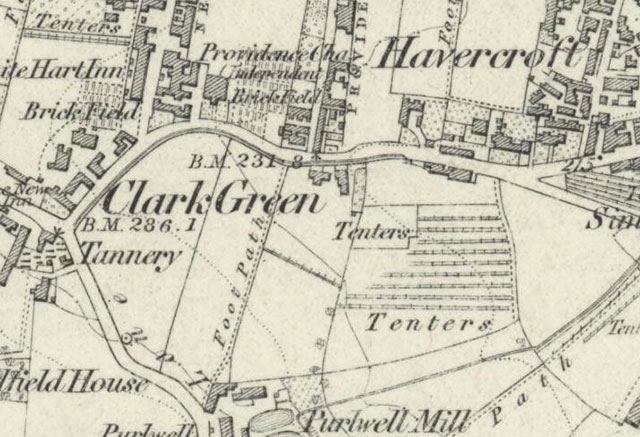
1854 map of Batley, Maps National Library of Scotland
This image of from a 1854 map would appear to contain the property once owned by
Benjamin Law. The two buildings just above and to the right of the letter "n" in Clark Green with the
tenter fields next to them meets the description from the article by Edwin Law in 1880.
Benjamin left Batley circa 1830. He died in Stockport in Cheshire in 1837. Sometime after his death
the family returned to Batley where his widow, Lydia, died in New Batley in 1849.
Benjamin Law and the Development of Shoddy
Rags To Cloth
Benjamin Law developed a process of recycling old woolen rags mixed with new wool
and turning it into new woolen cloth. Called "shoddy" it was an important advance in the manufacture of woolens.
The development of shoddy enabled the poor man to have a cheap suit. It was responsible for many
of the economic advances in Batley and the surrounding area and had wide spread and long term economic effects in the industry.
"The shoddy manufacture was commenced at Batley, Yorkshire, in the year
1813, being introduced by Mr. Benjamin Law, of the same place."
On the Shoddy Trade by Samuel Jubb Report of the forty-Third
Meeting by
British Association fro the Advancement of Science held at
Bradford in September 1873
Note: Interestingly, when Samuel Jubb's son, Joseph Jubb (born in 1821) wrote
The History of the
Shoddy Trade its Rise, Progress and Present Position he did not give credit for
the discovery of shoddy to Benjamin Law. The Law family were insulted
by this snub and
there was some back and forth in the local paper. See
Jubb.
The Laws never became rich from shoddy. The Jubb family did.
There is some debate about the year that Benjamin made his discovery.
The Law family puts the date at the latest in 1813 and possible as early as 1809.
Others put the discovery as late as 1820.
However, all sources seem to agree that
the inspiration came while Benjamin was on business in London. In the words of his grandson
Edwin Law writing in 1880:
"He was one day trying to dispose of a quantity of flocks to a saddler in
London when he was shown a material which it was said answered equally as well as flocks
and was cheaper. Whilst handling this substitute for flocks, which was woollen rags torn
into shoddy and twirling it in his fingers to test its textile qualities, he conceived the
idea of applying it to the manufacture of cloth. He purchased a quantity to try the experiment.
It was successful."
The discovery and early history of the shoddy and mungo trades.
Article by Edwin Law BR 13/11/1880, Batley Reporter, Transcribed by Wendy Rose, 2006
In November 1896 the Times Picayune of New Orleans La., stated:
A correspondent of the Leeds (Eng.) Mercury suggests that a
memorial be erected to the memory of
Benjamin Law who in 1813 invented "Shoddy" or as he terms it,
"that new cloth might be made out of old". Law was a small
trader of Batley, Yorkshire.
The same article was carried in January 1897 in the Daily Republican, Monongahela, Pa.
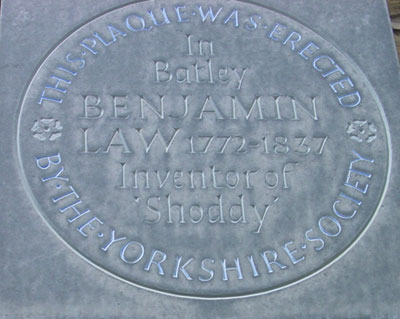
A plaque was finally erected in Batley in 1996.
In July 1925 The Woodland Daily Democrat of Woodland
California stated:
"Shoddy"
The shoddy trade was begun in Batley, Yorkshire in 1813 by Benjamin Law.
It also was among the earliest products of
American Woolen mills.
In 1909 there were 88 shoddy establishments in the
United States
This tidbit was also carried The Lebanon Daily News, Lebanon Pa, and the Bedford
Gazette, Bedford Pa in August 1925, and the Shamokin News Dispatch, Shamokin, Pa in July 1925,
.
According to Batley View and Review, 1898 Benjamin Law was in London on business about 1820.
He was visiting a saddler's shop hoping to sell his wares when he observed:
"some of the saddler's workmen stuffing saddles with flocks made from torn up
carpets and soft rags. With eyes ever on the alert for something new, Mr. Law took some of
the flocks in his hand and on examining them the thought struck him that they would mix
well with wool."
View and Review 1898 Batley
commnet.org
Whatever the date, Benjamin figured out how to use the shredded rags combined with some
new wool and weave it into a serviceable cloth.
"Mr. Law had the whole business to himself until 1812, when others seeing
the progress the Laws were making, entered into a business they had hitherto considered
somewhat wanting in respectability. In those early days of the shoddy trade people looked
askance and with aversion on the heaps of old woollen garments which had been collected with
much trouble and care for the purpose of being reconverted into wool and in passing them
described an arc of no mean radius, avoiding them as they would a plague spot. But the
desire of riches is superior to even John Barleycorn in inspiring us with contempt of dangers
and the vision of large profits and glittering gold at last removed the aversion and overcame all
squeamishness."
The discovery and early history of the shoddy and mungo trades.
Article by Edwin Law BR 13/11/1880, Batley Reporter, Transcribed by Wendy Rose, 2006
The new material was used:
"in the making of druggets, carpets, blue-grey blankets,
and other heavy woolen clothes, chiefly for America, the southern slave states at the time
taking a large quantity of cloth and blankets of Batley make."
View and Review 1898 Batley
commnet.org
The new material called "shoddy" enabled Batley manufactures to sell their goods much
cheaper than if they had used solely new wool.
"The new industry, for it can accurately be described as nothing
less than a new industry, gave a wonderful impulse to Batley manufacture and enterprise
as well as to manufacturers in the Dewsbury, Spen Valley, and other adjoining districts,
who were not slow to imitate each other in the rapid strides then were then making."
View and Review 1898 Batley
commnet.org
Local historian, James Willian, wrote The Rise and Progress of Batley
which was published in 1880. On
Benjamin Law and the development of shoddy:
"Manufacturers from Batley and other towns were in the habit of traveling about the country to dispose
of their goods, and frequently to London. In about the year 1820, Mr. Benjamin Law, of Batley, was there
on business, and being in a saddler's shop trying to dispose of his goods, he saw them stuffing
saddles with flocks from torn up carpets and soft rags, and on handling it he though it would mix well
with wool. On his return home to Batley he got some rags pulled, and used or blended it along with wool
and made it into cloth; under the above circumstances it came into use in the manufacture of all kinds of
woolen cloth, and the pulling of rags increased rapidly and soon spread to the Continent, where some
of the largest pulling factories are in operation, and whence immense cargoes of shoddy and rags have
been sent to this country. Batley and Dewsbury gentlemen and other form this country having established
factories in Berlin and other large towns on the Continent."
James Willans The Rise and Progress of Batley, 1880
Benjamin's discovery initially was not greeted as a positive development. There were those who considered the adulteration of virgin wool a crime. However, the economic benefits of the process soon became apparent and most local
manufactures soon jumped on the bandwagon.
Rags To Riches
On the growth of the town of Batley as a result of shoddy manufacturing:
"Batley is now entirely changed; formerly, and even at the beginning of the present century, it as
decidedly an agricultural village, farmhouses being dotted up and down in it and most of them on the
road sides, the land belonging to the farms being around them and a few cottages for labourers. The
old Parish Church was the only place of worship in the village. Batley has altered by degrees, but more
especially within the last 30 or 40 years, first by the manufacturing of coarse clothing. Since the introduction
of shoddy and mungo as a material for manufacturing the progress of the town has been marvelous.
At that time numbering only four thousand inhabitants, it is now a large town of nearly thirty thousand
inhabitants, with Mayor and Corporation, and a ratable value of 70 to 80,000 pounds, or twenty times
more than at the beginning of the century. Batley now possesses many beautiful places of worship,
spacious and well conducted schools, first-class houses for merchants and tradesmen, comfortable
and convenient cottages for artisans and operatives; good roads, railway accommodations to all parts of the
kingdom; tramways, water and gas works, such as no other town can surpass, having risen by the genius,
industry, indomitable energy and perseverance of its inhabitants, and has to all appearances a brilliant future
in prospect."
James Willans The Rise and Progress of Batley, 1880
And further:
"I will now attempt to give a rough history of the progress made in Batley since the time when wool
made from rages was first brought into use for manufacture of cloth. It was first applied by Mr.
Benjamin Law, and made from soft flannels, stockings, and carpets, and when ground up was called
shoddy. It came into general use about the year 1830 in the making of druggets, carpets, blue-grey
blankets and other heavy woolen cloth chiefly for America, the Southern or Slave States at that time
take a large quantity for garments and blankets. Other foreign countries also were customers. The
new material made out of pulled-up soft rags enabled them to sell the goods at a much cheaper rate
than they could have done when they had to use all wool; it gave a wonderful impulse to Batley manufactures.
The advantage of having sole use of the new material to themselves enabled them to secure very large
orders for goods which before were sent to other districts, and the mills and machinery then in Batley was
very far short of what the trade soon required. There were the Batley Old Mill, owned by accompany
consisting of tradesmen, farmers and maltsters, amongst them whom were J. Scatcherd, W. Ibbetson,
T. Hall, T Wilby, and a few manufacturers, Mr. Thos Taylor's mill at Clerk Green, Messrs Nussey &
Clapham's Brookroyd Mill, all the mills together at that time not nearly as large as an average one now
built, the consequence was, new mills were built. The Hick Lane Mill, owned by a company of nearly all
the principal manufacturers then in Batley, the Speddings, Sheards, Jubbs, Foxes, etc. About this time
the new staple was first brought into use by the pulling-up of fine cloth, (a finer staple than that from
stockings, carpets, etc) and was used in the manufacturer of finer cloth, pilots, tweeds, etc. This material
was introduced by Samuel and George Parr, nephews of the above Benjamin Law, and was called
mungo."
James Willans The Rise and Progress of Batley, 1880
Note: Samuel and George Parr, were the sons of Benjamin Parr and Elizabeth Sheard. Elizabeth Sheard
was a sister of Lydia Sheard, the second wife of Benjamin Law. Benjamin Parr and Benjamin Law
were partners in the Howley Mill on Howley Mill Lane near Benny Parr Woods.
"Shoddy, pulled from stockings, flannels, skirting, carpets, etc., is of such a staple in length of fibre and
elasticity that when scribbled ii t is almost equal to pure wool, and cannot e very easily distinguished
from it, and if required can be made into similar goods again to those from which it has been pulled,
entirely by itself, without a particle of wool being mixed with it, and the goods made from it will be sound and
serviceable, and will compare favorably with those made entirely from pure wool, and this, notwithstanding
all the abuse it has been subject to by a great many people, and in the press by persons who, of course,
have been entirely ignorant as to the valuable properties it possessed as an article of manufacture, both
as to the process of manufacturing , and its adaptation as to its uses which may now be witnessed by a
visit to any of the manufactories at present in operation in the district."
James Willans The Rise and Progress of Batley, 1880
It was necessary to blend in more wool for the manufacture of Mongo because it was a
finer cloth with a shorter staple, pulled from fine cloth rags.
The development of the shoddy and mungo trade gave "employment to a large number of men,
women, and children in the different stages of preparation, such as sorting, seaming, grinding etc.
"
James Willans The Rise and Progress of Batley, 1880
By 1880 there were something in the neighborhood of 50 mills of various sizes, totaling about 1,500
horse power, and employing about 5, 000 people, more than 25 times more than at the beginning of
the century with more than 100 of times the value of goods manufactured. In addition to the shoddy mills
there were mills manufacturing fine cloth from pure wool. Batley manufacturers had a reputation for
making good sound serviceable cloth of almost "every description of style and pattern".
Riches to Rags
Many people made a lot of money with his process. Benjamin, however,
was not as successful as his competitors. In fact his children and grandchildren as listed in
the censuses in Batley had rather mediocre jobs.
Apparently Benjamin was initially very successful as both a clothier and a
shoddy manufacturer.
"Mr. Law appears to have found it necessary to open out foreign markets
for his manufactured goods and with this purpose in view he sent his eldest son, John, then
a youth of some 17 or 18 years, to America with a quantity of goods to dispose of. The venture
appears to have been very successful, for the young man, much against his inclination, was
ordered by his father to undertake a second expedition. The second consignment was much larger
than the previous one. Mr. Law, in the hope of reaping a rich harvest of profits had invested
the greater portion of his capital in the venture. John sailed with the cargo but was never
heard of again. After he had sailed, it was said to his father that he had said that if compelled
to go, he would never return. Whether this was a mere idle threat, uttered in the vehemence
of his displeasure and afterwards fulfilled by accident, can never be known. When this
utterance of his son came to Mr. Law he followed him to New York and there heard that a youth,
answering his description, had sailed for New Orleans where it was said the yellow fever was
raging. He did not attempt to follow him farther but returned home, having lost his son and the
greater portion of his capital. From this time the prosperity of the family declined and finally,
the lucrative business from which others have reaped such a rich harvest and which has found
employment for thousands of people and opened out a new era for the West Riding of Yorkshire,
was abandoned and at the present time not one of his descendants, so far as the writer is aware,
is in any way connected with the trade originated by their ancestor."
The discovery and early history of the shoddy and mungo trades.
Article by Edwin Law BR 13/11/1880, Batley Reporter, Transcribed by Wendy Rose, 2006
Wendy Rose transcribed the 1880 article by Edwin Law and the letters related to it.
For the complete transcription of the Batley Reporter Articles of 1880 go to Wendy Rose
Benjamin Law in in the 1822 Baines Directory
Benjamin Law was listed in Batley as a flushing manufacturer in the Baines Directory of 1822.
His, partner and brother-in-law, Benjamin Parr, was also listed as a flushing manufacturer.
He was not listed in the directories for 1830 and 1834. There were no Laws listed in Batley in
either of the directories, although his sons, John, Joseph, and William were all adults by 1830.
However, there were three Sheards, George, Michael, "sen.", and Michl. "Jun." listed under the
heading, "Flushing, Padng. and
Drugget Mfrs." Michael, senior, was a cousin of Benjamin Law's second wife, Lydia Sheard.
Benjamin Law in Hyde and Stockport
The Laws Move To Hyde
Benjamin and family were said to have moved to Hyde, Cheshire. There were twins, a daughter, Rebecca, and a
son, Isaac,
baptized in
Batley in 1822. So the move most have occurred after that.
By 1837 they had moved to Stockport.
According to Lewis's Gazetteer in 1831, Hyde was a chapelry in the parish of
Stockport four miles from the town of Stockport. The chapel at Hyde was being build in 1831.
The local industry included spinning and weaving (on power looms) in
cotton mills that employed up to 5,000 persons. LDS does not have any records for the Church of England in Hyde before 1832. They have no marriages
before 1839. It is not clear why Benjamin would have moved to Hyde.
The Laws Move To Stockport
"The family left Batley and went to reside at Hyde, whence they removed to
Stockport where the founder of the shoddy trade died 21st February 1837 at the age of 65 and was buried in the burial ground of Batley Parish Church. His tombstone which is broken across may be seen opposite the clock tower, close by the wall separating the church yard from Church Lane. Mr. Law was not a native of Batley. He was born at Great Gomersal 8th November 1772 and was the son of Mr. George Law of the same place. Although the grave is neglected and the tombstone broken his best monument is the prosperity of the town where he resided and which
is due to his genius."
The discovery and early history of the shoddy and mungo trades.
Article by Edwin Law BR 13/11/1880, Batley Reporter, Transcribed by Wendy Rose, 2006
The tax records for Stockport, which
are available only to 1831 did not list Benjamin Law.
The banns of marriage for Stockport included two listings for Law: -
Joseph Law, widow, to Betty Bradley, widow, both of Disney, December 23, 1832.
I do not know who this Joseph Law was.
- Sarah Law of Stockport to Benjamin Horn of Stockport, May 17, 1838. This was the daughter of
Benjamin Law. Benjamin had died in Stockport in 1837.
William Law, a son of Benjamin and Lydia Law, had a daughter, Lydia, baptized in Stockport in 1835.
While some of Benjamin's children came with them. Others did not make the move to Cheshire.
"Although several members of the Law's family accompanied him into
Lancashire yet some remained here and continued to be engaged in shoddy trade
though perhaps in more humble ways
than the discoverer himself."
Letters to Editor Batley Reporter 20th November 1880, Benjamin Law (Benjamin Law was the son of John Law,
grandson of George Law and great grandson of Benjamin Law)
Children who appear to have stayed in Batley- Son George, (from Benjamin's marriage to Rachael Stubley) and George's children
remained in Batley.
- Daughter Hannah, born in 1805, married in Batley in 1825 and had children in Batley between
1826, 1832 & 1838. However, she and her husband John Parr were listed in the 1841
census in Heaton Norris with Lydia Law, see
below. The were back in Batley by 1851.
- Son Joseph, born in 1807, had children in Batley between 1833 and 1836.
Children who moved to Stockport
-
Son William (my ancestor) born 1809, married in Stockport between 1832 and 1835 and returned to Batley by
1838.
- Daughter Sarah, born in 1812, married Benjamin Horn in Stockport in 1838. She stayed
in the Stockport/Manchester area
- Son Samuel, born in 1815, married in Stockport and had a daughter, Sarah, born there
circa 1835. Note: I believe that Sarah was listed with Lydia Law in the 1841
census in Heaton Norris - Samuel was not listed with them, see below.
-
Son Abraham, born in 1817, was only a teenager when the family moved to Stockport.
Listed in Heaton Norris in the 1841 census. He had children born in Batley between 1845 and 1856
- Daughter Catherine, born in 1819, was only 18 when Benjamin died in 1837.
Listed with Lydia in Heaton Norris in 1841. She
married Robert Barrett in Stockport in 1842.
- Son Isaac, born in 1822, married in Batley in 1845. Listed with Lydia in
Heaton Norris in 1841.
- Daughter Rebecca, born in 1822. Listed with Lydia in
Heaton Norris in 1841.
Lydia Law and her
Children in Heaton Norris, Stockport, Lancashire in the 1841 Census
Lydia and some of her children moved to Heaton Norris in Lancashire before 1841.
At Watt (maybe Wall) Street, Heaton Norris, Stockport,
Lydia Law, age 60, Catherine Law age 20, weaver,
Rebecca Law age 20 weaver, Sarah Law age 5,*
Abraham Law age 20, spinner,
Isaac Law age 20 weaver,
John Parr age 40 woolen,
Benjamin Parr age 13 weaver,
Hannah Parr age 40,
Rachael Parr age 9
Esther Parr age 8,
Lydia Parr age 4
*Daughter of Samuel?? This enumeration district was described as:
All that part of Heaton Norris ward in the township of Heaton Norris
in the Borough of Stockport and county of
Lancaster a- - comprised in the following boundary commencing at the
Duke of Wellington Puplic House,
New Road, Lancashire Bridge Hill through
Radley's Yard -- - straight thru to the river Tame thence along the boundry of the
township to the road leading to
Manchester near the Ash Inn and thence by such road to the point first described.
On the same page were families on Sandy Lane.
Other streets named in this district were:
Radley Yard, Penny Lane, Bentley St., Chadwick Yard,
Manchester Rd and Bankfield.
Heaton Norris was described in 1840 as follows:
HEATON-NORRIS, a chapelry in Manchester parish, county of Lancaster; 5
miles south of Manchester, south of the river Mersey, intersected by
the Manchester and Birmingham railway, which is here carried over the
Mersey by a viaduct or bridge. See Stockport.
The Ashton, Manchester, and Oldham canal terminates here at
Lancashire-hill, a steep acclivity ahove the Mersey;
and the new road to Manchester crosses the chapelry.
Besides the suburhan village of Heaton-Norris, it contains
Heaton-Mersey, a village 2 miles west-north-west of Stockport.
Acres 5,180. Houses 2,127. A. P. £12,155. Pop., in 1801, 3,768;
in 1831, 11,238. Living, a perpetual curacy in the archd- and dio.
of Chester; returned at £108; gross income £145. Patrons,
the wardens and fellows of the collegiate church, Manchester.
The Dissenters' chapels are the Wesleyan Methodists at Tiviot-Dale,
an elegant structure opened in 1825, the Baptist at Heaton-lane, and the
Independent at Lancashire-hill. Here are 9 daily schools, two of which
are endowed: income of one, in 1826, £11 5s., and of the other, £9,
per annum. At Heaton-Mersey is a very large Sunday school, founded, in 1805, by R.
Parker, Esq. Poor rales, in 1838, £2,392 18s. This chapelry is now
assessed for the county-rates at the valuation of £33,581. Heaton-Norris
forms a large and handsome suburb to the thriving town of Stockport,
from which it is divided by the Mersey. The inhahitants are chiefly
employed in the Manchester manufactures. The cotton trade is very
extensively carried on here in large mills. There are also
extensive bleaching-works. In July, 1840, a large cotton mill, at Heaton
Mersey, 7 stories in height, was totally destroyed by fire. The loss
sustained has been estimated at £20.000.
The parliamentary gazetteer of England and Wales. 4 vols. [bound in 12 pt ... By England, 1840
Other Laws in Heaton Norris, Stockport
There are indications in the Cheshire/Lancashire BMD that the Laws who stayed in the Stockport
were in Heaton Norris. There are listings for all of the appropriate names: Law,
Barrett, Horn. Heaton Norris in the parish in the township of Manchester, and partly in the town
and parliamentary borough of
Stockport.
Possible children for Sarah Law and Benjamin Horn
Note: There were other Horns having children in Heaton Norris.
Death of Benjamin Law
Benjamin Law died in Stockport in Cheshire in 1837. His death was listed in the
Batley Parish records. "Benjamin Law Stockport age 63 buried February 26, 1837".
The civil records index does not start until the June quarter 1837.
The death of Benjamin Law was not listed in St Mary's Church, Stockport.
Death of Lydia Law
Church Record:
Lydia Law, Batley, age 68, November 22, 1849. (Batley Parish Records)
Civil Record: Lydia Law, age 68, widow of Benjamin Law, clothier, died on November 20, 1849 in New Batley
of Phthisis (pulmonary tuberculoses) not certified. The death was reported by Isaac Law
present at the death.(Civil Record)
Note: Isaac Law was Lydia's son.
Other Laws in Batley Parish
There are several records for Laws in Batley Parish that I have not been able to
reconcile with the known Law families in the parish. To see these records go to
Other Laws in the Batley Records
|