| WALSH/LANGAN INTRODUCTION : HOME PAGE | |
|
| |
| Inside the Irish Cottage
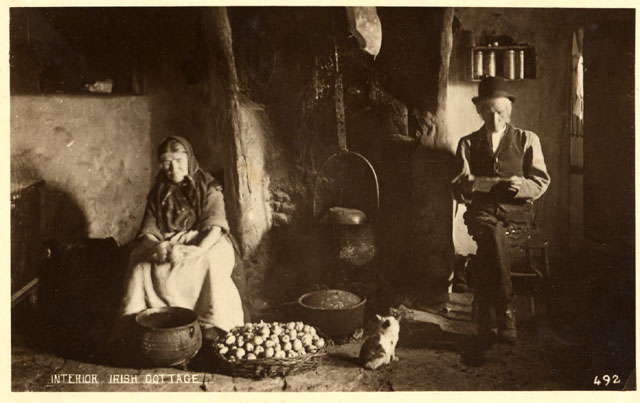
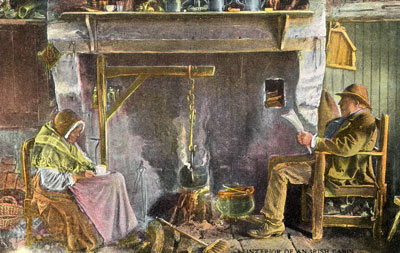
Many Irish cabins had one or two windows in the front and the same in the back. The number of windows was limited by the high cost of glass. Adding a window was expensive and had few benefits. Generally the landlord would not give his tenant any compensation for improvements made and would, in fact, often raise the rent. I had read in several places that the number of windows was also restricted by the "window tax". However, further research revealed that the window tax did not effect the small cabins. The window tax varied over time but did not apply to houses with less than seven windows. There were few options for artificial light inside the cabin. Turf fire was the main source of light as well as heat. Turf or peat has a very distinct and pleasant odor while burning.
Many cabins did not have a chimney; smoke escaped through a hole in the roof or through the thatch in general. Most cabins were smoky and dark. Obviously there were variations in size and a facilities with some families being better off than others. The following pictures show a variety of interiors, The Herons' dwelling as described in the novel The Famine by Liam O'Flaherty "was only half a cabin, as the Hollarans next door occupied the other half. Really only one room, it had been cut in two by a narrow wall that did not reach much above a man's height. Behind this partition was the family sleeping place. All the children had been put away there before the hag's arrival, lest they might get terrified by her raving. This was a useless procedure, as they could hear everything above the top of the partition. The living-room was in a very sordid state which was only natural on account of all those children romping about in a chamber that was only ten by eight, with a great deal of that space occupied by the furniture, cooking utensils and farming tools. There was even some oat straw and a little heap of potatoes, all that was left of the year's crop. The floor was an amazing sight. The earth had nearly all been dug up by the children and made into mud pies. The naked rock was exposed and it was quite difficult to walk from the door to the hearth, in the gloom which the light from a tallow wick could not dispel. There was hardly any light from the fire, which smoked badly. Heron, although he had his share of turf back in the common bog, had cut no turf that summer owing to a fight he had with the neighbour who cut with him. So he had now to rely on dried cow-dung for fuel. The dung had not dried properly and it smoked without giving light." |
 | |
| Post card collection of Maggie Land Blanck | |
| Interior Irish Cottage. Real Photo
No post mark | |
 |
No post mark |
| Post card collection of Maggie Land Blanck | |
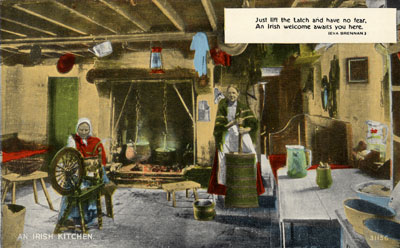 |
An Irish Kitchen
No post mark |
| Post card collection of Maggie Land Blanck | |
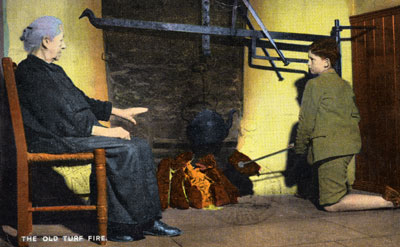 |
The Old Turf Fire
No post mark |
| Post card collection of Maggie Land Blanck | |
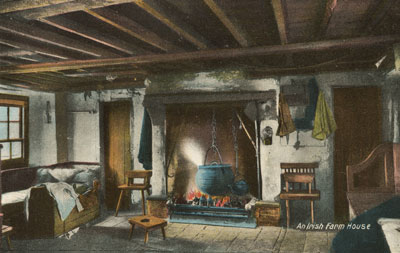 |
No post mark |
| Post card collection of Maggie Land Blanck | |
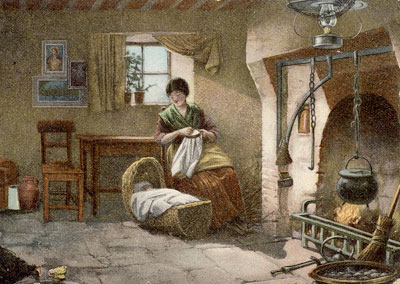 |
Postmarked 1906 |
| Post card collection of Maggie Land Blanck | |
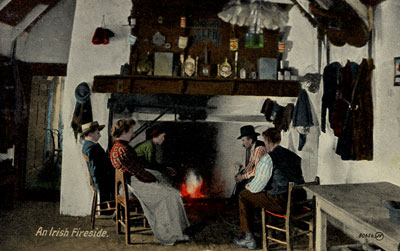 |
"An Irish Fireside"
No postmark |
| Postcard collection of Maggie Land Blanck | |
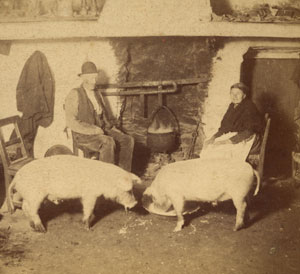 |
"We kept the Pig in the Parlor"
There are many references to the Irish, especially in the west of Ireland, keeping their animals in the house with them. However, it was the practice of peasant farmers the world over to keep their animals in or very close to the house. In the days before central heating animal warmth made a tremendous difference in comfort. |
| Stereo card collection of Maggie Land Blanck | |
 | |
| Stereo card collection of Maggie Land Blanck | |
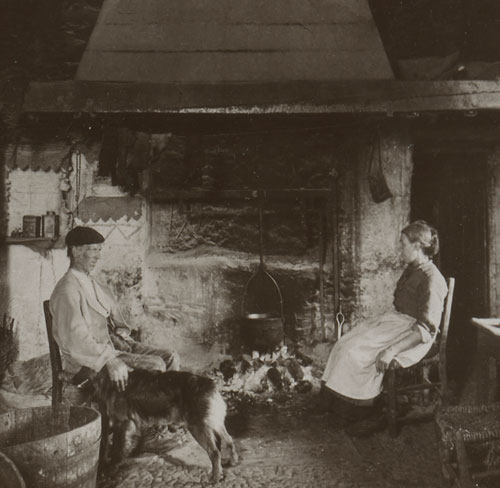
The Irish Peasant at HomeIreland has given the world some very great men, ambitious lads who served their king in India, who have sailed the seas, and who have contributed much to the political and commercial life in America. Many of them were born and brought up in just such a cottage as this. It has only two rooms, a living room and the bedroom which is entered through the open door at the right of the fireplace. Above the rafters which form the roof of the living room and bedroom there is a loft over which is the sloping roof. Here the children sleep. There is no stair going up the loft only a ladder.Printed on the back of the above image | |
 |
|
|
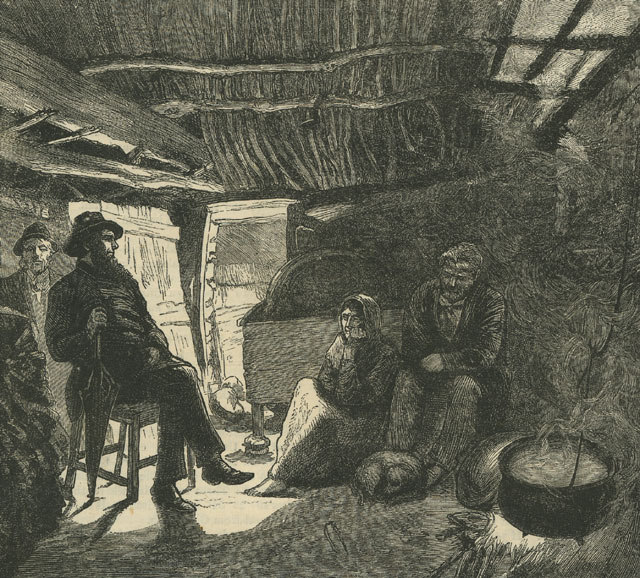
Frank Leslie's Popular Monthly, April 1880, collection of Maggie Land Blanck
"The miserable huts of the peasantry, seen by the feeble light which comes through the doorway and smoke-hole (to talk about chimneys would be an insult to architecture) give one the idea, not so much that the pigs have got into the parlour, but that the family have migrated to the sty. An unpaved clay floor, a roof of straw and weeds, dank, soaked and trotting overhead, a miserable bed in the corner, an iron pot over a peat fire, are the principle items of the property. Before door is a sink, black and filthy, for the refuse. Yet the inmates look hale and happy beyond what one would hope to see, and the thought at once suggests itself, how much might be accomplished by such a people, awaking to assert its dignity, and to discharge its duty."A LITTLE TOUR IN IRELAND BY AN OXONIAN, S. REYNOLDS WITH ILLUSTRATIONS BY JOHN LEECH, 1892 | |
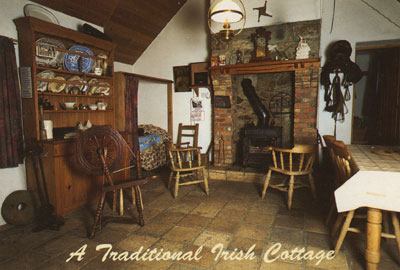 |
"A Traditional Irish Cottage"
No postmark |
| Postcard collection of Maggie Land Blanck | |
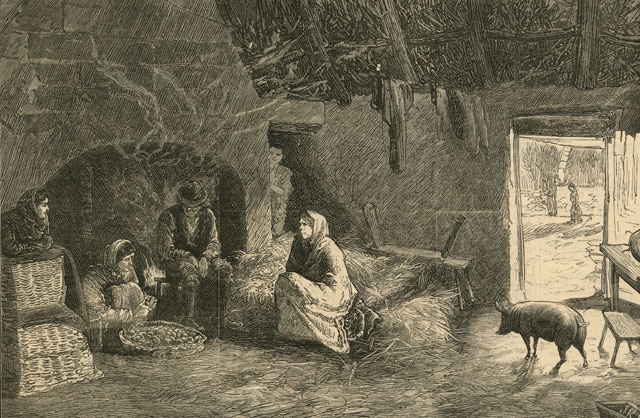 |
|
|
Print collection of Maggie Land Blanck
INTERIOR OF A HUT BY LOUGH CORRIB, GALWAY
The Graphic Dec 13, 1879 | |
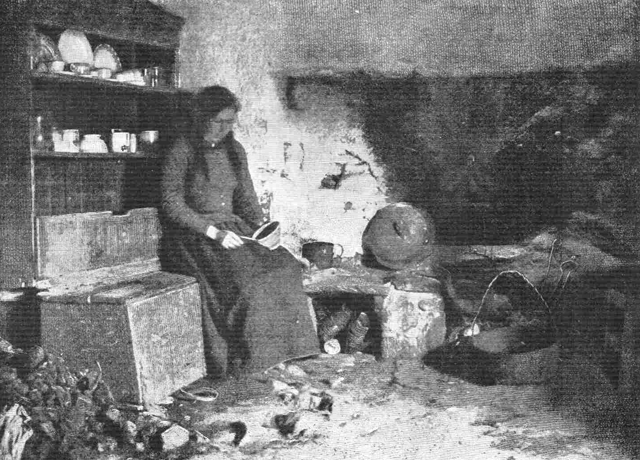 |
|
|
Irish Idylls' by Jane Barlow published in 1898 A LISCONNELL INTERIOR Shared by Peter Manning, January 2010 Lisconnel is in "the wild boglands of Connaught". (Irish Idylls, Jane Barlow, 1893) | |
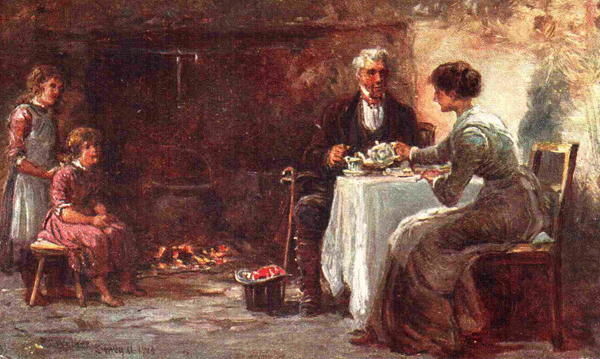 |
|
|
Shared by Peter Manning, January 2010 "Away from the tourist track, amongst the poor, the frank hospitality which is a feature of the national character is to be found in perfection; often in the humble cabin one meets with charming manners, and learns to understand the full meaning of an Irish welcome" | |
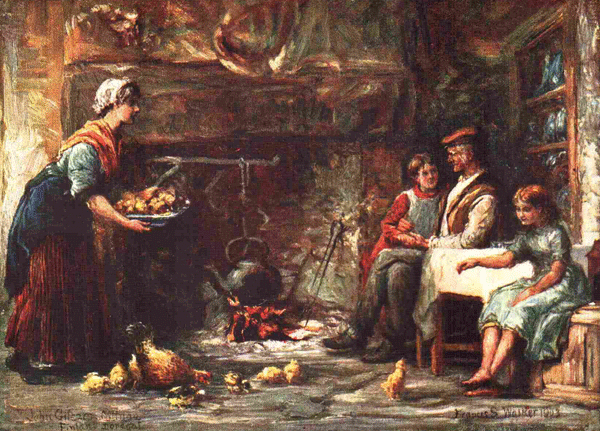 |
|
|
Shared by Peter Manning, January 2010 "A HAPPY HOME" | |
 |
|
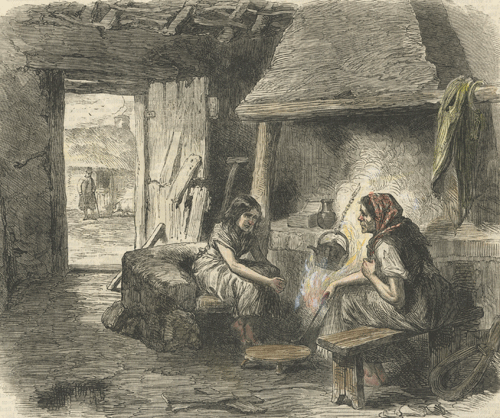
Print collection of Maggie Land Blanck SKETCHES FORM IRELAND INTERIOR OF A MUD CABIN AT KILDARE The Illustrated London News April 9, 1870 The image is interesting enough, but what is impressive is the accompanying article. This poverty stricken lady and her three children could read, but not write. The accompanying article speaks of "the miserable condition of a number of mud cabins in the principle street of Kildare." This images shows the interior of one of the cabins where the inhabitants "lounge in listless despondency". The dwelling consisted of a single room, eight feet by ten, occupied by a widow, her son, age 20, another son, age 16, and a daughter, age 10. They had no bed or bedding, "but slept in their clothes on the bare ground, with a few dirty rags over them. The only furniture was a rickety table and a broken bench, with an iron pot and kettle and two or three cups". "Save, that it actually has a chimney and a comparatively lofty roof, blackened, however, by a century of smoke, and that it accommodates at night simply a donkey instead of the customary pig, this is about as bad a specimen of an Irish cabin as could be found in any village in the country. There were puddles of water in different places on the mud floor, and the planks of the door very nearly tumbled apart every time it opened and shut. The widow who occupied the cabin although in rags and with bare legs and feet, was a person of some intelligence, who has a good choice of language, and had taught her children to read, if not to write as well; her idea being "there is nothing like education to get on in the world"Unfortunately, the rest of the article was cut off from the image. Notice the man with his pig who can be seen though the open doorway.
|
|
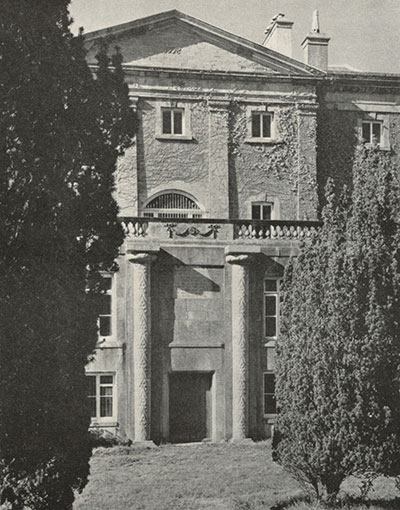
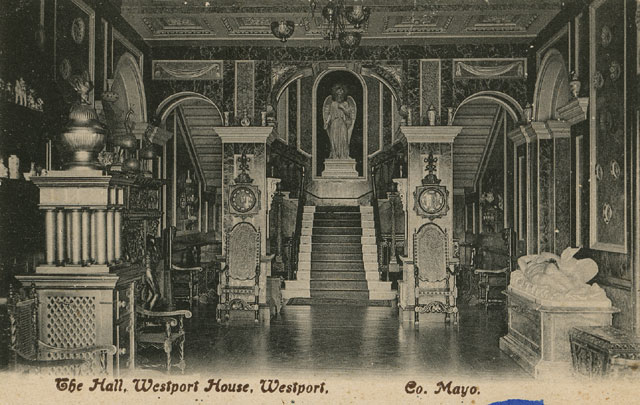
How The Other Half Lived For contrast between the haves and have nots, here are some images of Westport House, Westport, Co. Mayo. This 18th century Georgian mansion was built and is still owned by the Browne family, descendants of the Irish Pirate Queen Grace O'Malley. Westport House was the seat of the Marquess of Sligo. |
 |
|
|
Magazine collection of Maggie Land Blanck, 2012, Country Life May 6, 1965
THE SOUTH FRONT OF WESTPORT. In the foreground are the replicas of the columns from the Treasury of Artreus at Mycenae, the originals of which were brought to Westport by the 2nd Marquees of Sligo in 1812. The 2nd Marquees excavated at Mycenae where he discovered the columns and had them transported to Westport House. The columns lay for years in the cellar at Westport until 1904 when they were identified by the Earl of Altamont and presented by the 6th Marquees to the British Museum in 1905. The British Museum gave the replicas to Westport house in 1940.
| |
 |
|
|
Magazine collection of Maggie Land Blanck, 2012, Country Life May 6, 1965
THE DINING-ROOM, WITH DECORATION BY WYATT AND FURNITURE BY GILLOW | |
 |
|
|
Postcard collection of Maggie Land Blanck
| |
| If you have any suggestions, corrections, information, copies of documents, or photos that you would like to share with this page, please contact me at maggie@maggieblanck.com |
| Please feel free to link to this web page. You may use images on this web page provided that you give proper acknowledgement to this web page and include the same acknowledgments that I have made to the provenance of the image. Please be judicious. Please don't use all the images. You may quote up to seventy five words of my original text from this web page and use any cited quotes on this web page provided you give proper acknowledgement to this web page and include the same acknowledgments that I have made to the provenance of the information. Please do not cut and paste the whole page. You may NOT make use any of the images or information on this web page for your personal profit. You may NOT claim any content of this web page as your original idea. Thanks, Maggie |
| ©Maggie Land Blanck - Page created 2004 - Latest update August 2013 |