|
|
| WALSH/LANGAN INTRODUCTION - HOME - Eviction |
| Land Issues In 1530 Catholic Irish owned 100% of the land in Ireland. In 1703 they owned 14% of the land in Ireland. From early times the land in the west of Ireland was under the control of landlords while tenant farmers maintained small holdings at little or no profit. Although they had to pay rent to the landlord the Irish peasantry were very attached to the land on which their forbearers had lived and would do almost anything to remain in the place of their ancestry. Many landlords did NOT live in Ireland. Their properties were administered by local agents. Some landlords, who actually lived on their estates, had a paternalistic relationship with their tenants. However, since the landlord had total economic control over his tenants, he also had control on the political and social relationships that existed under his domain. Many tenants were "tenant at will" meaning they held no lease on the land, could be evicted at any time, and had no recourse in disagreements with the landlord. Tenant eviction and land agitation were issues in Ireland from at least the early 1700s when landlords determined that they could make more money from grazing than from the rents of their tenant farmers. Many land agitations issues were covered by the English, American, Australian and New Zealand press. Charlotte Elizabeth Tonna (nee Browne) (1790-1846) was an English evangelist and writer who lived in Ireland from 1818 to 1824. Irish Recollection was first published in 1841. Much of the book is an anti Catholic diatribe. She makes this comment on eviction. " On these occasions, a keeper was set over the property; some legal papers were served, and all the household goods, consisting of iron kettles, wooden stools, broken tables, a ragged blanket or two, and the little stores of potatoes, the sole support of the wretched inhabitants, were brought out, piled in a long row down the street, and "canted", that is, put up for sale, for the payment of perhaps, one or two pre cent, of the arrears."I am most interested in the Land League issues that arrose around 1880 as several important events took place in Mayo and Galway where my ancestors were from. These include: the murder of Lord Mountmorres in Galway in 1880, the Boycott incident in Ballinrobe in 1880, the shooting of Mr. Herne in Ballinrobe in 1881, the murder of David Feerick in Ballinrobe in 1880, the Huddy murder in Cong in 1882, and the murder of Walter M Bourke in Galway in 1882.
|
| The Irish Rebellion 1798 Irish Rebellion of 1798 From Wikipedia, the free encyclopedia There is a lot on the internet about the 1798 Irish Rebellion.
|
| Evictions Eviction was the most common way for a landlord to rid his land of unwanted tenants. Many of these evicted tenants made their way overseas to England, the Americas, Australia and New Zealand. some landlords even paid the tenants way - just to get them off the land.
|
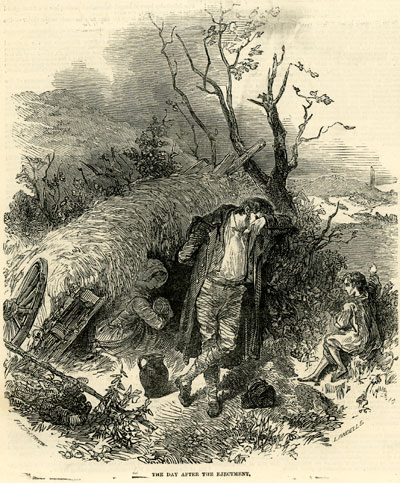 | To see more images of evictions in Ireland click on the image at left. |
|
Whiteboys, Ribbonmen and Molly Maguiers - 1760s to 1870s Irish agrarian organizations were active in several movements from the mid 1700s to the mid 1800 including, Whiteboys, Ribbonmen and Molly Maguires. "In consequence of disturbances by roving bands of Ribbonmen, the Government has ordered two squadrons of dragoon and a company of infantry to be stationed at Ballinrobe and Castlebar."Molly Maguires
|
| Fenians
|
Land issues in Ireland united people in both the USA and Ireland. The Fenian Brotherhood
was a movement
started in 1848 whose purpose was to obtain Irish independence from England.
"The Fenian movement did not represent anything like the full force of Irish patriotism, or even, indeed, a considerable portion of it, the bulk of the millions who believed in O'Connell and Smith O'Brien stood with folded arms outside the movement. Its policy was disbelieved in, although the Fenians worked with an energy worthy of the highest admiration, while an honest, mainly, self-sacrificing spirit of patriotism marked the men who were its martyrs. Never did braver men stand in the dock; and to the Fenians, Ireland owes that stirring-up of public opinion upon Irish subjects which hitherto had slumbered in a wasting inactivity." |
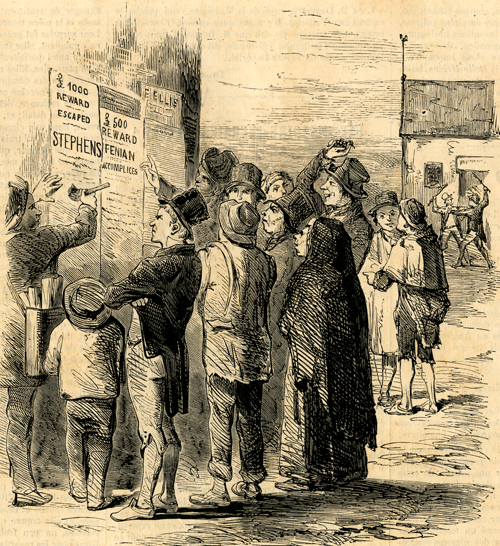 |
| Collection of Maggie Land Blanck TYPES DE FENIANS IRLANDIAS [Fenian Types, Ireland] L'Univers Illustre No date.
|
 |
|
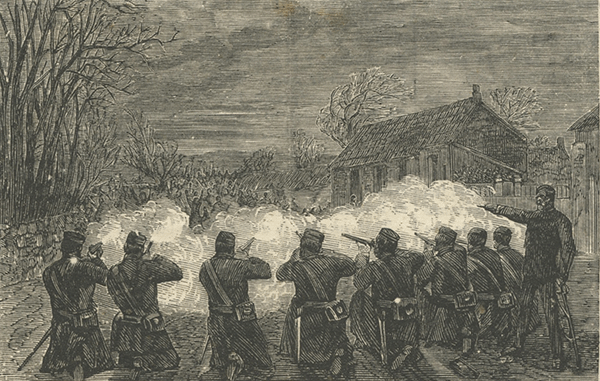
| Print collection of Maggie Land Blanck, 2012, publication unknown
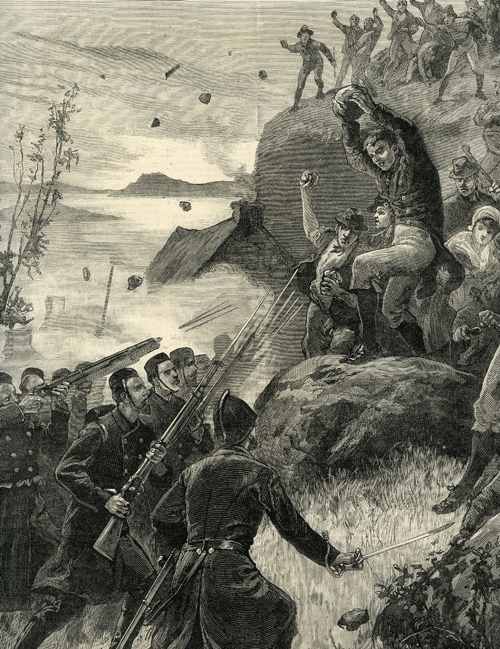
THE NEW IRISH MOVEMENT - THE POLICE AND THE FENIANS AT TALLAGHT IN 1867 In February 1867 there were several confrontations between the Fenians and the Irish Constabulary. The largest took place near Tallaght Hill where several hundred Fenians were attacked and driven off by the police. | |
 |
|
|
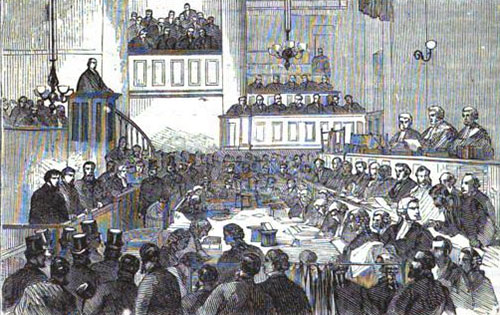
Frank Leslie April 1880, on line
Fenian Trials for High Treason in 1867 Note: The image is from Frank Leslies's magazine of April 1880 although the event took place in 1867.
| |
| Paying the Rent | |
| Most Irish did not own their land although families lived on the same property for generations. If an Irish tenant made improvements to his (or her) house or land he (or she) was subject to a raise in the rents, if the landlord so desired. Many landlords did not even live in Ireland, never saw their Irish estates and had matters administered by land agents. | |
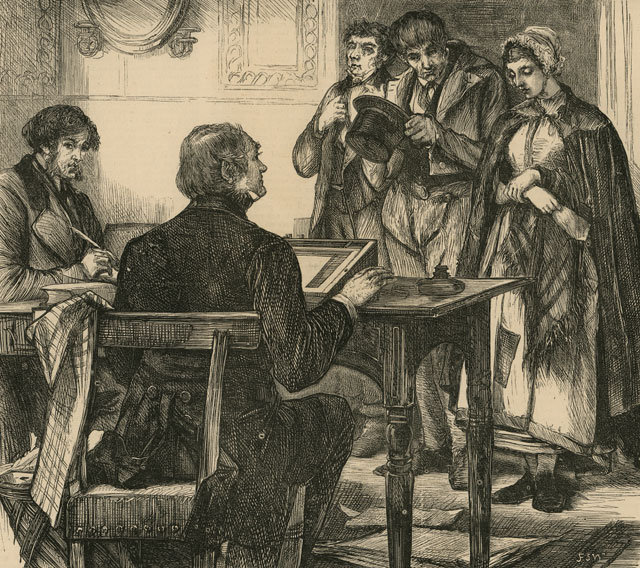
|
|
| Print collection of Maggie Land Blanck The Graphic June 4, 1870 Note: Look at the clothing in Evictions . Did the Irish also dress down for evictions? | |
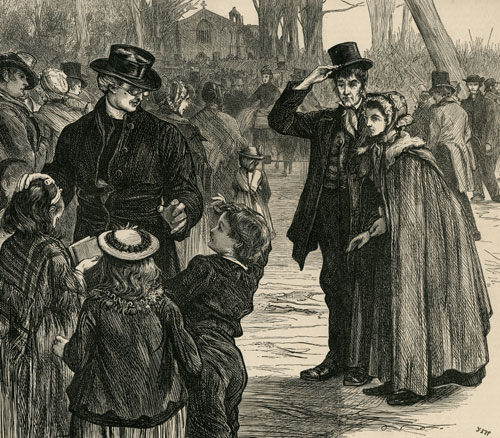 |
| Print collection of Maggie Land Blanck The next week, on June 11, 1870, the Graphic ran the above image in contrast to the June 4th image. The same couple is now presented in their best clothes and with a different demeanor as the greet the parish priest outside of mass. " The question of rent, on the present occasion, we may presume, has been settled; the bailiff has carried his point and the money has been produced, or the tenant has cajoled the steward into an abatement, or postponement, or what not; at any rate the evil day is past, and the tenant can appear without danger in his decent habit, which, by the time rent-day comes round once more, with its sorrows and anxieties, will be as pitifully ragged as ever."Notice the dandy attire of the priest!
|
|
Ireland in the early 1800s Several events took place in the early 1800s that put the lives of AngloIrish landlords and land agents in danger. These included: the murder of David Feerick in April 1880 in Ballinrobe, the murder of Lord Mountmorres in September 1880 near Clonbur, the ostracizing of Captain Boycott in October 1880 in Ballinrobe, the shooting of John Hearn in March 1881 in Ballinrobe, the murder of Luke Dillon in November 1881 at Claremorris, the murder of Joe and John Huddy near Clonbur in January 1882, the murder of John Blake in June 1882 in Loughrea, the murder of William M. Bourke and his military escort, Robert Wallace, in June 1882 in County Galway and others. The government was forced to provide military and police escorts to persons considered to be in danger.
|
|
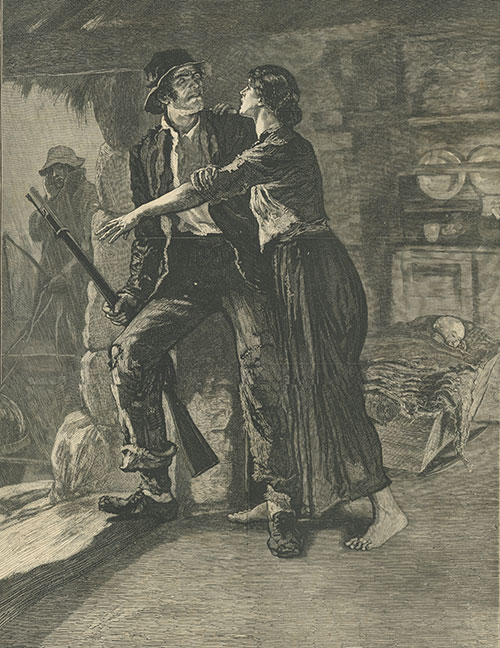
Print collection of Maggie Land Blanck, 2012, The Graphic December 18, 1880
"REIGN OF TERROR IN IRELANDIt is clear from the image that it was not only the lives of the landlords and land agents that were in danger. As the babe sleps, this Irish wife and mother pleads with her husband not to go out in the night with his gun. While there are not a lot of storys of the Irish being killed or hurt in the assaults on the land agents, some did spend time in jail and several were hung for their crimes. Some also were forced to emigrate. Many of the "Land War" incidents were said to have been carried out by members of the Land League. There is a lot on the internet about the Land League and tons of books have been written about the movement and its leaders. Suffice to say that it was a political organization whose prime aim was to abolish landlordism and to allow Irish farmers to own the land they lived and worked on. The movement was founded in County Mayo in the fall of 1879. It fought for "Fair Rent, Fixity of Tenure and Free Sale."
| |
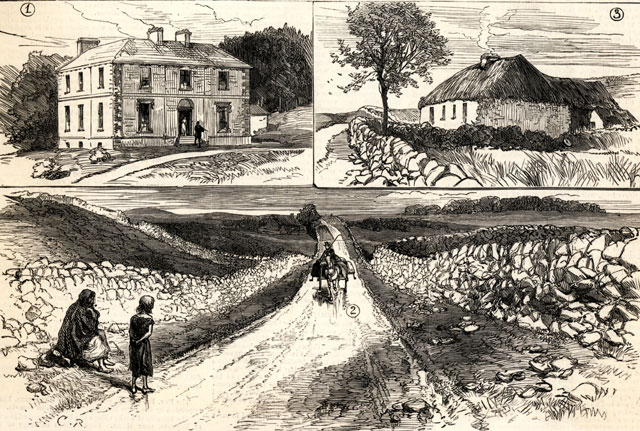 | |
| Print collection of Maggie Land Blanck Supplement of the Illustrated London News Oct. 9, 1880 1. Ebor Hall, the house of Lord Mountmorres. 2. The spot where he was murdered, and 3. Flanagan's cottage. Note: I never know if an image like this is meant to be ironic. The accompanying article was in general positive about Lord Mountmorres. However, juxtaposing the images of the house of the lord with the cottage of the peasant and the image of the gentleman in his carriage with the poverty stricken woman and child on the side of the road seems to emphasize the differences between the haves and have nots. Excerpts from the accompanying article: "An Irish nobleman, of ancient family and title, but of extremely impoverished state, resided in a lonely district of Galway with his wife and children; one of the poorest of country gentlemen, living the plainest style, hopeless of improving his fortunes, and deprived by comparative indigence of the enjoyment of social pleasures and honours befitting his legitimate rank. Of a quite, homely, studious disposition, and willing to do any good among his humblest neighbors.... He had but few tenants, and these had ever found him a consistent and indulgent landlord. But his position, not his personal character or conduct, made him a mark for the class hatred systematically provoked and organized to deeds of blood by the infamous conspirators of the Land League.....Two hours after the murder the body was still laying in the road. The Flanagan family who lived in a cottage not far from the site of the murder refused to allow the body to be brought into their cabin. The Flanagans said "if they admitted it, nothing belonging to them would be alive that day twelve months". In other words, they and their animals would be killed or maimed. It is not clear if this was due to suspicion or fear of retribution. The body of Lord Mountmorres was left in the yard until arrangements could be made to cart it away.
A £1,000 reward was offered for information leading to a conviction of the murder (or murderers) of Lord Mountmorres. Hugh Flanagan and his wife were later suspected of being connected with the murder and were arrested. They were released. The finger was pointed at Pat Sweeney, the disgruntled former herdsman, as the possible assailant. Pat Sweeney was arrested in Queenstown as he was about to emigrate. He was sent to Sligo for trial. Patrick Sweeney, an Irish speaker, needed a translator in the court. The case against him was dismissed. In October 1883 it was reported a tinker (or a man named Tinker) who was present at the murder of Lord Mountmorres turned informer and gave the name of the assassins some of whom had left the country. No possible assassins were ever caught and the crime remained unsolved. Michael Davitt, the Irish national agrarian agitator, "held" that "Lord Mountmorres was murdered because he 'eked our his wretched income as a landlord' by doing spy's work for the Castle, and taking bribes." It was pointed out in the Parnell Commission that Lord Mountmorres had become "unpopular long before he took eviction proceedings against Sweeney, which started in July, 1880". The local population believed that "their landlord" had been "in constant communication with Dublin Castle" and that this had added to his increasing unpopularity. He was also vocally opposed to the Land League.
"Lord Mountmorres became unpopular because of his known opposition to the League — an opposition which he professed in public." Witness, a police-ConstableThe death of Lord Mountmorres was of international interest and was covered by the New York Times which shed a bit of light on potential reasons for Mountmorres's unpopularity with his tenants. "RECENT MURDERS IN IRELANDIn October 1880 all of the suspects in the Mountmorris case were dismissed. Lady Mountmorres was granted £3,000 for the murder of her husband under the Crimes Act. However, she was boycotted by the local population and she and her children were forced to leave Ebor Hall and move to England.
Interestingly enough there had been a threat in 1855 on a previous Lord Mountmorres, who may have been William Browne's father, Hervey.
"OUTRAGE ON VISCOUNT MOUNTMORRES. 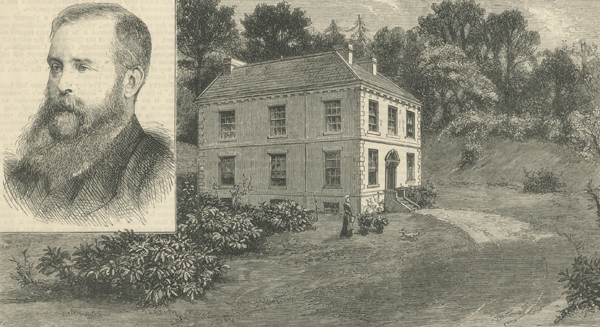 |
|
| Print collection of Maggie Land Blanck
Ebor Hall, Clonbur, Galway, Residence of the late Lord Mountmorres THE GRAPHIC, October 9, 1880 THE LATE LORD MOUNTMORRES MURDERED AT CLONBUR, COUNTY GALWAY Illustrated London News October 8, 1880
Viscount Mountmorres, Sir William Browne de Montmorency, Baron Mountmorres of the Peerage of Ireland was born April 21, 1832. He succeeded his father as the fifth Peer and eleventh Baronet in January 1871. He was descendant of a Captain in Cromwell's Army. The family had once been wealthy but by William Browne's time were left with a small estate near Clonbur "in the narrow strip of rocky moorland that separates two considerable lakes, Laugh Carrib and Laugh Mask, forming a natural peninsula of Connemara."
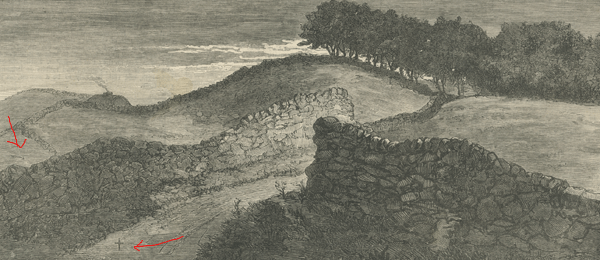
Rusheen, Where the Assassination Took Place. (The Cross shows the spot here the body was found, and the Arrow the place from which the assassins fired) THE MURDER OF LORD MOUNTMORRES IN IRELAND THE GRAPHIC, October 9, 1880 Note: I added the red arrows for clarity MLB Hugh Flanagan, his wife and daughters - refused aid to Mountmorres When the body of Mountmorres was found an attempt was made to move it to a nearby cabin belong to a farm couple named Flanagan. The cabin was just a few hundred yards from the murder site. The Flangans refused to allow the body in the house, saying everything that belonged to them would be dead within twelve months. Initially it appears that Hugh Flanagan was willing but his wife and daughters prevented it. Was that superstition or fear of retaliation? There is some agreement that it was suspicion. It was stated that the Flanagan house was close enough to the murder site for them to have heard the shots. The Flanagans were held for a while on suspicion of the murder. Pat Sweeney, Francis Gannon, Patrick Heffernan, William Sepncer and others - suspected in the Mountmorres murder On October 8, 1880 Patrick Sweeney and Francis Gannon were arrested on suspicion of the murder of Lord Mountmorres and brought before the magistrate in Clonbur. Patrick Sweeney, an Irish speaker (with no English) born circa 1833, was a herd on the Mountmorres estate. The week before the murder he had been evicted for failure to pay his rent to Lord Mountmorres. Sweeney was described in the papers as dejected and despondent, old (around age 70) and infirm. Francis Gannon was married and was described as "a smart, active man" between 30 and 40 years of age who walked into the courtroom with a "Jaunty air" waving to friends. Sweeney and Gannon were placed in custody for eight days. October 14, The Times London: "Two further arrests were made on Tuesday for the murder of Lord Mountmorres. The prisoners are Patrick Heffernan and William Spencer. The former is a plasterer at Clonbur, and is believed to be a chief accomplice in the crime. Spencer is a steward of Lord Ardilaun, living near Ashford, Cong. Spencer left Clonbur shortly before Lord Mountmorres, and was drinking at midnight in the village. He had a revolver for his own protection, being unpopular in the county. The two prisoners were conveyed to Galway Gaol."October 16, 1880: "THE STATE OF IRELAND. THE MURDER OF LORD MOUNTMORRES. DISCHARGE OF THE PRISONERS. CONG, FRIDAY, TWO O'CLOCK. P.M. The prisoners, Patrick Sweeney, the late Lord Mountmorres's herd; Francis Gannon, a slater of Ballinrobe, Patrick Hefferan, a plasterer, working at Clonbur; and William Spencer, under-steward to Lord Ardilaun, were brought before Mr. Dennehy, the resident magistrate, at Clonbur, this afternoon, charged with complicity in the murder of Lord Mountmorres."There was one witness who told a rather vague story about passing two men on the road near the time of the murder. He could not identify any of the accused men. The prisoners were discharged. 1881: "Two more men have been arrested on the charge of having been concerned in the murder of Lord Mountmorres. Their names are Patrick Heffernan and William Spencer. Heffernan, who is a plasterer, and has been recently married, was arrested at his house at Clonbur at about eight o'clock on Monday night, and his house was searched. He is believed to be one of Gannon's principal witnesses. Spencer, who is also a married man, serves as steward to Lord Ardilaun at Ashford. Gannon and Sweeney, who were brought before the Clonbur magistrate on Friday, were again remanded, and sent back by steamer from Cong to Galway. Gannon is to be defended at the expense of the Land League, who have also awarded £5 to his family. The Queen has sent through the Marchioness of Ely a letter of sympathy to Lady Mountmorres." (Pall Mall) In June 1883 Patrick Sweeney was arrested at Queenstown as he was about to emigrate. He was detained from the 13th or June to the 7th of July when he was sent to Sligo to give evidence. He was released on July 14th. July 1883: A report in the Sydney Herald: "THE MURDER Of LORD MOUNTMORRE8. At Queenstown, on June 12, a detective constable arrested a man named Patrick Sweeney on a charge of complicity in the murder of Lord Mountmorres two years ago. The man held in his possession a ticket for New York, which he had purchased on the previous day, and he intended to sail by the Inman steamer on June 12. The prisoner said he had been arrested before on the same charge, but had been set at liberty on account of no incriminating evidence being forthcoming. His arrest is said to be the result of a private inquiry now being held at Cong. A special warrant was subsequently granted for his re-conveyance to Cong, He is a man about 50 years of age, and speaks only Irish.Dispatches from Dublin Ireland in August 1883 say that Patrick Sweeney was "liberated from custody". In 1888 and 1890 an informer named Mike Burke testified that Pat Sweeney and others had tried to persuade him to "do away with Lord Mountmorres". Later they had told him that they had "done away with Lord Mountmorres." Mike was apparently not a reliable witness. He could not keep his facts straight. William Spencer was the steward of Lord Ardilaun of Ashford Castle. In January 2017 Spencer decendent Mike Stone found another aricle about the Mountmorres murder in which reference was made to William Spencer: "THE STATE OF IRELAND. THE MURDER OF LORD MOUNTMORRES. DISCHARGE OF THE PRISONERS. CONG, FRIDAY, TWO O'CLOCK. P.M. The prisoners, Patrick Sweeney, the late Lord Mountmorres's herd; Francis Gannon, the slater of Ballinrock, Patrick Hefferan, a plasterer, working at Clonbur; and William Spencer, under-steward to Lord Ardilaun, were brought before Mr. Dennehy, the resident magistrate, at Clonbur, this afternoon, charged with complicity in the murder of Lord Mountmorres."A witness, a stock manager to Mr. Berridge, claimed that he accompanied several men including William Spencer from Clonbur when they approached the spot where Mountmorres was murdered. They passed two men who seemed excited. "Soon after this Spencer got off the car, and saying that he had been threatened fired on a revolver twice, declaring that he should like to see the man who would shoot him. The shots could not have reached the place where Lord fell." Lord Mountmorres, 5th viscount
Lord Mountmorres, was born in 1872 and succeed his father as Viscount in 1872. He married Harriet Brodick of Hamphill Stubbs, Yorkshire. He was succeeded by his son the Hon. William Geoffrey Bouchard de Montmorency who was born in 1872. There were insinuation in the press that Mountmorres was a drinker and a bottle of whiskey was found in his carriage. He had fallen from his car more than once and his horse had more than once made its way back home without him. He only had a few tenants - 15 or so. His holding were only 350 acres. He was not popular with his tenants - there was a lot of animosity - about his unwillingness or inability to reduce the rents and his threats of evicting his tenants. Funeral: "The funeral of the late Lord Mountmorres took place in Dublin on Thursday. At five o'clock on Wednesday morning a hearse and mourning coach arrived to remove the corpse from Ebor Hall to Galway, en route to Dublin. Some distressing incidents occurred in connection with the removal of the remains. The two men who had driven the hearse and mourning coach and who were employed to take the remains and the mourners to Galway were asked by one of the deceased's relatives to assist in placing the corpse in the coffin, but they refused to do so. In this dilemma the driver of a car from Tuam expressed his willingness to assist, and with the police laid the body first in a zinc and then in an oaken coffin. For this act the man was publicly thanked by Major Brothrick. This did not end the difficulty with the Galway drivers. From information received, it was advised that the corpse should not be taken through the place where the fair was being held. It was therefore suggested that another route to Galway should be taken; but to this the drivers refused to consent, and it was only on threats of violence that they suggested a compromise which would enable them to avoid the fair. The body arrived in Dublin on Thursday morning. (The Pall Mall Budget) NO ONE WAS EVER CONNIVICTED FOR THE MURDER OF LORD MOUNTMORRES
William Sepncer - suspected in the Mountmorres murder In March 2017 William Spencer descendant, Michael Stone, shared some information on William Spencer.
"He was born in England in 1838. He became employed by Lord Ardilaun as a steward, and eventually head steward of Ashford.1901 Census: Clogher District: Cloonbur County: Galway William Spencer 60, steward, born Tipperary, Sarah Spencer 57, born Tipperary, Susan Spencer 17, seamstress, born Galway, Fredrick Spencer 14, born Galway, all able to read and write, all Church of Ireland. 1911: Deerpark, Cloonbur, County: Galway, William Spencer 71, steward land, Sarah Spencer 63, total number of children born 10, 8 living, both Church of Ireland, both born Tipperary 1920: William Spencer Estimated birth year: abt 1839 Date of Registration: Oct-Nov-Dec 1920 Death Age: 81 Registration district: Ballinrobe Volume: 4 Page: 37 FHL Film Number: 0101608 Grave Stone: In the church ruins outside the Ashford Castle Grounds: "In loving memory of William Spencer, died 21st, November 1920, aged 82 years". Next stone: "SACRED to the memory of Elizabeth Spencer who departed this life, February 1st, 1869, Aged 28 years, May she rest in peace" In 1917, Fred P Spencer, the son of William Spencer and Sarah Spunner, born May Ireland December 26, 1886, was a mechanical engineer living in St. Louis Mo. with his wife and six children.
Pat Kearney - in regards to Lord Mountmorres In March 2014 Barbara Anne Kearney wrote that her ancestor, Pat Kearney, was involved in the Land League in the 1880. Pat Kearney was "cited in various transcriptions of depositions and hearings of the Parnell Commission. Specifically, he - and his pub in Clonbur - were implicated by those testifying in the plotting of the murder of Lord Montmorres." See The Parnell Commission: The Opening Speech for the Defence Delivered By Charles Russell Baron Russell of Killowen and more in this book. And Special commission act, 1888: reprint of the shrothand notes of ..., Volume 2
| |
 |
|
| Image courtesy Barbara Anne Kearney, August 2014
Ebor Hall, April 2014 | |
 |
|
| Image courtesy Barbara Anne Kearney, August 2014
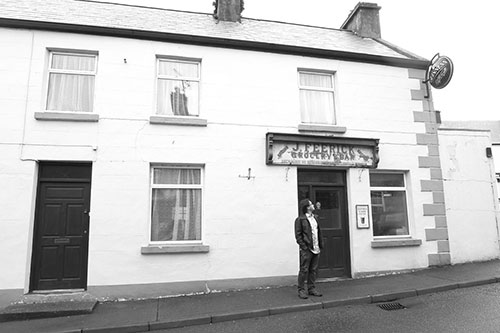
Pat Kearney's pub in Clonbur, 2014 See Barbara Kearney's website at Patrick Kearney, Clonbur The Whites of Mohill, Country Leitrim in regards to Lord Mountmorres In October 2015 Cushla Randle shared a letter giving a taste of the concerns of the landed gentry in 1880. In a letter to her sister, Mary Charlotte White (the widow of Captain George White of Cloone Grange, Lertrim) wrote: " You will have heard of the murder of Lord Mountmorres he is well known to Audley's people* and I have met several of his family - they are all poor but he was the worst off and could not latterly live like a gentleman - there will I fear be more murders before the winter is over. Altogether we are getting it hot and heavy - you will wonder at my thinking of moving in such times but the unusual chance of getting a suitable house in the Co. Leitrim - within four miles of Willie** - moderate rent 50 a year - with good garden and twelve acres of land. I shall let the land."Cushla Randle wrote: Captain George White, died in 1874 aged 47 and his son died at 39 in 1892. They were both High Sherrif. They lived at Cloone Grange and are in Burkes landed gentry, but George is very invisible. He came to New Zealand in 1853 married Mary Catherine (sic) in 1854 had a son in 1855 and they returned to Ireland before 1861.The White family had a house at Cloone Grange, near Mohill. They also owned townlands in both the parishes of Cloone and Mohill. William Henry White, Esq. High Sheriff was listed in Cloone Grange, Mohill in 1882 and 1883 (Thom's Directory of Ireland and Debrett's House of Commons 1882). George White married 25 April, 1854, Mary Charlotte, dau. of Henry Hill, of Ruislip Park, Middx. and had an only son, WILLIAM HENRY WHITE, of Cloone Grange, co. Leitrim, J.P. P.I.: ; b. 31 Jan. 1855; d. 1887, having m. 1st--6 July, 1876, Audley Harriette, youngest daughter of John Reynolds Dickson of Woodville, So Leitrim . She died in 1887. They had George, Audley Mary, Alice, Helen. In 1888 William Henry White married Mariam Charlotte daughter of W. H. Hayes. William died in 1892. Mariam Charlotte married John Weston in 1892. (In 1892 Mariam Charlotte widow of the late Major W. H. White of Cloone Grange, Mohill, County Leitrim married John J. Weston of New South Wales.)
George White was high sheriff of Leitrim in 1861. William Henry White of Cloone Grange was high sheriff of Leitrim in 1879. In 1861 George White Esq., was listed at Drumkeeley, Mohill. In 1908 John M'Kiernan, Drumshambo North, Aughavas, asked to be reinstated on farm land at Drumkillvy, Mohill, County Leitrim, "on the estate fo Mr. George White, from which his father was evicted some years, ago." (The Parliamentary Debates By Great Britain Parliament) In 1910 evicted tenants from the estate of George White at Cloone Grange were asking to be reinstated to their farms.
| |
|
| |
| Captain Boycott, Fall 1880, Ballinrobe
the inception of "Boycotting" - landlord and
land agent for Lord Erne Charles Boycott, an Englishman by birth, rented a farm from Lord Erne three miles from Ballinrobe, Co. Mayo. Boycott also acted as estate agent for Lord Erne, who was an absentee landlord. Tenants of Lord Erne asked for a reduction of their rents. Boycott not only refused but started evictions. Land League leaders suggested that everyone in the locality should refuse to deal with him. Soon he was without workers on his farm, the local merchants refused to sell to him, crowds booed him as he passed. He was, in effect, unable to continue to live as he had before. Coercion was a force in getting everyone to comply with the isolation of the Boycott family.
The military was brought in to assure Boycott's safety. Orangemen from the north volunteered to help bring in Boycott's crops. The troops and Orangemen were booed by the locals. The situation escalated as the national and international press covered the incident. In the end Boycott left Ireland and returned to England.
"Boycotting" proved an effective means of change through social ostracism. Lord Erne, John Crichton (1802-1885), was the third Earl of Erne and was an an Irish Representative Peer from 1845-1885. He inherited his title from his uncle, Abraham Creighton, in 1842. The family seat was in County Fremanagh, Ulster. Lord Erne held 31,389 acres of land in Fremanagh and 2,184 acres in Mayo. Captian Boycott was the agent for 1,550 acres near Lough Mask and Castlebar. For more information on the Boycott story and for images from the International press covering the story go to Boycott now or at the bottom of the page. |
 | |
|
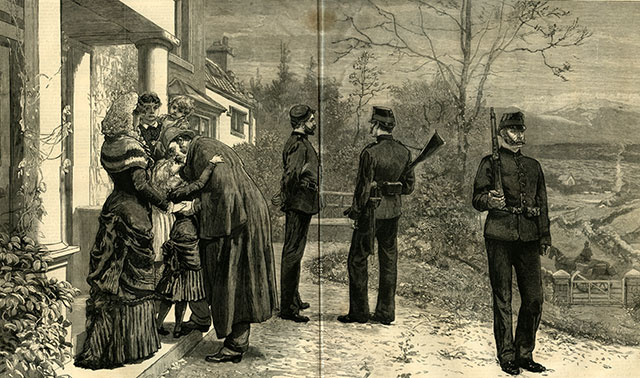
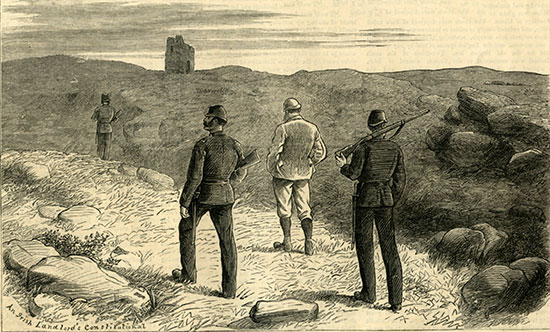
Print collection of Maggie Land Blanck The Graphic, Nov. 20, 1880 THE LAND AGITATION IN IRELAND - A RESIDENT LANDLORD: THE DAILY FAREWELL This image was in the same issue of the Graphic which carried a number of images of the Boycott incident in Ballinrobe. See Boycott An accompanying article notes that this image "does not represent Captain Boycott at Lough Mask, but is merely a general sketch of the conditions under which many Irish landlords and agents are now living". In other words military protection was offered to other landlords and land agents.
| |
 | |
|
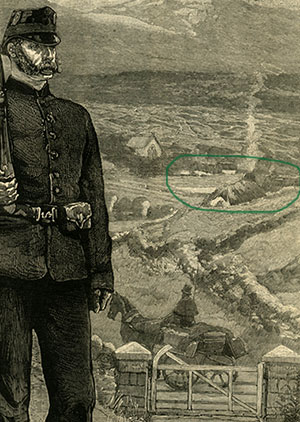
Print collection of Maggie Land Blanck The Graphic, Nov. 20, 1880 A detail of the above print. Compare the "Resident Landlord's" abode to the homes of his tenants.
| |
 | |
|
Print collection of Maggie Land Blanck The Graphic, Nov. 20, 1880 An Irish Landlord's constitution.
| |
| Boycotting Continued January 1881 "Boycotting" continued throughout Ireland and the world to bring changes to socioeconomic situations. | |
| |
| Print collection of Maggie Land Blanck Illustrated London News from January 1, 1881 | |
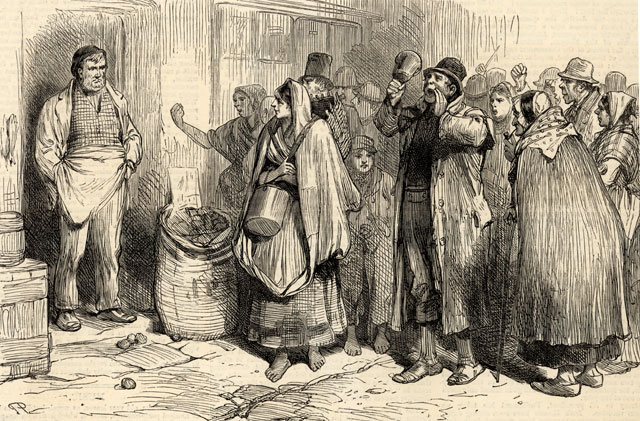
| THE STATE OF IRELAND; "BOYCOTTING" A TRADESMAN, COUNTY MAYO
January 1, 1881 Clearly boycotting in this instance meant more than not shopping in the store of this tradesman. The townsmen have come out to "groan" and make unpleasant noises and comments. Unfortunately, the article that accompanied this picture was not included when I bought the image. | |
| The Land League The Irish Land League was a political organization who's aim was to free the poor tenant farmers from the burden of the rents imposed by landlords. | |
| |
| Print collection of Maggie Land Blanck | |
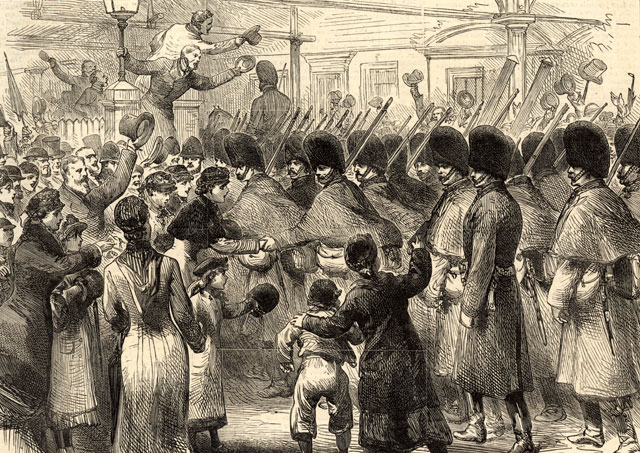
| DEPARTURE OF THE SCOTS GUARD FROM LONDON FOR IRELAND: JANUARY 1, 1881
The Land League wished to abolish landlordism and to enable each farmer to own his or her own land. The Irish National Land League was founded in Castlebar in October 1879. Prominent members were Charles Steward Parnell, Thomas Brennan, Michael Davitt, John Dillon, and Andrew Kettle. The Land League organized tenant groups to withhold rent and resist evictions. The period from 1880 to 1892 was known as the Land War, a period of much agitation and violence. In November 1880 Parnell and other members of the Land League were charged with seditious conspiracy. They were brought to trial in January 1881. The Scots guards and other troops were sent to Dublin to prevent the outbreak of violence. Unfortunately, the article that accompanied this picture was not included when I bought the image. | |
 |
|
|
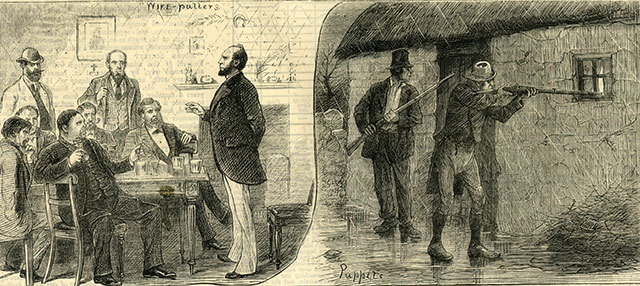
Print collection Maggie Land Blanck, The Graphic, January 8, 1881 The Wire Pullers and the Puppets This image insinuates that the well fed and well dressed leaders of the Land League sat around a warm dry place making decisions that were executed by the destitute, thin, poorly attired peasant in the dark and cold rainy night.
| |
 |
|
|
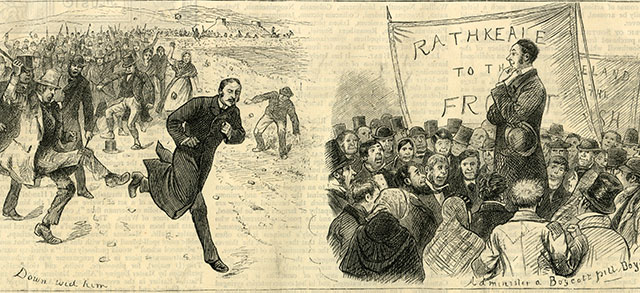
Print collection Maggie Land Blanck, The Graphic, January 8, 1881 Down with Him & Administer a Boycott Pill Boys THE LAND AGITATION IN IRELAND Unpopular land agents, bailiffs and other who worked for the English landlords were frequently stoned or had garbage and mud thrown at them. Another popular "punishment" was boycotting. In this and in so many other images of the Irish they are depicted as coarse and brutish looking - frequently with simian features.
| |
 |
|
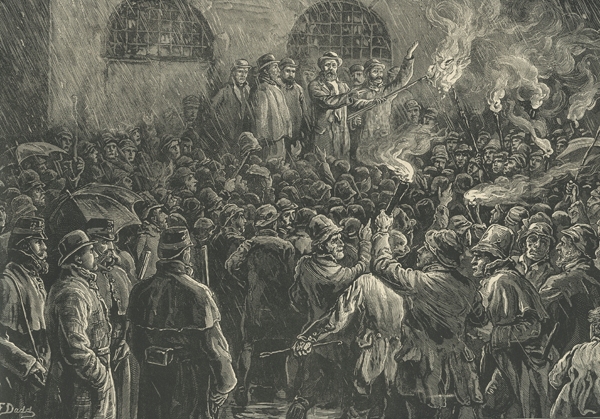
Print collection Maggie Land Blanck, The Illustrated London News, January 8, 1881 THE IRISH LAND LEAGUE; MR BOYTON BURNING THE DUKE OF LEINSTER'S LEASES ON A '"'98 PIKE" IN THE MARKET-PLACE OF KILDARE Michael Boyton was an Irish American member of the Land League. He was also one of the 14 people brought to trial in Dublin in 1881 for seditious conspiracy. The demonstration depicted in this engraving occurred "on the eve" of the trial in Dublin. The building in the background is the market house in Kildare. The '98 Pike refers to the Irish Rebellion of 1798. The Duke of Leinster in 1881 was Charles William FitzGerald, the 4th Duke of Leinster. He held 67,00 acres on his estate in Kildare. There were about 400 tenants holding from 75 to one hundred and twenty acres. Holders of leases on the Leinster estates were not compensated for any improvements they made on the property unless the had the written approval of the Duke.
|
 |
|
| Print collection of Maggie Land Blanck, 2012, publication unknown
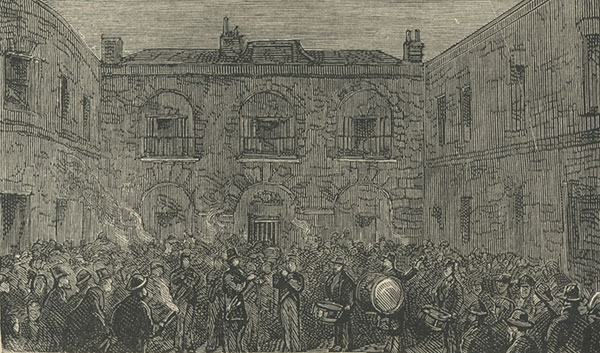
SERENADING THE IMPRISONED LAND LEAGUERS ON ST. PATRICK'S NIGHT
Members of the Land League who were incarcerated in Kilmainham goal in County Meath were serenaded by sympathizers on St. Patrick's day night 1881. | |
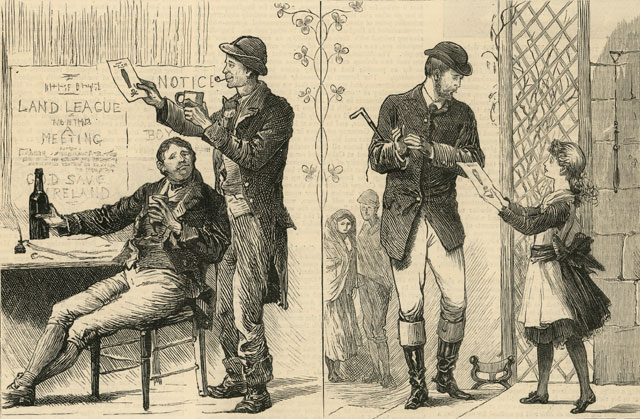
| St Valentines' Day in Ireland, February 1881
Threats and warnings were made by Land Leaguers to the landlords and land agents. Typically, many images in the AngloIrish and English papers depicted the Irish as miscreant, raggedy, drinkers. While the AngloIrish were portrayed as sophisticated, nicely dressed, proper, gentlepeople.
| |
| |
| Print collection of Maggie Land Blanck | |
| THE MAKER (glefully)_ A-h Jeames-'tis illigant." THE RECEIVER- "Is this for you, Father? Is it fun? | |
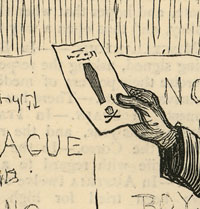
| The card which depicts a coffin and cross bones. |
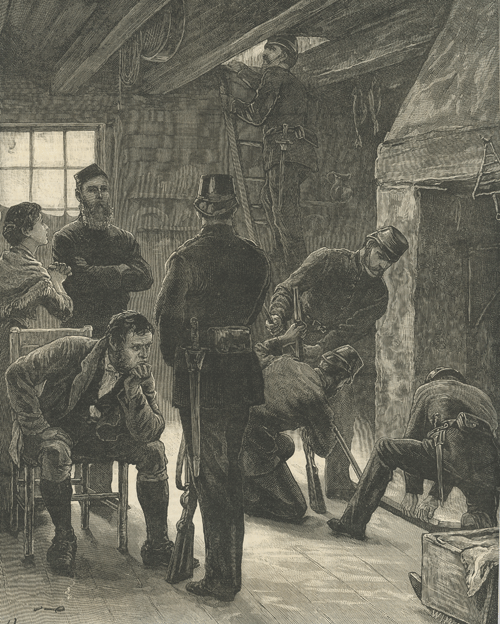
| Searching For Arms The 1881 Arms Act proved "an effective check on the possession and sale of arms because each applicant for a license had to be certified as loyal by the local police inspector" | |
 |
|
Print collection Maggie Land Blanck, The Illustrated London News, April 9, 1881 THE STATE OF IREALND; SEARCHING FOR ARMS Accompaning article missing.
|
 |
|
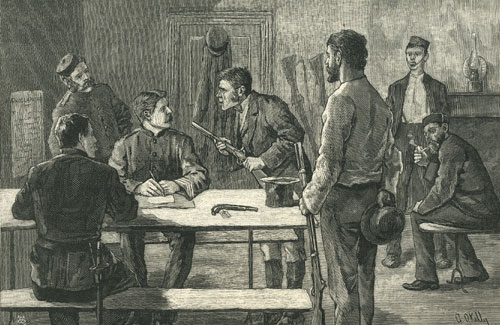
Print collection Maggie Land Blanck SURRENDERING ARMS IN A PROCLAIMED DISTRICT, The Illustrated London times, July 30, 1881 The above image is a sketch from County Galway where as a result of Peace Preservation Act of 1881.
"It is the room of the local police barracks, where a sergeant and one constable are seated to receive the fire-arms, guns and pistols of various description, which all unlicensed persons, in the district are strictly required to bring in, and to deliver into the charge of the guardians of the public peace. A label is written and attached to each weapon so received, stating the name and address of its owner, and the price he would pretend to claim for it; but. Whether from sheer ignorance, or from impudent cunning, or with a derisive purpose, some of these people do not scruple to mention preposterous sums of money as the value they set upon worthless articles, which could be dangerous only to the shooter- old flint-locks, rusty barrels tied on with wire or sting, and some pieces lacking the hammer or trigger, priced at many shillings, when they are not worth as many pence for mere old iron. There are, however, a number of the old Enfield muzzle-loading rifles formerly used in the Army. The inspector will afterwards come to the barrack and make a correct valuation."
|
| More on the Irish Land League | |
| |
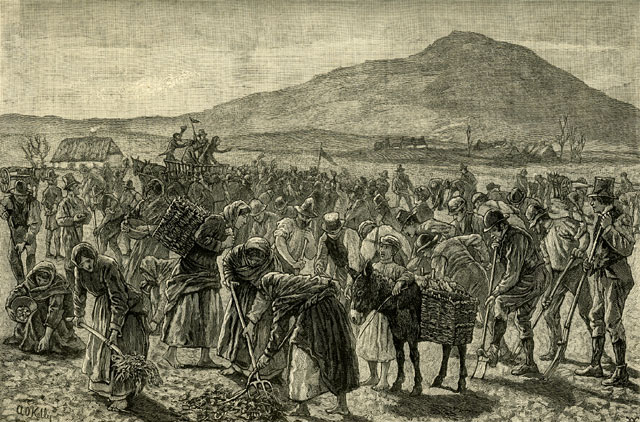
| Print collection of Maggie Land Blanck The Illustrated London Times, May 7, 1881 (The artist was Aloysius O'Kelly born Dublin, Ireland, 1851 died 1936) "The State of Ireland: Tilling the farm of an imprisoned Land Leaguer"
| |
|
In 1881 there were 40 or 50 Land League prisoners in Kilmainham Gaol
"having been arrested by the Irish Government under the Peace Preservation Act".
....." most of the prisoners are rather obscure persons, and there are a few of the peasant or small farmer class. In the case of some of these, who have left their farms in Mayo or Connemara, a demonstration of sympathy has been got up by assembling numbers of people, men and women, as shown in our Artist's Sketch, to dig and plant in their fields."The ariticle also mentions some "Land" incidents in the west.
| |
|
| Print collection of Maggie Land Blanck. |
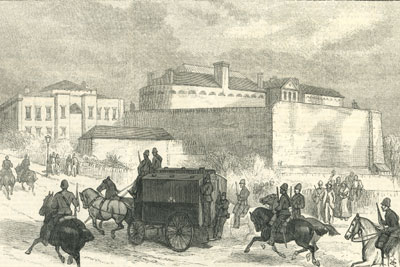
| KILMAINHAM JAIL, DUBLIN The Illustrated London News, July 30, 1881
|
|
| Print collection of Maggie Land Blanck, 2012 |
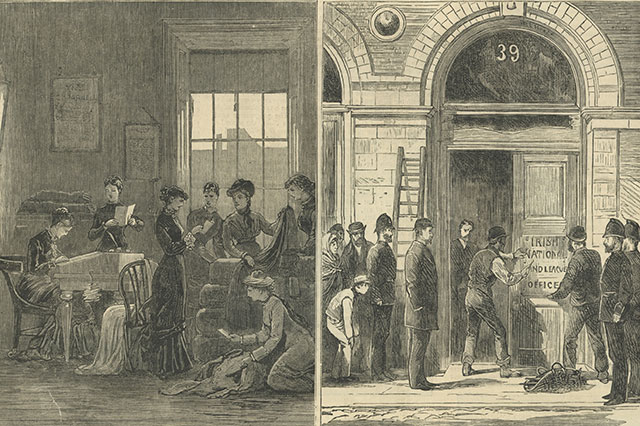
| LAND LEAGUE LADIES AT WORK IN THE DUBLIN OFFICE AND REMOVING THE NAME PLATE FROM THE LAND LEAGUE OFFICE, DUBLIN The Graphic, November 12, 1881
The first represents the Dublin branch of the Ladies Land League at work overhauling clothing, &c., intended for the use of the evicted, and the families of the imprisoned suspects. At a recent meeting these patriotic ladies unanimously pledged themselves never to marry an Englishman, and never to give a policeman a drink. The other sketch shows the removal by order of the Government of the name-plate from the door of of the Land League Office in Sackville Street, Dublin. |
| Attacks on Process Servers Process servers represented the landlord. They collected the rent and evicted tenants for being in arrears on the rents and other infractions. Several process servers became the objects of tenant resentment and were stoned or shot. These included: David Feerick in Ballinrobe in 1880 and Joe and John Huddy Clonbur, Galway in 1882. See below.
|
|
| Print collection of Maggie Land Blanck, 2012 |
|
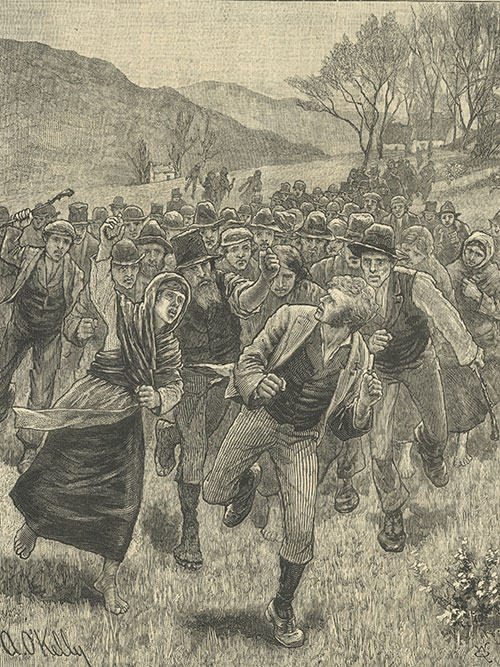
The Illustrated London News, July 30, 1881, (The artist was Aloysius O'Kelly born Dublin,
Ireland, 1851 died 1936) THE IRISH LAND LEAGUE AGITATION: ATTACK ON A PROCESS SERVER According to the accompanying article: William Daly, a process server, suffered from a "broken head", a bailiff named Conners in the employ of Lord Dinsdale was shot and killed.
|
| Shooting of John Hearn, Ballinrobe,
Land Agent for the Mountmorency Estate in Cloongowla March 1881
John Hearne was a land agent for the Mountmorency Estate in Cloongowla. He was shot on February 28, 1881.
|
| |
| Print collection of Maggie Land Blanck | |
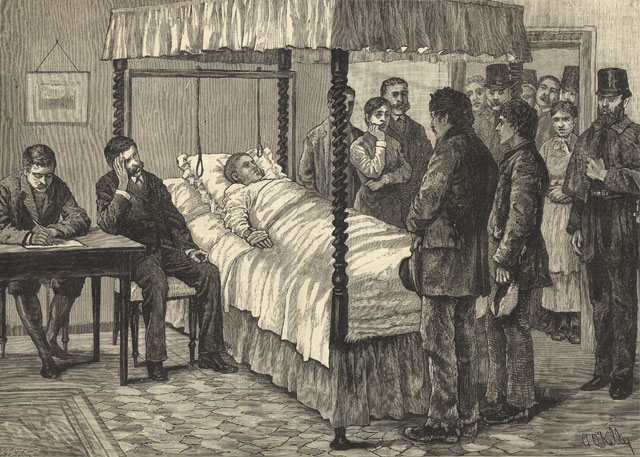
| "PRISONEERS CHARGED WITH SHOOTING MR. HEARN AT BALLINROBE, MAYO, BROUGHT
BEFORE HIM FOR IDENTIFICATION" ILLUSTRATED LONDON NEWS MARCH 26, 1881 On Febraury 28, 1881 around 2 in the afternoon only 200 yards from his house there was an "attempt by shooting" on the life of John Hearne, age 65 of Killoshine cottage, as he returned from the Ballinrobe Petty Sessions to his home. He was about three quarters of a mile from the courthouse and had stopped to watch some work going on in his fields when he was atacked by two men who shot him six times. Hearne age 65, was a Land Agent for the Mountmorency Estate in Cloongowla and a Petty Sessions clerk. He was hit several times but walked home and survived the attack. Three men, Patrick Hession of Cloongowla and two of his nephews, Richard and John Nally of Ballykinave, Claremorris were charged with the attack but for some reason were not sent to trial. No one was tried for this event. A possible motive for the attack was the eviction of three tenants in May 1880 on the de Montmorency estate for non payment of rents. Hearn had reportedly received some threatening mail warning him not to evict anymore tenants from Cloongowla signed "A Boycotter". John Hearne, esq. (1815-1899) The Hearne family of Killoshine were Methodists. They rented a house, Killoshine Cottage, and 30 or 40 acres from Colonel Knox. In 1881 John Hearn, Market Street, was a Petty Sessions clerk for Ballinrobe and an agent for the estates of: Captain Harvey J. de Montmorency in Cloongowla, Ballinrobe, the Kenny estates in Ballinrobe and the Livesy estate in Kilbride. He was listed in the 1881 Directory for Ballinrobe as clerk of the petty sessions. He must have known my ancestor John Walsh who was a steward on the Kenny Estate John Walsh (1827-1894 - Ballinrobe
A list of Irish Census substitutes from the web site "Tracing your Mayo Ancestors: 1852- 1854 Tenants of Ballinrobe - Index to the tenants of Mr. John Hearne, Agent for the estate of F.J. DeMontmorency. Alphabetically arranged listing 240 tenants name, townland, rent and year. SMFHRC Jnl. 1989 p. 22-26. John Hearne born 1815 and died 1899 at Ballinrobe married Frances Anderson, on August 18, 1853. They had a son, Robert Ernest Hearne (1863-). Robert Ernest Hearne died in Ballinrobe Dec 1942. The subject of the Hearne attack was revisited at a hearing on the Land League in October 1888. At that time it was stated that there had been some eviction in the area on October 18, 1880. Several men were evicted and then reinstated as caretakers. Also on October 18th one of Heanre's sons "was pointed at by J. W. Nally... and mobbed when he returned home." It was not clear if Hearne actually had anything to do with the evictions or merely that he was "connected with the law". A month later Hearne received some threatening letters regarding evictions at Cloongowla where he was the agent. He lost some of his hearing as a result of the shooting and suffered greatly from his wounds. He gave up his "agencies" and his clerkship at the Petty Sessions. In 1894 probate was filed for Frances Hearne effects £202 19 s and 11 d, late of Killoshine Cottage, Ballinrobe Mayo who died June 1, 1894 granted a Ballina to John Hearne of Killoshine cottage, farmer the husband. John Hearne, farmer, late of Killoshine Cottage, Ballinrobe, died 20 February 1899 and left an estate of £796 10s 9d to his son, Robert Ernest Hearne of Killoshine cottage, Ballinrobe Clerk of Petty Sessions. John's son, Robert Ernest Hearne (1863-1942, was listed in Ballinrobe in the 1901 and 1911 censuses:
Killosheheen [Killoshine] Cottage Killosheheen cottage was built by John H. Hearne (1814-1899) Clerk of the Petty Sessions at Ballinrobe. Patrick Hession of Cloongowla - implicated in the Hearne shooting Patrick Hession had been evicted by Hearne for non payment of rent. He was later reinstated as caretaker on the property. He was accused (with his two nephews, Richard and John Nally) of shooting Hearne.
List of those in prison under the Protection of Person and Property Act 1881, published as a supplement to United Ireland, 10th Sept 1881: KILMAINHAM PRISON DUBLIN - Patrick Hession, Ballinrobe, Co. Mayo. Farmer - Richard Nally, Claremorris, Mayo. Labourer - John Nally. Claremorris, Mayo. Labourer. In a speech given by Parnell in August 1881 he stated: "of the 22 who had been arrested in Mayo, and who were still retained in prison, all belonged to most respectable trades and occupations, with the exception of one who was returned as having no occupation. Seven were farmers, five labourers, one a land steward, one a newspaper correspondent, one a baker, three shopkeepers, two shoemakers, and one tailor." And further: "On those 22 men 100 women and children were dependent for their support. One man had a family of nine, another of 10, another of six, and so on; and all these families were left without support." Parnell averred that were being held to prevent any danger to "witnesses and persons on whose information the arrests took place." He called the grounds of the arrest of Patrick Hession "vague and untenable" and declared local public opinion was that Patrick Hession was imprisoned for his "connection and sympathy with the Land League." Richard Nally and John Nally of Ballykinava (Claremorris) - implicated in the Hearne shooting Richard Nally and John Nally, young men, sons of a herd, and relatives of the wife of a Patrick "Hessian" (who had recently been evicted by Mr. Hearne) were arrested in connection with the incident and were held in the Claremorris barracks. They claimed to have been sowing potatoes on their father's farm at Ballykinave the time of the shooting. Ballykinave is near Ballindine. It is about a four hour walk from Ballindine to Ballinrobe. Hearne said it was possible they were the men who shot him. He said the men were wearing blue jackets with fur caps pulled over their heads. A young woman swore she had seen John Nally loitering near the wall in the area where Hearne had been shot. The Nally borothers were committed for trial. March 7, 1881: BALLINROBE, Sunday, At one o'clock this morning, John and Richard Nally, charged with attempting to assassinate Mr. John Hearne, were brought into Ballinrobe from Castlebar, under the escort of constabulary. In Parnell's speech in August 1881 he mentioned the case of John and Richard Nally: "They were charged with shooting at and wounding a Mr. Heard; and though the magistrates before whom they were brought refused to return them for trial, because of the absence even of a prima facie case, the Chief Secretary in London considered that he had evidence enough to justify him as a juror in practically finding them guilty of an offence of which they were previously practically acquitted. "1st February 1882. LIST of all Persons Detained in Prison under the Statute 44 Vict. c. 4, entitled "An Act for the Better Protection of Person and Property in Ireland".April 1, 1882 THE SUSPECTS IN KILMIAINHAMNote: There were two John Nallys in Kilmanham jail in 1882 (John Nally of Ballykinava and John W. Nally of Balla arrested in March 1881 on charges of inciting to murder.). Captain Harvey J. De Montmorency - Landlord Cloongowla Captain Harvey J.de Montmorency is recorded in Griffith's Valuation as holding the townlands of Cloongowla, parish of Ballinrobe, barony of Kilmaine. Mr. De Montmorency resided for much of the year in England. He was not related to Lord Mountmorres murdered in 1880. NO ONE WAS CONVICTED IN THE SHOOTING OF JOHN HEARNE
| |
Walter M Bourke, and his military escort, Corporal Robert Wallace, murdered June 1882 - Galway
Walter M Bourke was a wealthy West Irish landlord. He was born circa 1836 the son of Mr. J, Bourke, Crown Solicitor for Mayo County. Walter Bourke received a degree from Trinity college, Dublin. He owned two estates in Ireland, at Curraleagh (near Claremorris in County Mayo) and at Rahasane Park (in county Galway). He had made a fortune as a barrister in India before returning to Ireland to buy Rahasane. He inherited the property at Carraleagh. He had several "disputes" with his tenants and was in the process of carrying out evictions at the time of his death. The Illustrated London News of May 14, 1881 carried a story about Walter M Bourke evicting his tenants near Claremorris, Co Mayo. A year later he was shot near his estate in Galway. |

|
| Collection of Maggie Land Blanck. Illustrated
London News,
Walter M Bourke May 14, 1881
|
| THE IRISH LAND LEAGUE AGITATION; MR WALTER BOURKE SERVING WRITS
ON HIS TENANTS It was extremely difficult to find process servers due to the hostile and dangerous conditions they met while trying to serve evictions notices. Walter Bourke, a Claremorris landlord and a candidate for a county constituency, took it upon himself to serve writs to his tenants at Curragh Leigh. He galloped up on horseback, strode into the house with his pistol drawn, and presented the writ to the surprised tenant. He was backed up by his servant who was also armed. At one point he spied one of his tenant, Malachy Fallon, in town and chased him into a building, up the stairs and from room to room until he cornered him in the garret where the poor fellow as obliged to accept the writ. [Illustrated London News, May 14, 1881] Michael Scanlan of Middle Mase, Claremorris was one of six families evicted by Walter Bourke of Carraleigh, Claremorris. Michael and his family were forced to live in a sod hut constructed in a ditch by the side of the road. There was no room for their furniture and they were forced to keep their table and chair by the roadside. [Hansard's parliamentary debates, Volume 262, By Great Britain. Parliament, Thomas Curson Hansard] Walter M Bourke owned a "moderate size estate" of 4,141 acres near Claremorris. The 1878 rents on some parts of the Bourke estate were 57 per cent above the government valuation in 1878. On other parts of the estate they were 91 percent above the government valuation. Fifty families were evicted from the Bourke estate in 1881. Various reports stated that the land was of poor quality and that the rents were paid not from monies earned off the land by seasonal migration to England. When the seasonal migration was no longer profitable the tenants could not meet they rent. [Land and Popular Politics in Ireland: County Mayo from the Plantation to the to the Land War, By Donald E. Jordan]
"CARRYING A GUN INTO CHURCH. A singular scene has just occurred at Claremorris. Mr. Walter Bourke, J.P., who has been Boycotted and his life threatened, attended mass with his family on Sunday, and carried a gun into the chapel with him. The people became excited, and demanded that he should leave the gun outside, which he refused to do. They then demanded that he should be put out himself, but the Rev. Canon Bourke persuaded him to go into the sacristy. The congregation still demanded the removal of Mr. Walter Bourke and the gun, but the Rev. gentleman declined to order his removal. The congregation then left in a body, carrying the Rev. Canon and his clerk with them in the crowd. Quiet was restored, and the congregation returned on Mr. Bourke, his family, and servants leaving the chapel. A memorial has been presented to the Lord Lieutenant by the Rev. Mr. Corbett, CC, complaining of Mr. Bourke bringing his gun into another chapel." Mr. Burke had been mentioned in an Illustrated London News article of May 21, 1881: "Some remarks were made last week, having reference to the instance of a landlord near Claremorris, Mr. Walter Burke, who finding that none of the ordinary process-servers in the county would venture to go round and deliver writs of ejectment to his defaulting tenants has resolved to do it himself." " He took an active part in the prosecution of Father Conway a few years ago. A few months ago he entered the church at Carraro, armed with a repeating rifle while mass was being celebrated. The priest ordered him to leave the church, and he escaped by a side door in order to avoid being mobbed."The murder: Walter Bourke of Carraghleagh Co, Mayo and Rahasane Park, Co. Galway, age about 46, and his military escort, Corporal Robert Wallace, were shot and killed outside Castle Taylor, Ardrahan, Co Galway in June 1882 by a party of four or five assassins. Bourke was shot once in the neck and once in the head. The brains of the victims were scattered about the sight. Some reports say Bourke and Wallace were riding together in a dog cart - Bourke driving and Wallace sitting on the back seat looking backwards. Other reports say they were on horseback. In any event, they were shot in "board daylight" in a public place. The killers walked away carrying their own arms and the rifle and carbine they had taken from Bourke and Wallace. A inquest found that Bourke and Wallace died of gunshot wounds "willfully inflicted by some person or persons unknown." It is believed that the shooting was work of the IRB (Irish Republican Brotherhood). Rifles found near the murder spot were "marked the shamrock". The local Catholic clergy encouraged their flocks to do everything possible to bring the murderers to justice. Witnesses said that six men had left the scene. There are conflicting reports about arrests - from no one to three. No one was tried. "Mr. Walter M Bourke, J. P., a barrister who had made a considerable fortune at the practice of his profession in India, and who had settled down as a landed gentleman, and his guard, Corporal Wallace, of the Royal Dragoons, were shot dead on the highroad at Ardrahan. Mr. Bourke was a Catholic, and had earned some considerable notoriety by attending mass at Carroroe Church with a repeating rifle, and would not leave the Church even at the request of the clergyman."1882: The Irish government offered rewards:
1882 The Parliamentary Debates: The three dragoons provided as protection to Bourke were not provided with horses. By riding in the same vehicle together they lost the advantage that a separate would have afforded. However, it was also argued that a mounted escort could not shoot as accurately as one in a vehicle. Corporal Wallace left a widow. Unfortunately, the Widow Wallace "was not on the married establishment, he having married without leave." She did in the end receive compensation o £300. Ballinrobe Chronicle June 17, 1882:
|
|
| Print collection of Maggie Land Blanck
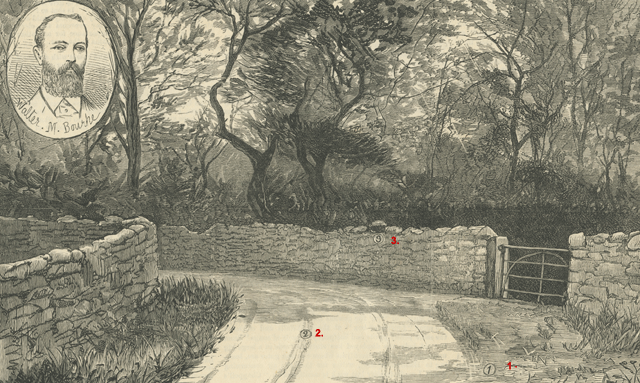
1. Spot where Mr. Bourkes' body was found. 2. Where the body of Corporal Wallace lay. 3. Loophole to wall, through which the shots were fired. (Gate by which the murders afterwards came out)
SCENE OF THE MURDER OF MR. WALTER BOURKE AND CORPORAL WALLACE, AT ARDRAHAN,
COUNTY, GALWAY
In October 1888 the London Times had a multi page report on the Land League issues in which the Attorney general spoke against the Land League actions. He stated that P. J. Gordon at Claremorris encouraged the "boys" to keep their powder dry, the flag flying, and to continue the battle against the land thieves in particular to "blow Bourke to blazes one fine morning - Walter of Curraleigh" who had all the money his father had robbed from the poor tenants. Gorden had added that "In one case he threw our 13 weak children and brought 300 police to evict them." The Attorney General declared that this was a direct incitement of the crime that was subsequently committed. According to the New York Times account of the murder, Bourke took an active part in the prosecution of Father Peter Conway. Peter Conway was a activist priest from the famine days until his death in 1872. He was the curate of Ballinrobe Parish for a number of years. See Religion Corporal Robert Wallace Corporal Robert Wallace of the Royal Dragoons (1st Dragoons) was accompanying Walter Burke when they were shot. It was reported that Wallace, a six foot tall Scotsman, had only arrived from the Curragh Camp two days before. Anxious to see the countryside he exchanged duties with a comrade. Corporal Wallace was shot three times - twice in the head and once in the heart. "Funeral Of Corporal Wallace. - The funeral of Corporal Wallace, 1st Dragoon Guards, who had been shot dead while escorting the late Mr. Walter M. Bourke, near Ardraban, County Galway, took place with full military honours June 13th. The deceased, who was only 25 years old, was a native of Scotland, having been born at Shotts, Lanarkshire. He had been six years and 105 days in the army, and during that entire period he had borne an irreproachable character. He was, indeed, a man of high military training, excellent conduct and steadiness, and had been especially selected for dangerous service. Previous to his promotion he had formed one of the personal guard of a gentleman named Digby, residing at Tuilamore.......... A melancholy circumstance in connection with his murder was that he had, it appears, volunteered to be one of the protection party in attendance on the late Mr. Bourke, and had been only a few days engaged in discharging that duty when he was assassinated. Shortly before three o'clock the cortege, which included a contingent of corporals from each regiment in the Dublin garrison, started for Arbour Hill Cemetery. First advanced the Firing Party, consisting of fifteen men of Wallace's own regiment, headed by a non-commissioned officer, followed by the band of the 58rd Shropshire Regiment; the drum and fife band of the Coldstream Guards, the full band of the 21st Hussars, and the band of the Royal Dragoons, playing in turn a Miserere. Next came the body of the murdered man, borne on a gun-carriage of the Royal Horse Artillery, drawn by six horses, draped in black. The Union Jack was spread over the coffin, and on this pall were placed wreaths of flowers sent by the Lord Lieutenant, the officers and men of the 18th Hussars, stationed at Gort, and by the Soldiers' Institute. The deceased's charger, led by one of Wallace's comrades, next followed, and then came the mourning-coach, in which sat the murdered soldier's mother and brother, who had arrived from Scotland on Sunday. Next in processional order followed a large party of the 1st Royal Dragoons, under command of Col. Hutton. Then came some veterans from the R. Hospital, Kilmainham, and detachments from the 53rd Light Infantry, the 13th Regiment, the Coldstream Guards, the Royal Artillery, tho 21st Hussars, the Royal Horse Artillery, and a contingent of Royal Irish Constabulary Phoenix Park. Major-Gen. Lord Clarina and several officers brought up the rear. As the funeral passed onward to the cemetery it wis received with the utmost manifestations of respect by the people who stood in the streets to see its mournful progress, all remaining uncovered as the gun carriage upon which rested Wallace's body slowly moved by. At the grave tho customary volley was fired ; and the last honours having been paid to the dead, those taking part in the funeral returned from the cemetery.Corporal Wallace was just in the wrong place at the wrong time. "The funeral of Corporal Wallace, at Dublin, on the day before, was also attended by a public demonstration. The Corones jury in Galway returned a verdict of murder by some person or persona unknown." (Mysteries of Ireland 188?) Widow Rawn Wallace was awarded £300 for the death of her husband. "Mrs. Rawn Wallace, wife of Corporal Wallace, £300 for the murder of her husband while he was escorting Mr. Walter Bourke, who was also murdered"
|
|
Who committed these crimes? It was claimed that it was common knowledge among the local population just who had committed these crimes. The events were freely talked about in the community. But despite the large rewards offered everyone remained silent to the authorities. Although hundreds of troops were poured into the West of Ireland "crimes" continued to be committed right under the noses of the military and the police.
1883 Court claims for compensation for crimes in 1880, 1881, and 1882 in Mayo and Galway awarded by the Lord Lieutenant of Ireland
Under the Crimes Act monetary awards for loss of relatives or personal injuries were given for crimes committed.
Awards for deaths in counties Mayo and Galway were as follows:
See Feerick
Awards for injuries in county Mayo and Galway were as follows:
Awards for Deaths in co. Mayo and Galway made by the Grand Juries of Ireland were:
Awards for injuries in co Mayo and Galway by the grand Juries of Ireland were:
Parliamentary Papers, House of Commons and Command, Volume 63 (1884) and COMPENSATION FOR MURDERS IN IRELAND. OAMARU MAIL, VOLUME IV, ISSUE 1322, 11 SEPTEMBER 1883, National Library of New Zealand
|
|
27 Agrarian Murders in Ireland in 1882
It was said that there were 27 agrarian murders in Ireland in 1882: chief amongst which were those of the Joyce family, five in number, slaughtered while asleep in their little cabin in the mountains of Maamtrasna 1.; of the two bailiffs of Lord Ardilaun, (an old man and his grandson,) who were shot dead when they went to serve eviction notices on tenantry dwelling near the shores of Lough Mask, Connemara, and whose bodies were then tied in sacks and sunk in the deep waters of the lake2.; of Mrs. Smythe, whose head was blown literally into fragments at Barbavilla, Westmeath, as she drove home from church one Sunday afternoon in a carriage with her sister and her brother-in-law, (a local landlord)3.; of Mr. Walter Bourke (a landlord) and Corporal Wallace (one of Mr. Bourke's military bodyguard,) who were both shot dead in broad noon-day on the public road near Rapassane, Galway4.; of Mr. Blake (land agent of the Marquis of Clanricarde) and his servant man, who were both shot dead on the road near Longhrea, Galway5.; of Constable Kavanagh, who was shot dead at Letterfrach, Galway6.; and of Mr. Herbert, a grand juror, who was shot dead at Castle-island, Kerry3.. All these twenty-seven murders were assassinations, pure and simple, and in no case whatever could even the palliation be urged that death resulted as the consequence of a fight. The murderous design was always stealthily and deliberately carried into execution. In one instance in which a herdsman named Linnane, seventy years old, was shot dead while sitting at his fireside at Miltown, Mally, Clare, because he had worked on a "boycotted" farm, the circumstances of the case were more than ordinarily mournful, for his son, who had been sitting at his side when the fatal shot was fired by the " Moonlighters" who attacked the house, lost his reason through his fright and horror, and died crazy some months afterwards. But besides this fearful catalogue of crime, in very few instances of which any one was brought to justice, were the startling assassinations of Lord Frederick Cavendish (the Chief Secretary for Ireland) and Mr. Burke (the Under Secretary for Ireland,) on Saturday evening, May 6th, in Phoenix Park, Dublin. Then, also, frequent assassinations occurred in Dublin streets; these, thongh undoubtedly political, cannot be exactly classed with agrarian crime. In different parts of the city, four informers were assassinated, and a police constable named Cox was shot dead while aiding in an attempt to arrest a party of armed Fenians, thus bringing the entire number of political and agrarian murders committed in Ireland during the past year up to thirty-four. | |||||||
| Proclamations
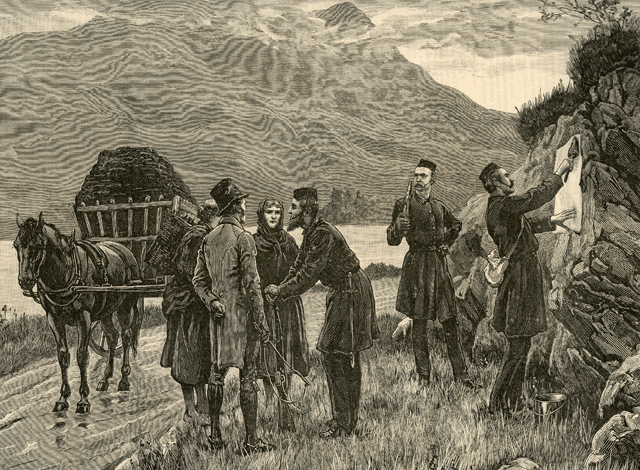
The Lord Lieutenant of Ireland and officials of Dublin Castle had the authority to "proclaim" a meeting unlawful and further had to right to order force to suppress the meeting in question.
| |
 |
|
| Print collection of Maggie Land Blanck HARPERS WEEKLY, December 17, 1881 (Aloysius O'Kelly born Dublin, Ireland, 1851-1936) The Condition of Ireland — Posting the Government Proclamation in Connemara Unfortunately, the relevant part of the accompany article is missing.
| |
| Boycotting Continued An article in the The illustrated London News of March 13, 1886 shows how the idea of boycotting took hold all over Ireland and was used as a method to push at the English dominance in society.
"The social condition of Ireland has in all ages been deplorable; from one case to another, that country has never been at peace for seven years in the course of seven centuries. The peculiar symptom exhibited at this moment of its chronic malady is the organized system of interference with private dealings and personal affairs by the arbitrary decrees of the local branches of the National League, formerly known as the Land League. These decrees are enforced by putting every man or woman who disobeys them under a species of interdict or excommunication, forbidding all members of the League, who are the majority of the neighbors, to render the commonest services of life to the obnoxious person."The article was accompanied by four drawings. | |
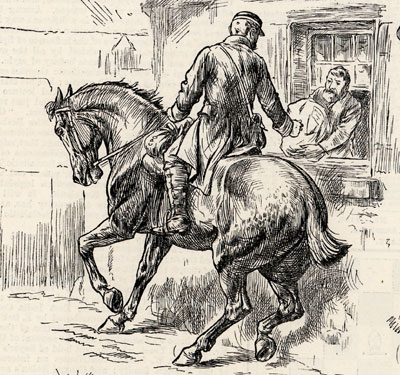
| "Parcel Post Bringing Provisions To Boycotted Emergency Men At Kilcooley"
""Here is and "emergency man," one specially employed by the Defense Association to take charge of the house from which a tenant has been evicted; the neighbouring baker and butcher have been prohibited from selling him food, so he is obliged to order it from a distant town, and the package, sent by the parcel post is handed to him though a window." |
| |
| Print collection of Maggie Land Blanck | |
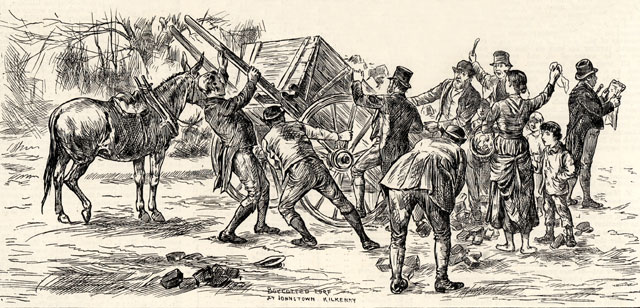
| "Boycotting turf at Johnstown, Kilkenny"
"A cartload of boycotted turf is stopped on the road, upset, and scattered, by a mischievous assembly of peasants; while the deputy of the National League, turning his back on this petty outrage, pretends not to be aware of it, and reads, United Ireland as if all were quite and serene. | |
| |
| Print collection of Maggie Land Blanck | |
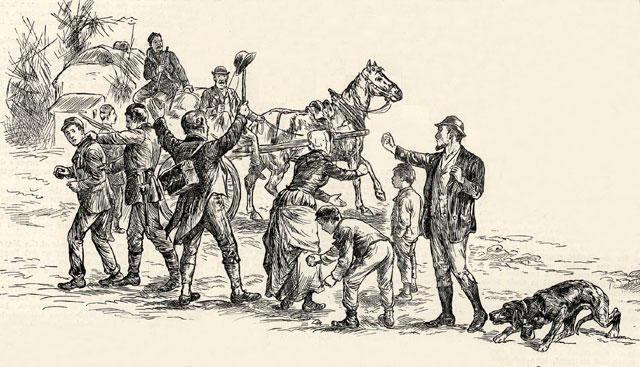
"Boycotting caretakers conveying provisions from Thurles
"In another scene, the cart bringing provisions for a party of "caretaker" on a boycotted estate is waylaid by a family, man, wife, and boys who have been recently ejected from one of the farms, and whose insults might proceed to acts of violence but for the presence of armed police." | |
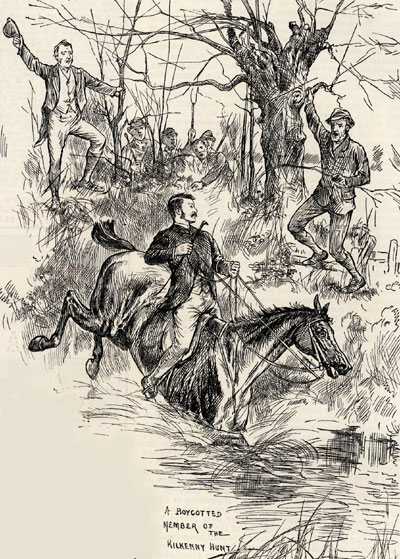
| "A Boycotted Member of the Kilkenny Hunt"
"The Kilkenny Hunt, being a pastime for the landed gentry, was severely boycotted, and here we see the farmers, on the bank of a stream, treating a gallant horseman as a trespasser, and driving him off when he attempts to land in their fields. What would the hard-riding, free-living, cross-county gallopers of Charles' Lever's entertaining tales have said to such an interruption of their sport?" |
"These minor annoyances keep up a bad feeling between different classes, interfere with trade and industry, deprive home life of its comfort, and spoil the naturally pleasant temper of the Irish people. The continual reports of their occurrence have greatly prejudiced English minds against consideration of those plans for the benefit of Ireland which statesmen are disposed to entertain. It is extremely impolitic, on the part of leaders of the Irish political movement, to permit within reach of their influence, such unjustifiable exhibitions of spite and malice, which are likely to create a false idea of the national character, and to impede salutary legislation." |
|
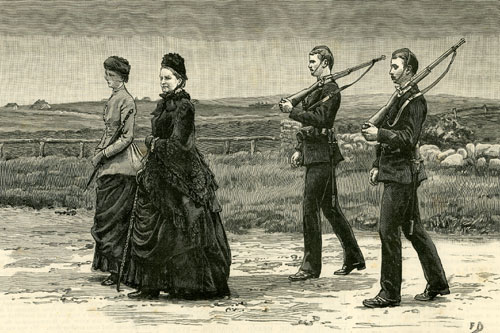
| What Boycotting means In Ireland-A lady of the manor making calls. No date. Publication unknown. |
| Print collection of Maggie Land Blanck Notice the difference in dress between these "ladies of the manor" and the peasant ladies on their estates as seen in other images. The guards were provided by the government. It would be interesting to know how much the government spent on soldiers to escort "ladies of the manor" on visits during the "troubles" in the 1880s. | |
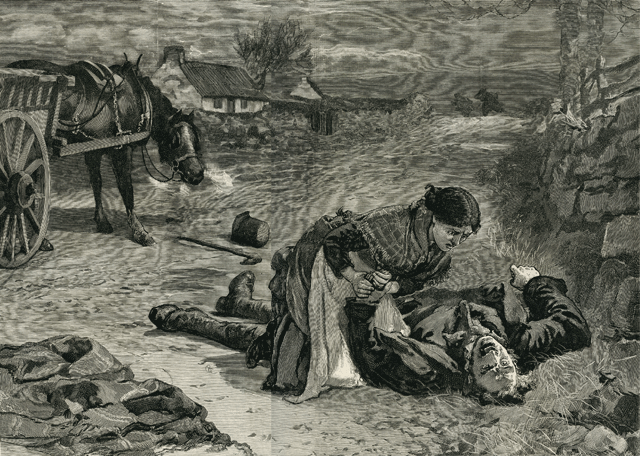 |
| Print collection of Maggie Land Blanck Boycotting of James and Norah Fitzmaurice, County Kerry 1888
"A Brutal agrarian murder was committed in the early hours of the morning of Jan. 31, 1888" in County Kerry. The victim was a feeble man of sixty-six years of age named James Fitzmaurice. Having retaken a farm from which he and his brother had been evicted, he was denounced as a land-grabber, and boycotted."Fitzmaurice had been given police protection but on January 31 he declined a police escort as he set out with his daughter at half past four in the morning to the Listowel Fair. Two men followed them. Fitzmaurice turned back to talk to the men while his daughter went on in the cart. An argument ensued and Fitzmaurice was overcome by his assailants and shot two times. The assailants fled. Fitzmaurice walked a few paces along the road and collapsed. He was taken to a nearby house where he died shortly thereafter. Norah Fitzmaurice gave evidence against the accused murderers, Daniel Hayes and Daniel Moriarty, at the trial. They were convicted and sentenced to death. Daniel Hayes and Daniel Moriarty were executed in April 1888. Norah Fitzmaurice was boycotted for testifying at her father's murder trail.
The Boycotting of Norah FitzmauriceClearly there was something more going on here than the malicious boycotting of a young woman solely because she testified against her father's murders. See Religion for the accompaning picture. |
| |
| Print collection of Maggie Land Blanck
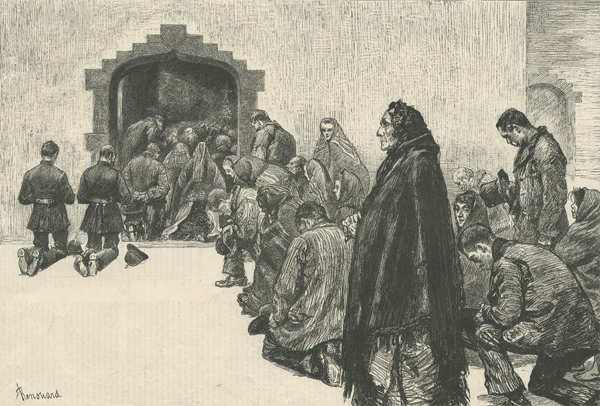
The Graphic April 21, 1888 STUDIES FROM LIFE IN IRELAND — VIII OUTSIDE THE CHAPEL — BOYCOTTED POLICE The accompanying article is missing. I assume the boycotted police were those who accompanied the agents who were serving eviction notices. | |
| More Land League
| |
| |
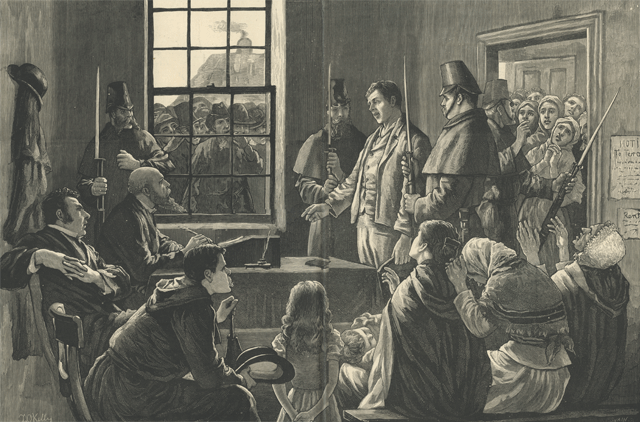
| Print collection of Maggie Land Blanck DISTURBED IRELAND: BEFORE THE MAGISTRATE by A. O'Kellly (Aloysius O'Kelly born Dublin, Ireland, 1851-1936) The Illustrated London News, February 5, 1881 No text accompanied this print when I bought it. A restricted access Internet site (Project Muse, O'Sullivan, Niamh. Imaging the Land War) suggests that this print is related to a land reform issue in Ireland. Aloysius O'Kelly: Art Nation Empire By Niamh O'Sullivan, notes that this images "operates as a ironic meta-marrative" countering the accompanying text that denounces the need to deal with 'seditious Fenian and agrarian intrigues' perpetrated by 'those misguided dupes who are tempted to acts of vilence and outrage'. Court investigations were extremely common at the time but O'Kelly treated the incident with solemnity "imbuing it with a highly charged sence of drama". | |
| |
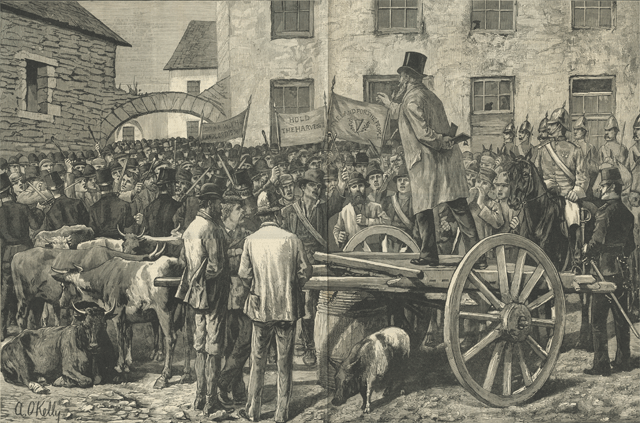
| Print collection of Maggie Land Blanck The Illustrated London News, June 18, 1881 (Aloysius O'Kelly born Dublin, Ireland, 1851-1936) "THE LAND LEAGUE AGITATION IN IRELAND: A SHERIFF'S SALE OF CATTLE, TO PAY THE RENT" The placards read: DOWN WITH LANDLORDISM, HOLD THE HARVEST AND THE LAND FOR THE PEOPLE, According to the accompanying article few auctioneers could be found who were willing to officiate. Consequently, it was left to the sheriff or sub-sheriff to run the auction which was generally held in the market square. "These proceedings have during the last few months, been frequently attended with scenes of turbulence and riot". "Emergency Committee" members (generally friends of the landlord) where in attendance to make bids if no other bidders came forth. The crowd jeered, yelled and cursed as each lot came up. "They assemble and march in procession to the place, with a band of music and banners; and, if they get possession of the cattle, will parade them, decorated with the Irish national colors, through the streets of the town."For the most part, however, the cattle went to to the Emergency Committee. Members of the Committee can be seen standing to the left of the auctioneer and protected by the line of policemen. In the background is a detachment of dragoons at the ready if trouble should arise. In June 1881 meetings were forbidden (or proclaimed) in Carlow, Kilcronin, county Louth, Conrath, county Meath and Keadue, county Roscommon, Mills-Street, county Cork, Neagh, Kildare, Skibbereen, Skull and Ballydehob.
| |
| |
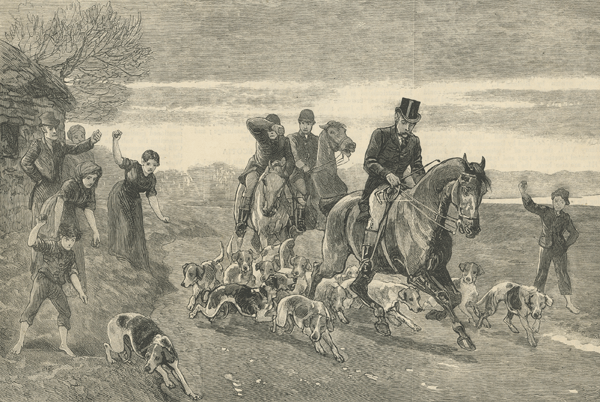
| Collection of Maggie Land Blanck, 2012, circa 1881
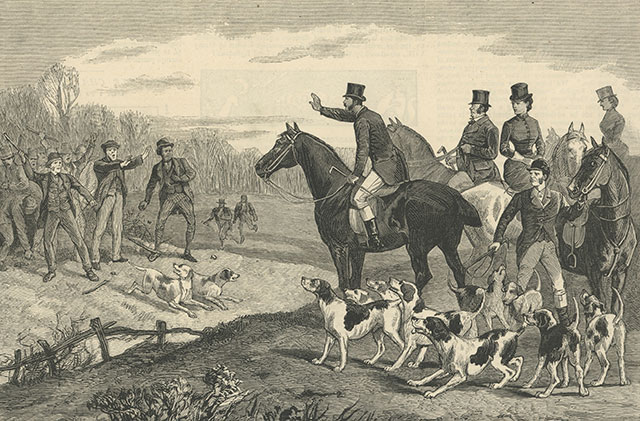
THE CONDITION OF IRELAND - STOPPING THE KILDARE HOUNDS AT KNOCKACREEE The Kildare Hunt was one of the most prestigious in Ireland.
Few tenant farmers whose lands contained coverts full of foxes relished the sight of the local hunt charging across fields sprouting winter and spring crops, not to mention the damage often done to fences and gates.The hunts had been tolerated until 1881. Then beween November and December there were a number of protests resulting in the cancelation of several hunts. Several hounds were stoned to death and some were poisoned by strychnine. These tactics, along with boycotting and ambush, convinced the gentry that the Land League would stop at nothing to drive the old landlords away. | |
| ||
| Collection of Maggie Land Blanck, Unknown publication THE CONDITIONS OF IRELAND "PLEASURES OF THE HUNT" The image can be dated to around 1881 based on the period of protest against fox hunting and the mention of the recent publication of a pamphlet by Fortrell called "How to Become the Owner of Your Farm". The accompanying short article stated that things were generally quite in Ireland. The image represents: "a condition of things which has of late become quite common in various parts of Ireland, the peasantry turning out with sticks, stones, and other missiles to attack the hounds, horses and riders whenever they show themselves in the hunting-field." | ||
| |
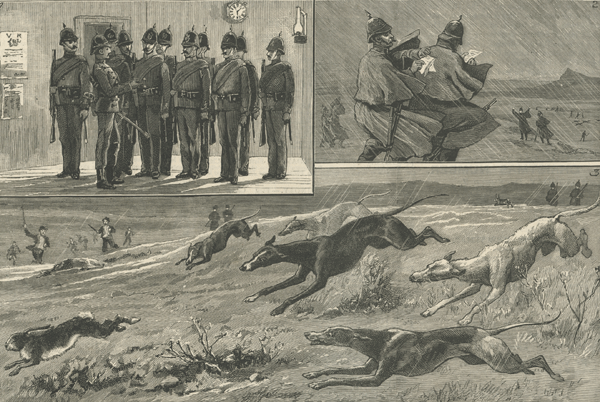
| Print collection of Maggie Land Blanck | |
| "A LEAF FROM CONSTABLE PATRICK MURPHY'S NOTE-BOOK AFTER A LAND LEAGUE HUNT NEAR BALLNAMUCK" 1. Before We start for out twenty mile Drive to Mushroom Hill We are paraded and instructed "to take Notes of all" We may see, and to prevent a Breach of Peace" 2. Taking notes with Difficulties 3. "Thirteen Hares were killed after a most enjoyable Day's Sport (!?) and in a most sportsmanlike manner (Vide Local Newspaper). Accompanying article: "These sketches may be best explained by a leaf from Constable P. Murphy's note-book: —"Left Ballynamuch at 1:30 A.M., for Mushroom Hill, to prevent Land League Hunt taking place. Twenty Irish miles. March to the mountain. Crowd assembled with dogs. Men all armed with bludgeons. We are 'to prevent a breach of the peace, and to take notes of all we see.' Begor, we'd want a powerful note-book. I wonder would it be a breach of the peace to break my rifle over the returned Yankee blagyard's head? Mem. Ask the Head when we go home. 12:30 P.M. Raining like the divil. No more note-taking. The boys have just killed a hare, after a fine course of fifty yards. There are ten dogs at it, a big fellow, for fear it would escape, gave it a 'polthogue' with a wattle. The League will have fine soup these times. It is very cold. What the divil did they send us for I'd like to know. I wish I was back in Ballynamuck again. The rain is making porridge of my notes. No whiskey, and tobacco wet!" "Land League Hunts attracted large crowd of farmers and laborers who defied the laws against poaching on the landlords land. "These nationalists hunts often turned into festive occasions with hundreds of farmers and labourers gathering near a covert or woods. After much cheering and blowing of horns, not to mention some consumption of liquid refreshments along the way, they would move of with their dogs and hunt until they had killed enough hares and rabbits for their needs. Farmers who owned horses capable of clearing a low fence or narrow ditch would often join in the chase and ride after any four-footed game". | |
|
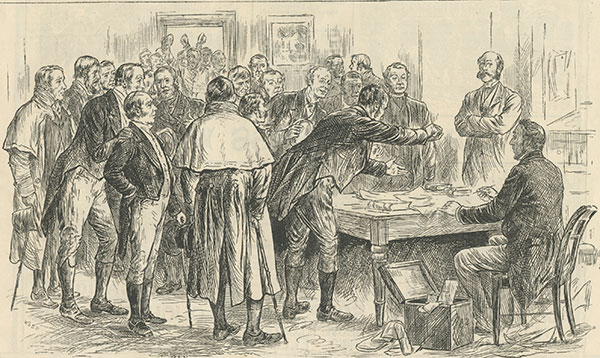
| Print collection of Maggie Land Blanck, 2012, Illustrated London News March 20, 1886
BOYCOTTING IN IRELAND: REFUSING THE RENT |
|
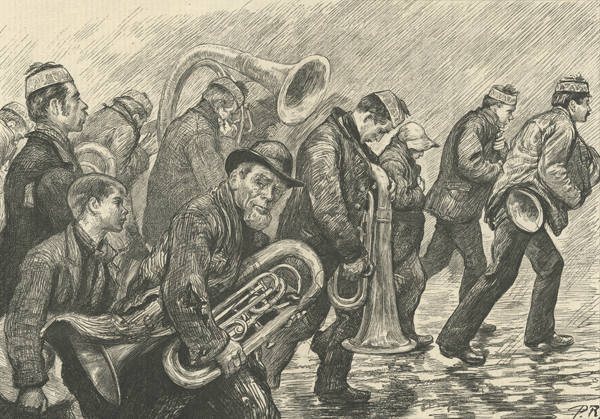
| Print collection of Maggie Land Blanck
The Graphic, March 31, 1888
"A LEAGUE BAND IN THE RAIN" Brass bands played at Land League meetings, evictions and havestings: Ballinrobe, Ballintubber, Ballyroan Brass Band , Ballyshannon, Claremorris Brass Band and more.
"...the Land League band turned out, playing round the town, and collecting the young and fiery spirits of the locality." |
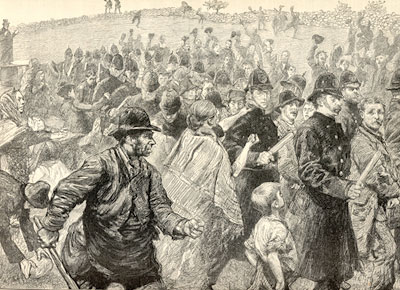
|
"Sketches in the West of Ireland- Arrests at a "Proclaimed" Meeting" From Harper's Weekly, March 24, 1888
|
| Print collection of Maggie Land Blanck
| |
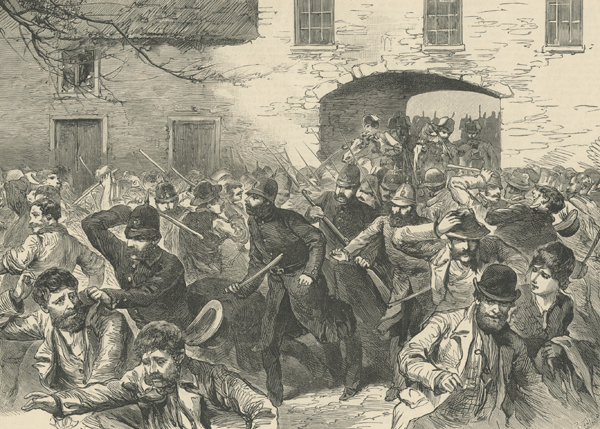
|
| Print collection of Maggie Land Blanck "POLICE AND HUSSARS CHARGING THE PROCLAIMED MEETING AT ENNIS; SCENE IN THE COURTYARD" The Illustrated London News, April 21, 1888
This image and the image that follows were on the same page of the Illustrated London News of April 21, 1888
|
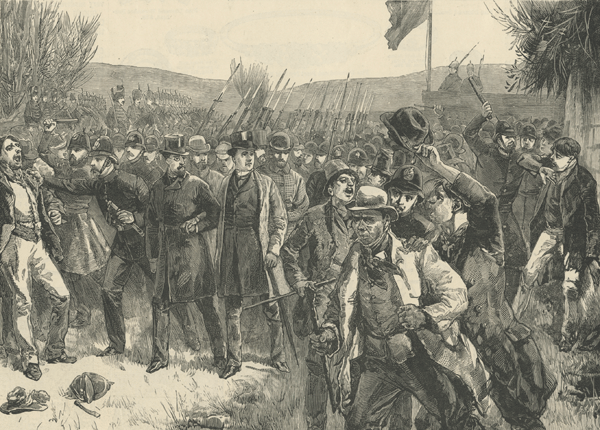
|
| Print collection of Maggie Land Blanck "DISPERSING THE NATIONAL LEAGUE MEETING AT LOUGHREA The Illustrated London News, April 21, 1888 In protest to a Coercion Act*: William O'Brien "called a public meeting at Loughrea, which was perhaps the best proclaimed district in Ireland. An enormous crowd attended the meting from all parts of the County of Galway. But an army of soldiers and constabulary was poured into the town, the demonstration was proclaimed and suppressed.* Coercion Acts were emergency acts of Parliament passed in an attempt to maintain order in Ireland. Over 100 were passed between 1801 and 1922.
"Meanwhile the Coercion Act has been further employed as an engine of oppression in the hopes of quelling the spirit of the tenants by imprisoning their leading men. On Agpril 8 another great meeting was held at Loughrea.........the people attended in vast multitudes, all with the National League cards in their hats.The Government proclaimed the meeting and endeavored to suppress and disperse it, but did not succeed in preventing Mr. O'Brien making his speech to a subsidiary meeting. |
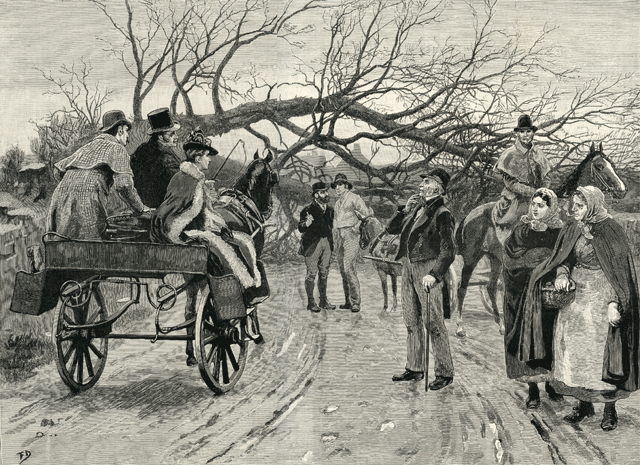
|
| Print collection of Maggie Land Blanck |
| THE GRAPHIC May 17, 1890 "Obstruction — Scene in a disturbed district in Ireland"
|
|
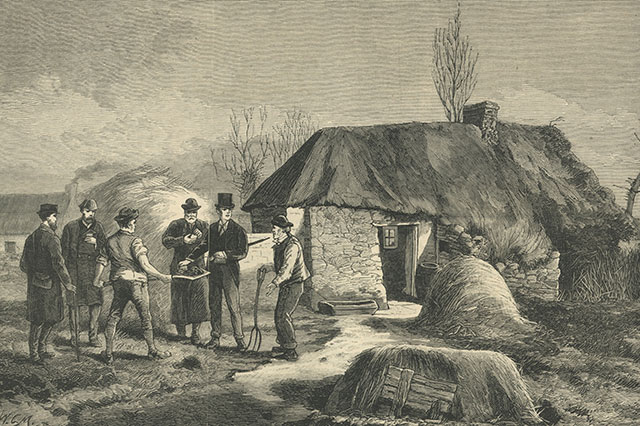
| Print collection of Maggie Land Blanck, 2012 THE CRISIS IN IRELAND - LAND COMMISSIONERS INSPECTING A HOLDING NEAR LIMERICK The Land Commission was established to make loans from public funds so tenants could buy their farms from the former landlords. In this image four well dressed gentlemen are inspection the premises and more importantly the actual soil itself. The one farmer is holding a shovel full of dirt. |
|
Hard Times in 1891 The most famous of the hard times in Ireland was the "Great Famine" of the mid 1840s. However, famine was a continuous issue in Ireland.
|
|
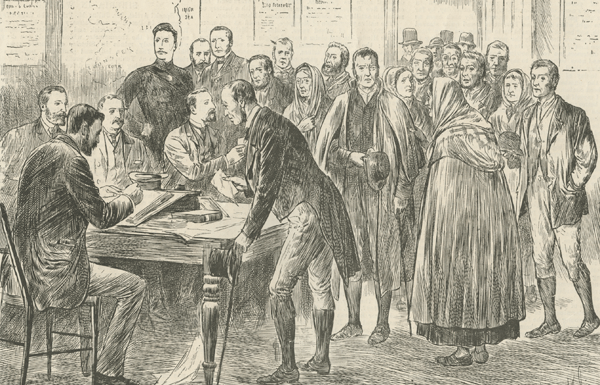
| Print collection of Maggie Land Blanck "RELIEF OF IRISH DISTRESS; APPLYING FOR SEED POTATOES AT THE BOARD, CLONAKILTY UNION Publication and date unknown. 1891 based on an article on back of image - Richard Lefevre Blunt new Bishop of Hull.
Most of the accompanying article about the "seed potatoes" is missing. However, enough remains to indicate that the distribution of seed potatoes was the responsibility of the local poor-law union. Clonakilty is is west County Cork, Ireland. In February 1891 the Local Government Board reported: "Apart from the potato crop, the small farmers are well circumstanced, but they are confronted with a greater scarcity of potatoes than they have experienced for over thirty years and this fact will cause distress in each locality according to the extent to which the people rely for sustenance upon potatoes......Much of the west of Ireland was still dependent on the potato in 1891.
|
| The Land Issues as Related in Part by Frank Leslie's Magazine, April 1880 Frank Leslie April 1880
In 1845 (the year immediately preceding the famine) the population was at the highest point it attained during the present century, and probably the highest it ever reached. It was estimated at 8,295,061. In 1847, the year when the famine was at its height, the numbers are given as 8,025,274. In 1875, just thirty years after the maximum, the numbers had fallen to 5,309,494. In 1877 they were estimated at 5,338,900, showing an increase over 1875 of 29,412. |
|
The Gombeen Man A kind of rural Irish loan shark, the Gombeen man was a moneylender who charged exorbitant interest. The word comes from the Irish gaimbin = usury. "Once a farmer gets into debt with the gombeen man he seldom gets free from the big man's clutches"A history of the Irish Parliamentary party ..., Volume 2 By Frank Hugh O'Donnell, 1910 discribed the gombeen-man as "the universal usurer, the shopkeeper who sells on credit, and does not like to sell for ready money, because his main profit comes from keeping his customers in debt." And further: "He is the curse and vampire of the countryside." and "He is the most liberal doner to all Chruch objects." and "Better sometimes quarrel with the priest than with the gombeen-man". It was claimed that about 25% of drinking establisments, groceries and general stores were run by gombeen men.
| |
|
Tobacco, sugar, coffin nails, The gombeen like a spider sits, Surfeited; and, for all his wits, As meagre as the tally-board, On which his usuries are scored. Joseph Campbell, The Gombeen Man
|
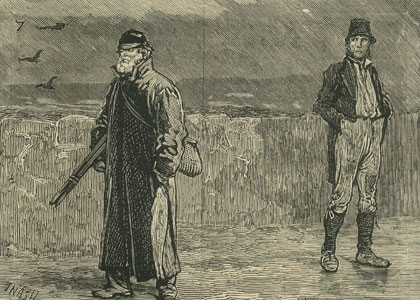
|
"The Gombeen Man"
|
| The Graphic, December 11, 1880. Print collection of
Maggie Land Blanck
| |
| Patrick J. B. Daly, solicitor, (c 1850-) Patrick John Bernard Daly was a wellknown solicitor in co. Mayo who was employed by the Land League to defend "oppressed tenant farmers" (HANSARD'S PARALIAMENTARY DEBATES). 1877: Patrick J. B. Daly, Applicant's Attorney, 1 Merchants Quay, Dublin and Ballinrobe co. Mayo (Ballinrobe Chronicle) 1881: Thom's Directory of Ireland Daly, Patrick J. B. solicitor 52 Abbey street, middle, Ballinrobe 1885: January 73, at St. Patrick's, Ballinrobe, the wife of Patrick J. B. Daly, solicitor, of a son. 1887: Birth, March 22 at St. Patrick's Ballinrobe, County Mayo, to Patrick J.B. Daly, solicitor, and his wife, a daughter was born. 1899: June 7, at Eyre Square, Galway, Death Mary Margaret, eldest daughter of Patrick J. B. Daly solicitor (The Irish Law Times and Solicitors' Journal, Volume 33) 1889: Patrick J. B. Daly testified that he was a solicitor admitted to the bar in 1874, had lived in Ballinrobe up to 1888, and in 1889 was living in Galway. While living in Ballinrobe he had defended:
When questioned he stated that he had also been the solicitor for:
He stated that the Land League was weak in Ballinrobe in 1879 and 1880. He could not remember that anyone was convicted except in the Huddy case. The Times (London) February 2, 1889 Other testimony in inquiries concerning the Land League show that Mr. Daly was the solicitor for Mr. Fitzmaurice who was prosecuted at Castlebar for interfering with the process servers on the Boycott property. 1901: Eyre Sqaure Galway City: Daly Patrick M 50 Male, married, Head of Family Catholic, solicitor, Irish English speaker, born Galway, Daly Mana E 72 Female Mother Catholic, mother, widow, English speaker, Daly Bard J 17 Male Son Catholic, son medical student, English speaker, Goos Anne 72 Female Visitor, Catholic, single, Lordam Bridget 18 Female Spinster, Servant Catholic, single, 1911: Daly Patrick John Bernard 60 Male Head of Family Roman Catholic, solicitor, widowed, Irish English speaker, Greally Mary 34 Female Servant Roman Catholic, English only |
| The Land Reclaimed By The Irish | |
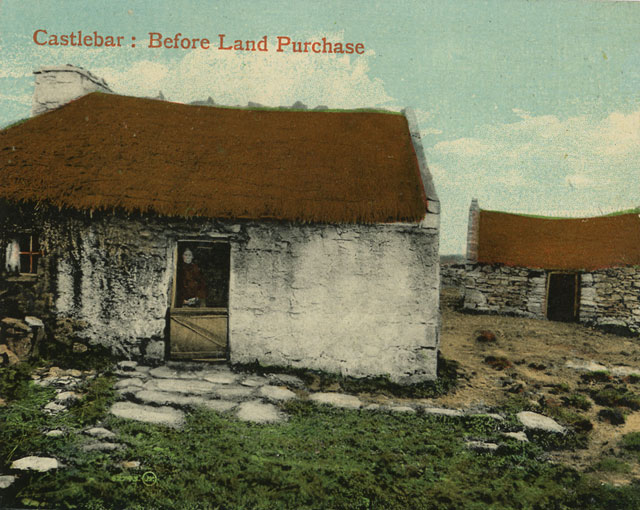
| |
| Postcard collection of
Maggie Land Blanck
| |
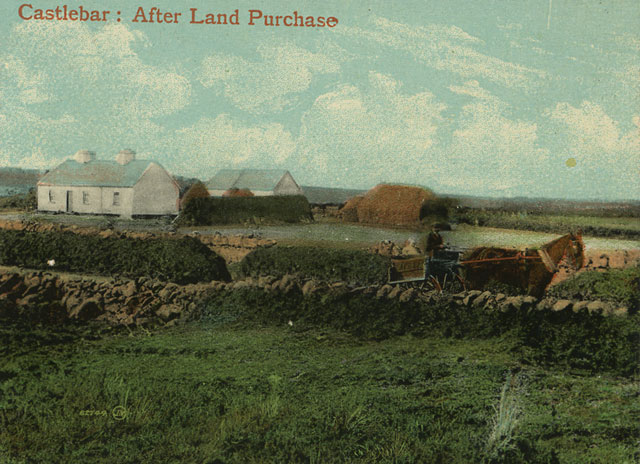
| |
| Postcard collection of
Maggie Land Blanck The above two images are from one postcard that shows a before and after picture of the same area in Castlebar. After centuries of oppression by English landlords the Irish peasant began to gain control of the land through a series of Acts that allowed them to purchase the land they had been living on:
By 1921 two-thirds of land was in the hands of Irish tenants.
| |
| If you have any suggestions, corrections, information, copies of documents, or photos that you would like to share with this page, please contact me at maggie@maggieblanck.com |
| Eviction | |||
| The Boycott Incident | |||
| Land League | |||
| Landlords | |||
| Religion | |||
| Ballinrobe | JOHN WALSH | ||
| MATHIAS LANGAN | |||
| WALSH/LANGANS INTRODUCTION | |||
| HOME PAGE | |||
| Irish Life | |||
| ©Maggie Land Blanck page created 2004 latest update, October 2015 |