|
|
| WALSH/LANGAN INTRODUCTION - HOME |
| The People
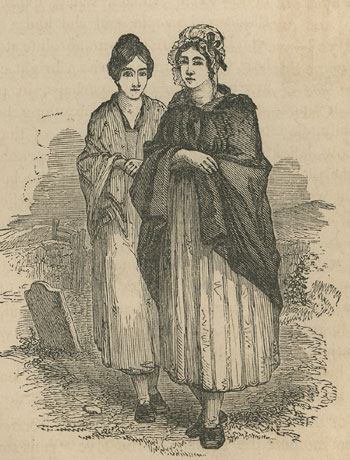
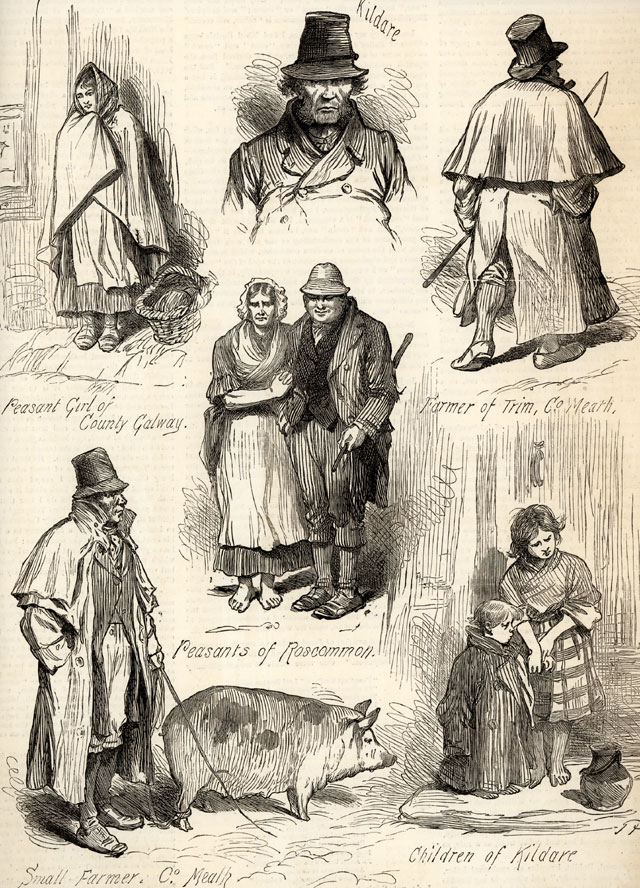
The earliest sketches I have for the peasant in Ireland are from the famine year of 1847 (see 1847 Famine Pictures ). The next dated image is from 1874 (see Emigration ). I have a lot of images from 1880 to at least the turn of the century. These images show that there was not much change in the attire of the Irish peasant. Be sure to also look at what everyone was wearing on the following pages: Famine 1880 , Irish Peasant 1897 , Turf, Land Issues, and Transportation While women's skirts appear to have become a little shorter over time, there is little other change in their attire. They wore full long skirts over petticoats sometimes with an apron on top. Their petticoats were frequently died a bright red. Red petticoats were frequently mentioned by travelers in Ireland. For warmth women wore capes and shawls. Hear covering include kerchiefs and occasionally a bonnet. Women are frequently seen bare footed. Men wore either straight-legged paints or knee britches and almost always have on clogs or boots. There was a wide range of types of hats and caps for men and boys. Women and children are frequently barefooted even when the weather appears to be quite cold, see bottom of this page. "POVERTY IN IRELAND
A Description Of The Irish Peasants Near Ballinrobe In 1870
"There was no denying that "in those days we looked on our tenants as animals, and they looked on us as kings." They lived in hovels, and came twice a year to pay their rent, taking out of their tall hats banknotes dirty with sweat and soil. Most of them could not speak English, and when he was a child, George recalled always having been afraid of them: he used to run into the woods when he saw the women coming up from Derrynanny with the men's dinners. On Sundays at the Carnacun chapel the family in its carriage would pass by the men in knee breeches, frieze coats, and stovepipe hats; inside the church, the men sat on one side, the women hiding their faces behind shawls on the other, while from the family pew the boy stared down on a grinning dwarf, a blind girl, and other people strange in the young master's eyes. During the sermon Father James Browne threatened them all in Irish with hellfire, making the women fall to knees and beat their breasts. GM claimed to have wondered what would happen should they meet their tenants in heaven: would the men doff their hats, and say, "Long life to yer honor?" Would the women curtsey? In the days after the funeral, they paid the heir all respects; indeed, he mischievously boasted that a woman came to the door with a donkey, laden with two creels of chickens, and her daughter, shyly hiding behind a shawl. Both the girl and the birds were an offering to the new master of Moore Hall, but he had seen, Moore later wrote, the women of London with their kits off, as painted by his uncle Jim Browne, and would have none of the shy girl. In contrast to his father's remarkable identification with his Catholic tenants, George Moore confessed that he felt for them only bewilderment, fear, and repulsion.George Moore of Moore Hall: "Moore's literary output is diverse: A Mummer's Wife (1885), A Drama in Muslin (1886), Esther Waters, (in print since its first edition in 1894, dramatised and filmed), and the short stories of The Untilled Field (1903), are moderately well-known; his ground-breaking, autobiographical Hail and Farewell (1914) created significant aftershocks in Dublin social and literary circles, and so irritated W.B.Yeats that he saved his retaliation until after Moore's death twenty years later."The Moores lived at Moore Hall atop a wooded hill in the Barony of Carra. It was located on the south side of the parish of Ballyhean on the upper end of Lough Carra below the Partry Mountains 6 miles north of Ballinrobe, west of Claremorris and south of Castlebar. It is now in ruins.
| |
| Women | |
|
Peasant women circa 1868
|
| From Wearing of the Green by Mrs. S. C. Hall, 1868, book collection of Maggie Land Blanck | |
|
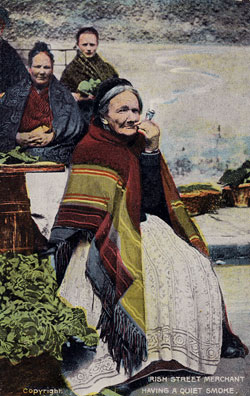
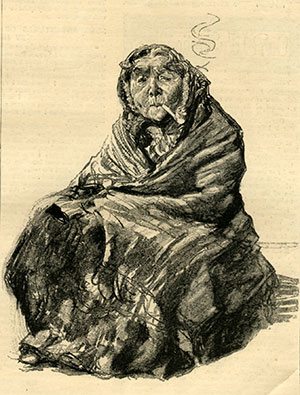
"Irish Street Merchant Having a Quite Smoke"
My dad, Bud Land, always used to tease my mother, Agnes Goehle, about her Irish grandmother who smoked a pipe. No postmark Irish women smoking was a rather frequent image in "sketches" and on postcards. |
| Postcard collection of Maggie Land Blanck | |
|
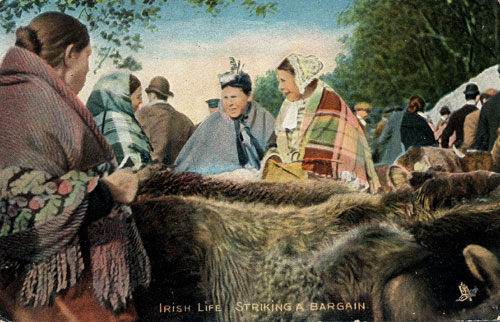
"Irish life striking a bargain"
Post marked 1906 |
| Postcard collection of Maggie Land Blanck | |
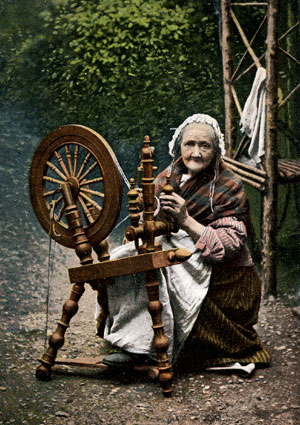
| "Irish Spinning Wheel"
There is no date on this postcard, however, the same picture is in Stoddard's Lectures on Ireland which are dated 1901 |
| Postcard collection of Maggie Land Blanck | |
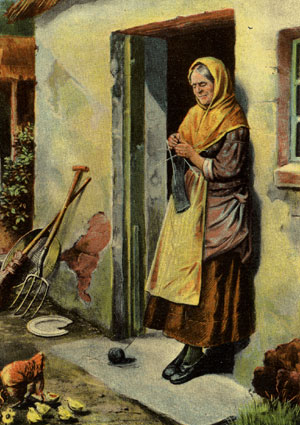
| "Irish Peasant"
Not dated |
| Postcard collection of Maggie Land Blanck | |
|
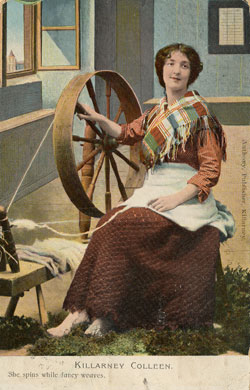
"Killarney Colleen,
She spins while fancy weaves"
No postmark |
| Postcard collection of Maggie Land Blanck
| |
|
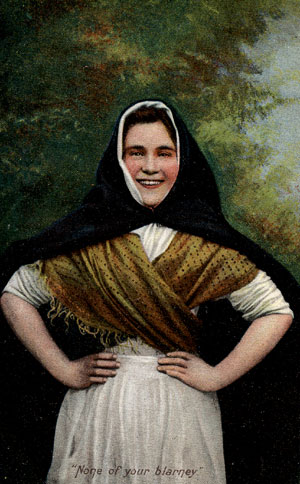
"None of your blarney"
No postmark |
| Postcard collection of Maggie Land Blanck
| |
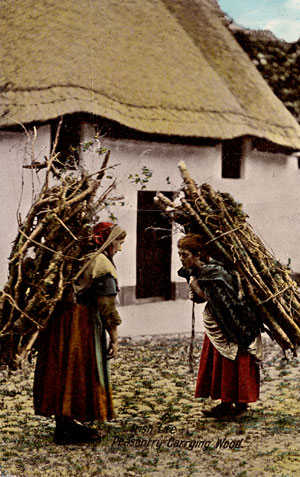
| "Irish life, peasant carrying wood"
No postmark |
| Postcard collection of Maggie Land Blanck | |
|
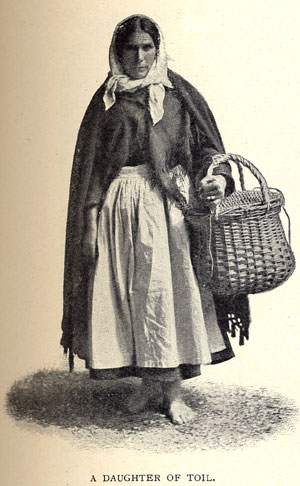
"A daughter of toil"
|
| Stoddard lectures Ireland, 1901 | |
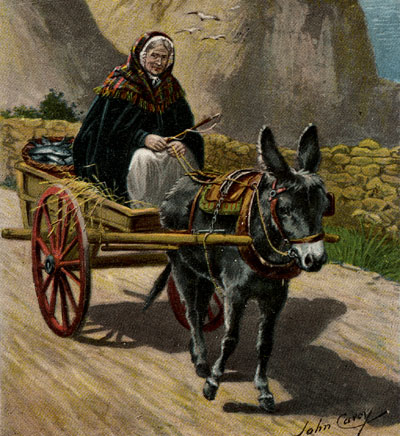
| "My donkey an' me"
Postmarked 1904 |
| Postcard collection of Maggie Land Blanck | |
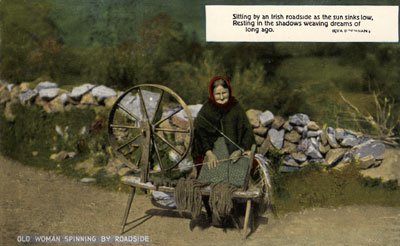
| Old Woman Spinning By Roadside
|
|
Postcard collection of Maggie Land Blanck
This postcard "was sent to Alfred Haddon from Belfast on 9 July 1931 by the photographer of the image. The message reads "Hows this for ethnog?" | |
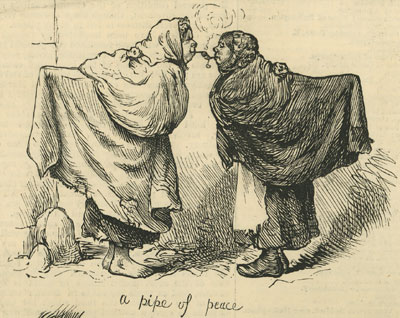
| These women are wearing their capes over baskets hence the odd shape of their backs. Notice the drawing was done in February (and it is certainly cold enough to be wrapped up) yet the one woman is bare footed. |
| The Illustrated London News, February 21, 1880. Print collection of
Maggie Land Blanck
| |
| 
|
| Postcard collection of
Maggie Land Blanck
| |
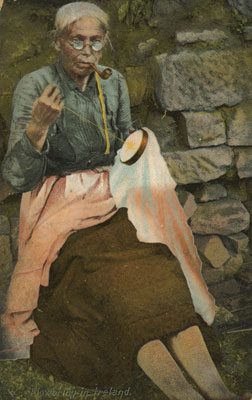
| Flowering in Ireland Posted 1906 |
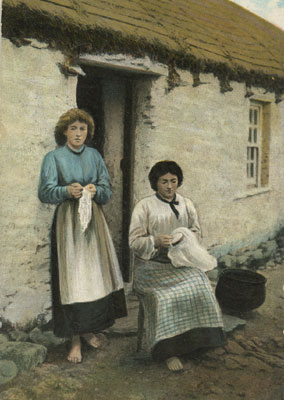
Irish cottage Industries- Sprigging and Lace Making Not posted |
| |
| Postcard collection of
Maggie Land Blanck
| |
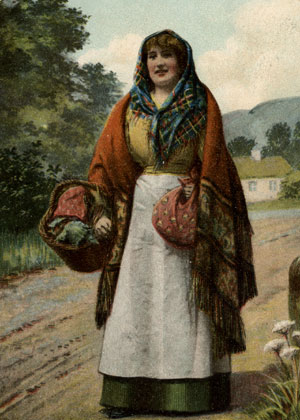
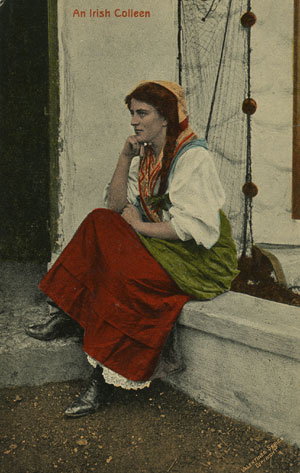
| Posted 1905 |
| Postcard collection of
Maggie Land Blanck
| |
| The Graphic February 18, 1888 |
| Print collection of
Maggie Land Blanck
| |
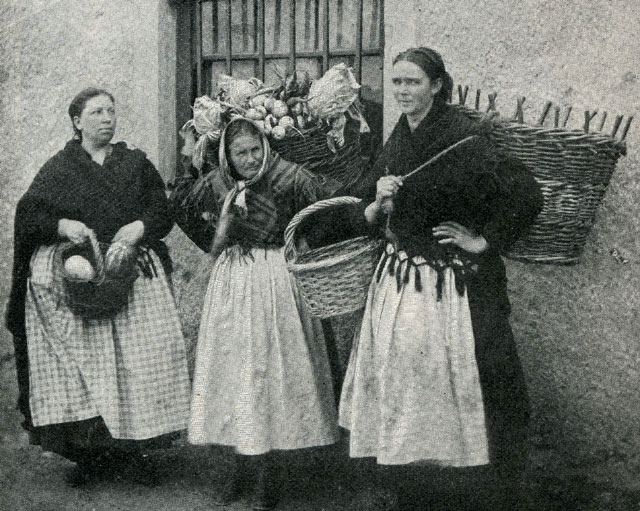 | |
| Outlook 1909, collection of Maggie Land Blanck
| |
| Men | |
|
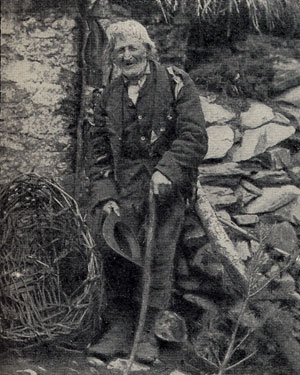
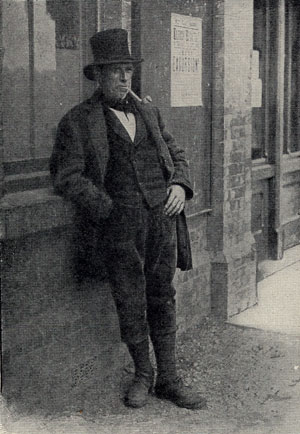
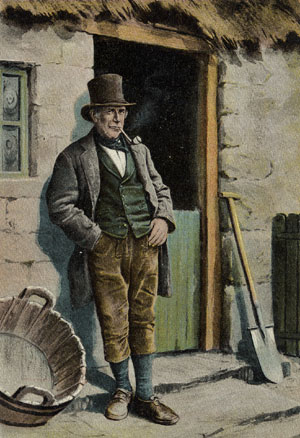
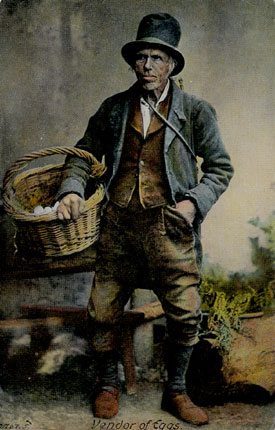
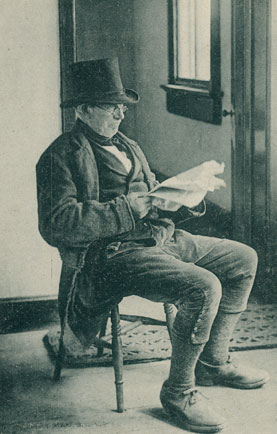
Most of the following pictures show men in tradition Irish peasant attire which included knee britches. Other images show men wearing long pants. |
| Stoddard lectures Ireland, 1901 | |
 | 
|
|
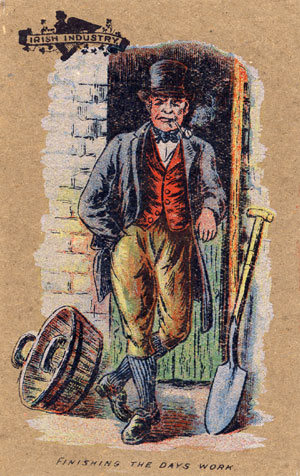
Postcard collection of Maggie Land Blanck Unlabeled on left the postcard on the right is labeled "Irish Farmer". Notice that the man is the same it is only the background that has changed between the person labeled "farmer" and his counterpart who is clearly leaning against a building in a town. . | |
| |
| Postcard collection of Maggie Land Blanck | |
|
Seated man with the paper "Irish Peasant Farmer" Man with the basket "Vendor of eggs" Man with the pitch fork "Peasant and turf stack". Click HERE for more information on "turf". | |
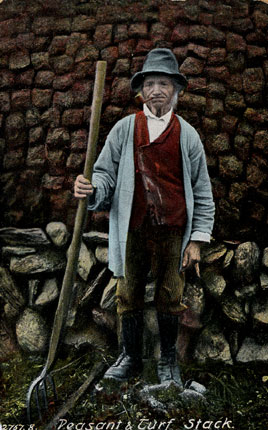
|  |
| Postcard collection of Maggie Land Blanck | |
| "Irish Farmer"
Not dated |
"Finishing the Days Work"
Posted 1908 |
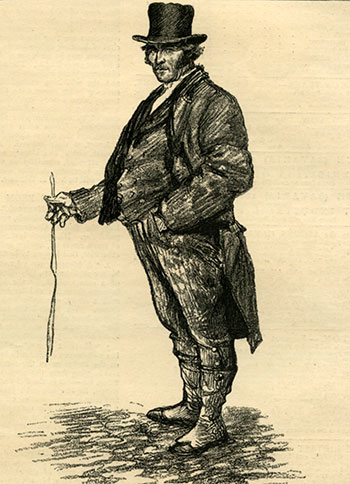
| The Graphic February 18, 1888 A Galway Farmer |
| Print collection of
Maggie Land Blanck The accompanying article stated that this "splendid specimen of an Irish farmer" wore clothes made of "grey frieze" that was common in the south west of Ireland. It was made of wool by the peasants and lasted forever. Frieze is a coarse plain woven wollen fabric with an uncut nap on one side.
| |
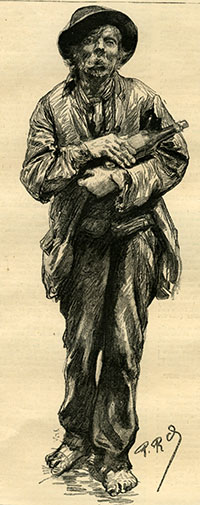
| The Graphic February 18, 1888 Wiskey |
| Print collection of
Maggie Land Blanck
| |
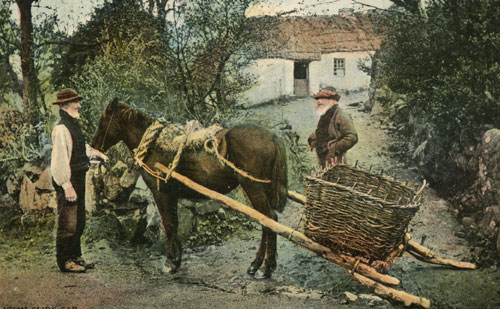
|
|
| Postcard collection of
Maggie Land Blanck
| |
| Men and Women Together | |
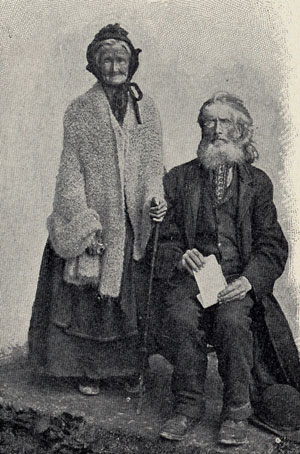
|
"Mother and son"
|
| Stoddard lectures Ireland, 1901 | |
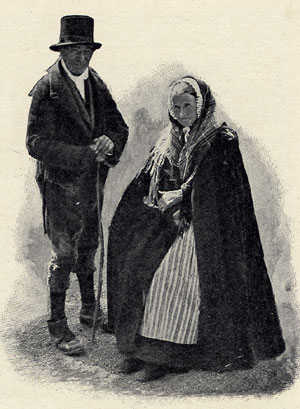
|
|
| Stoddard lectures Ireland, 1901 | |
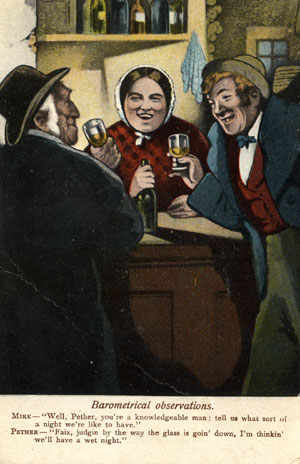
|
|
| Post card collection of Maggie Land Blanck | |
|
|
| The Illustrated London News, February 21, 1880. Print collection of
Maggie Land Blanck
| |
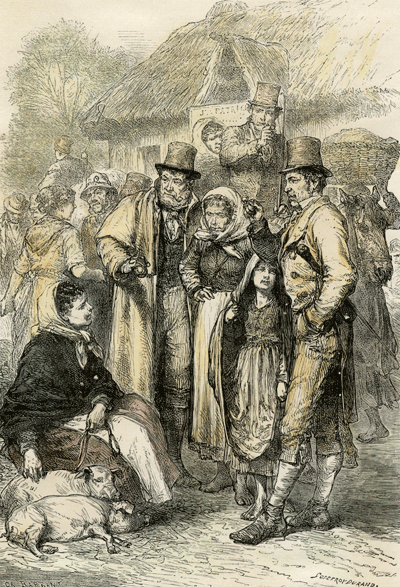
|
|
| Collection of Maggie Land Blanck No date | |
| Children | |
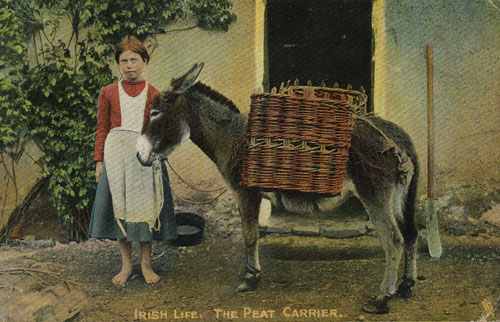
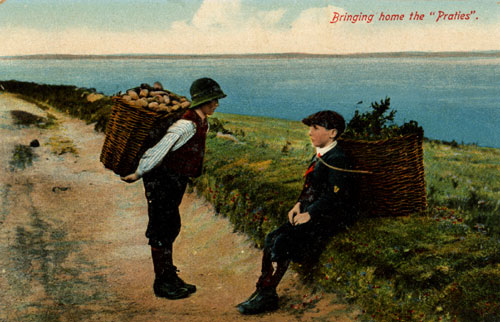
| "Irish Life The Peat Carrier""
Postmarked 1907 |
| Postcard collection of Maggie Land Blanck | |
|
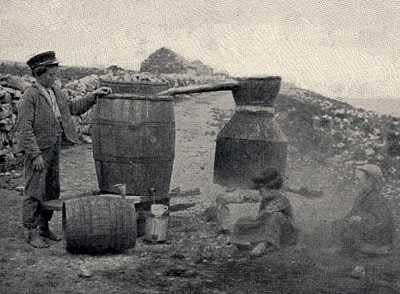
A secret still
|
| Stoddard Lectures Ireland, 1901 | |
|
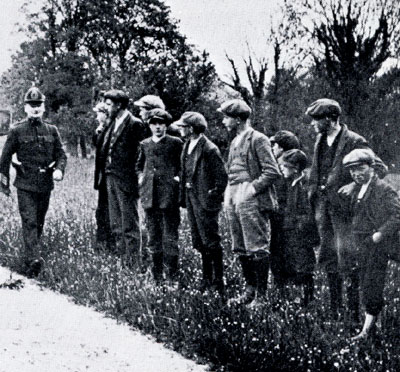
Boys watching the Royal Constabulary on eviction duty 1880
This picture is connected to the Boycott issue, so these boys must be from somewhere fairly near Ballinrobe. |
| From Captain Boycott and the Irish by Joyce Marlow | |
| |
| Stoddard lectures Ireland, 1901 | |
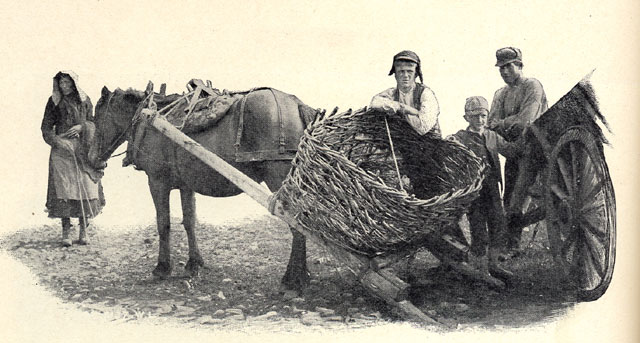
| "A low cart"
| |
| |
| Photo collection of Maggie Land Blanck | |
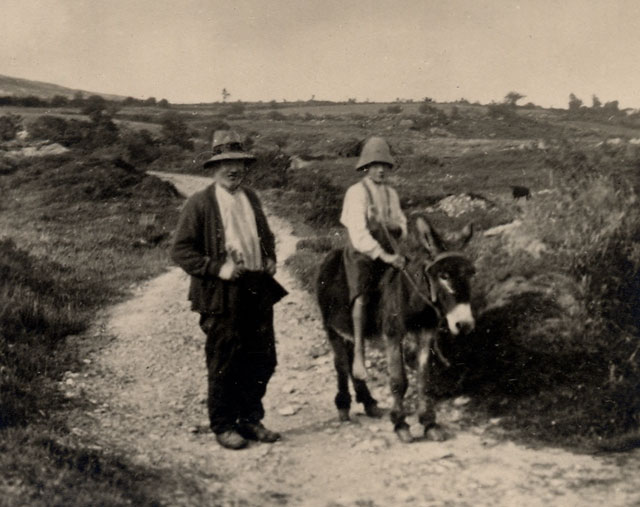
| "On an Irish mountain road"
Date unknown, most likely 1930s | |
| |
| Photo collection of Maggie Land Blanck | |
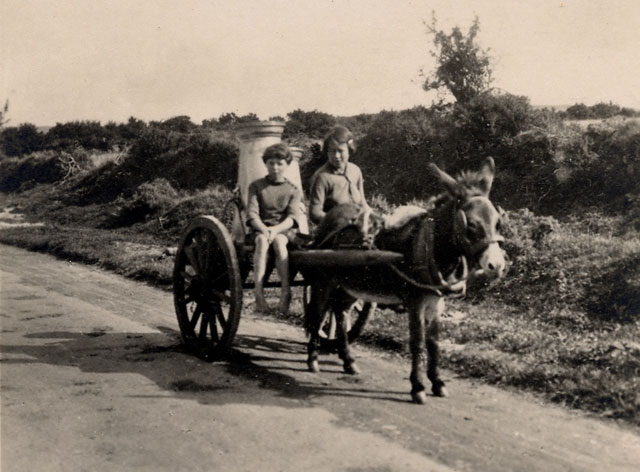
| "Going to the Creamery"
Date unknown, most likely 1930s | |
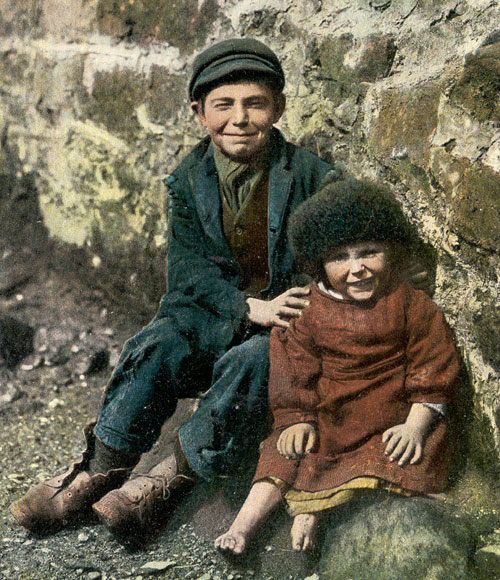
|
Young Ireland
Not posted |
| Postcard collection of Maggie Land Blanck, 2004 | |
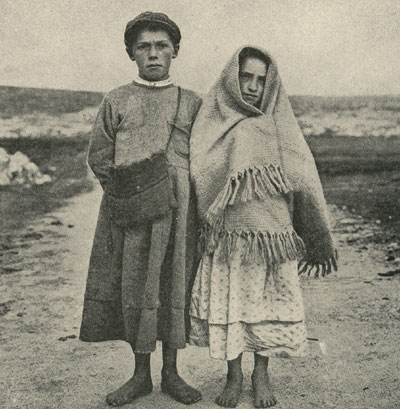
|
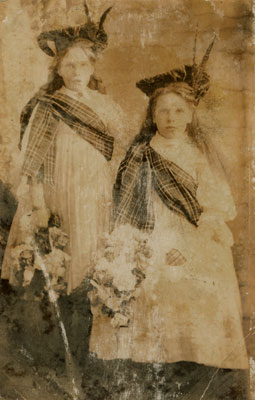
While they are both wearing dresses clearly one is male and the other is female. Unfortunately, the caption was torn. |
|
Photo collection of Maggie Land Blanck, 2004 In June 2010 John Doherty found the text that went with this image, but could not find page 2939 referred to in the caption. YOUNG IRELAND, TOUCHED TOO SOON BY EARTHLY CARE | |
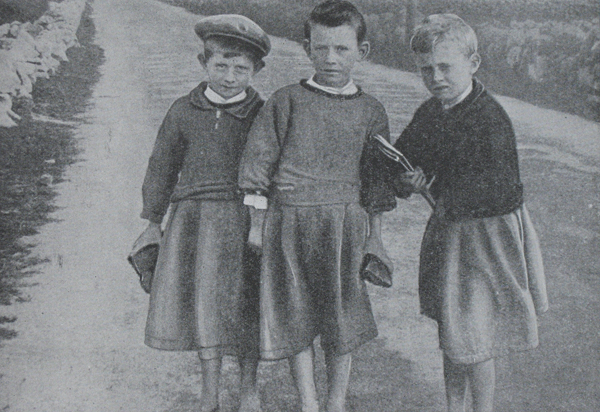
|
|
|
Photo courtesy John Doherty April 2010.
'Peoples of the World in Pictures', general editor Harold Wheeler,published by Odhams Press
Limited in 1936. In April 2010 John Doherty sent the above picture whose caption did shed some light on the subject of boys in petticoats. SCHOOL BOYS CLAD IN PETTICOATSJohn wrote: "Incidentally, my late mother, Mary told me of her youngest brother, Tom, wearing a petticoat untill he was about six years old, which was in 1926, when they lived in Ballinamona,Shrule.Dark Rosaleen: a story of Ireland today By M. E. Francis, 1917 "Children scampered in the wake of mothers and sisters—bright-eyed, picturesque youngsters, the smaller boys wearing petticoats differing in nothing from those of the little girls, being thus, according to local tradition, rendered immune from the depredations of the fairies, who, if the secret of the sex were not withheld, might spirit them away. Unpoetically-minded people suggest that the origin of the tradition lay in the fact that tailors are scarce in the neighborhood of Connemara, and that petticoats are more easily manufactured at home than trousers."It is curious that the fairies would be fooled by the skirts alone and not take into account the boyish haircuts and caps. See Religion and Alternative Believes
| |
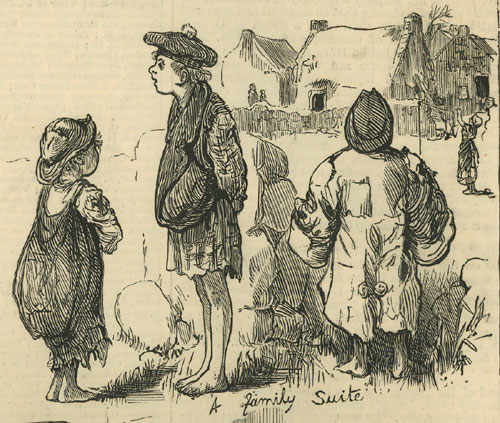
|
|
| The Illustrated London News, February 21, 1880. Print collection of
Maggie Land Blanck
| |
|
|
| Photo collection of
Maggie Land Blanck
| |
|
|
| Postcard collection of
Maggie Land Blanck
| |
| More General Images of the Irish Peasant In The West
| |
| |
| Print collection of Maggie Land Blanck, 2004 | |
| The Illustrated London News, December 4, 1880 | |
 | |
|
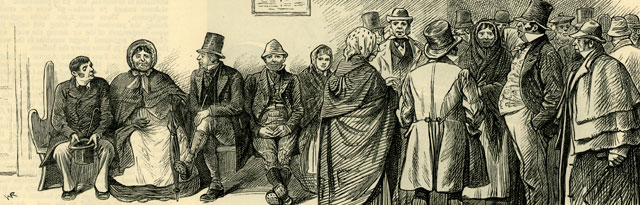
Print collection of Maggie Land Blanck The Graphic, December 3, 1881 Applicants for "Fair Rent" | |
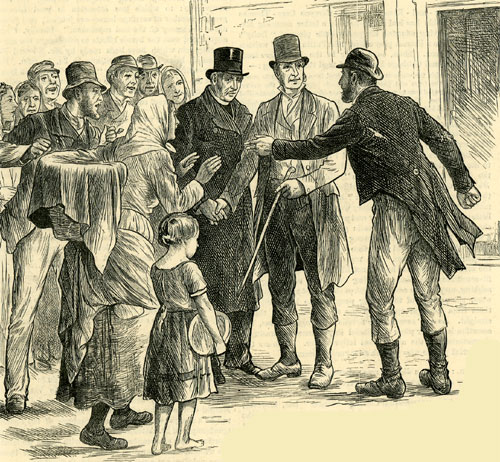 |
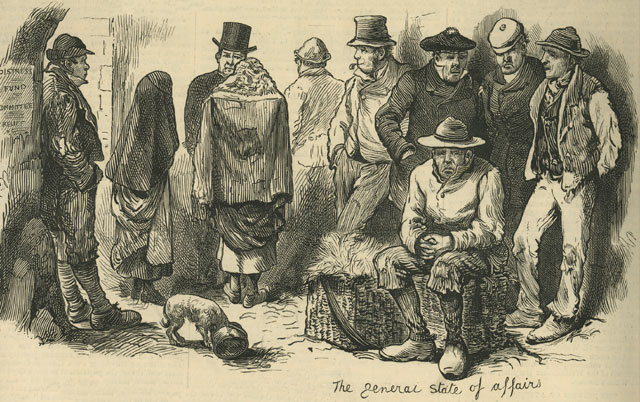
The Illustrated London News, January 14, 1882 State of Ireland |
|
Print collection of Maggie Land Blanck
| |
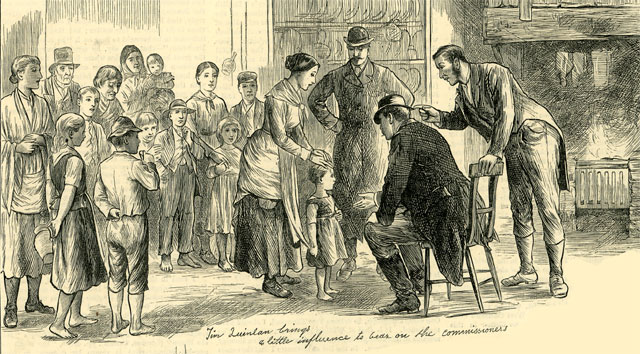 | |
|
Print collection of Maggie Land Blanck The Illustrated London News January 14, 1882 The State of Ireland | |
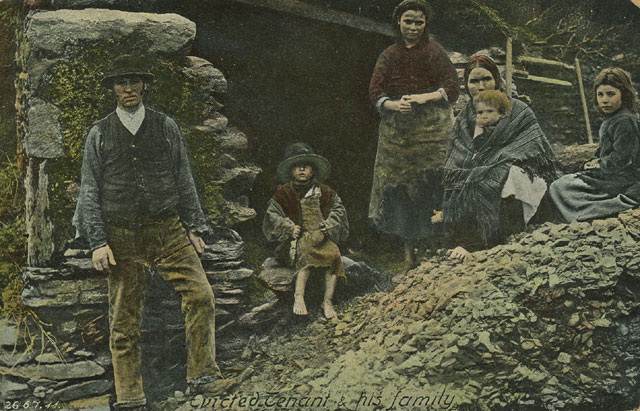
|
|
| Postcard collection of
Maggie Land Blanck
| |
|
Pig on a Leash
| |
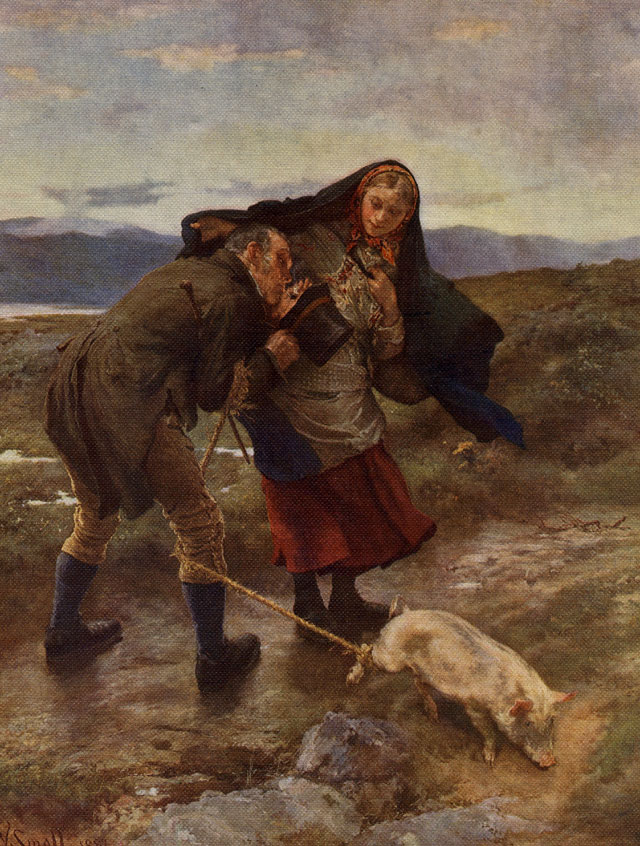
| |
| Print collection of Maggie Land Blanck
| |
| W Small, 1889
| |
|
Social Differences
| |
| |
| Print collection of Maggie Land Blanck
| |
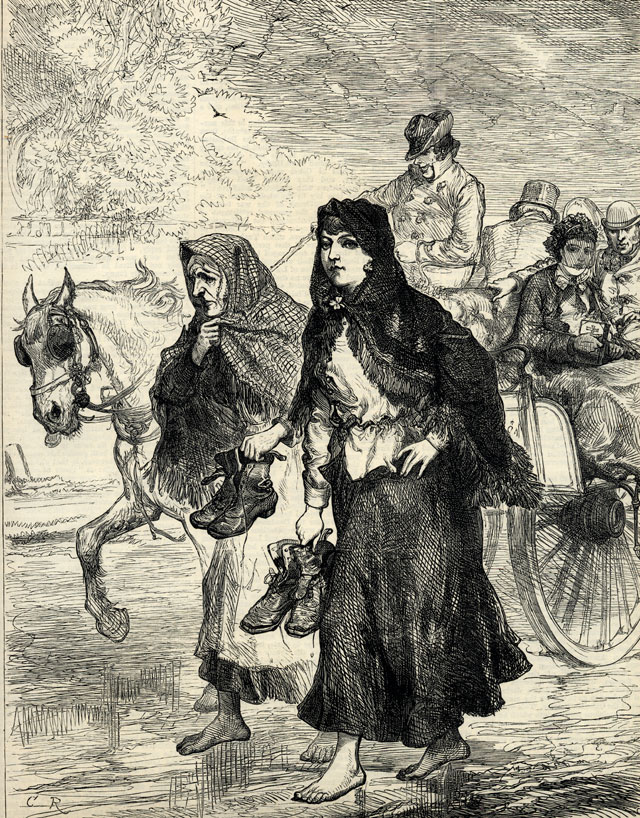
| Irish Sketches: Going to Church
From the Illustrated London News, March 27, 1880
The small article that accompanies this pictures suggests that the people in the jaunting car are the squire and his family and says: "Whether the Squire and his family be going to the same church or chapel as the two barefoot peasant women is a question that we have not the curiosity to ask; and since the Disestablishment Act of Mr. Gladstone' Ministry in 1869, which redressed a grievous political injustice and secured complete religious equality in Ireland, there is no authority but that of conscience in this affair of "Going to Church"Martha Langan Carty's Shoes Martin Langan and Ellen Moghan, both from Ballinrobe in County Mayo, Ireland married in New York City in 1897. They had two daughters, Martha born in 1898 and Helen born in 1900. Apparently Martin and Ellen had their differences. Ellen, also known as Muddy, took the two girls and retuned to Ballinrobe, probably before 1906. According to Ken and Bob Carty (the sons Martha Langan) Ellen worked in the convent of the Sisters of Mercy in Ballinrobe. She and the girls lived on Glebe Street. They returned to the sates in 1920. In her reminiscences of life in Ireland Martha Langan Carty told her sons, Ken and Bob, about what nice shoes she had. They both found it very funny that she should brag about her shoes. However, nice shoes were surely a source of pride to a little girl living in a west Mayo town. Most of the young girls and indeed many grown woman who lived in the countryside outside of Ballinrobe probably only had one pair of shoes and those shoes were more than likely not very nice by a town girls standards. Many pictures of rural Ireland show women and children without shoes even in what appears to be quite cold weather. These ladies who are on their way to church are carrying their shoes. Presumably they will put them on when they arrive at church. | |
|
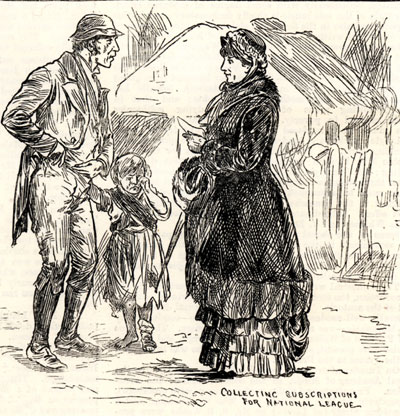
COLLECTING SUBSCRIPTIOS FOR NATION LEAGUE
The Illustrated London News, April 10, 1886
The woman is clearly of a different social standing than the tattered man and his one socked child. |
| Print collection of Maggie Land Blanck
| |
 | |
|
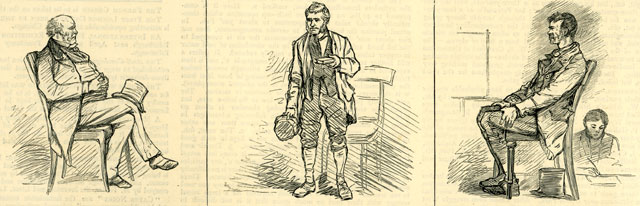
Print collection of Maggie Land Blanck The Graphic, December 3, 1881 These little sketches, entitled "A Landlord", "A Bailiff", and "A Tenant", show the difference in the physique, dress, and demeanor of the three classes connected to the land in Ireland. | |
|
Irish Men and Women
A page dedicated to Irish men and women who's names and at least a little of their history
are known.
|
| If you have any suggestions, corrections, information, copies of documents, or photos that you would like to share with this page, please contact me at maggie@maggieblanck.com |
| The Potato and Other Crops | |||
| Houses | |||
| Turf | Transportation | ||
| JOHN WALSH | |||
| MATHIAS LANGAN | |||
| WALSH/LANGANS INTRODUCTION | |||
| HOME | |||
| Irish Life | |||
| Please feel free to link to this web page. You may use images on this web page provided that you give proper acknowledgement to this web page and include the same acknowledgments that I have made to the provenance of the image. Please be judicious. Please don't use all the images. You may quote up to seventy five words of my original text from this web page and use any cited quotes on this web page provided you give proper acknowledgement to this web page and include the same acknowledgments that I have made to the provenance of the information. Please do not cut and paste the whole page. You may NOT make use any of the images or information on this web page for your personal profit. You may NOT claim any content of this web page as your original idea. Thanks, Maggie |
| This page was created in 2004: Latest update August 2013 |