| The Potato and Other Crops |
| WALSH/LANGAN INTRODUCTION - HOME |
| Potatoes | |
| The Potato, for many years the staple of the Irish peasant diet, contains a large
quantity of starch, a small amount of protein, vitamins C, B1, and riboflavin and provides
many of the daily essential nutrients.
Butter and/or buttermilk, which were eaten with the potato, provided calcium and vitamin A. The potato is a member of the nightshade family which includes other "New World" crops like tomatoes, peppers and tobacco. The potato was first brought from the Americas to Europe in 1573 and introduced to Ireland about 1590. By 1780 it was the staple of the Irish diet. The traditional Irish method of planting the potato was in "lazy beds". Low drenches were dug at about three foot intervals. The sod and dirt were piled in between the trenches. The beds were enriched with manure, rotted straw, and/or sea weed. Whole potatoes were cut into pieces so that each piece contained an eye. These seed potatoes were usually put in the ground in May. The beds were tended to keep the weeds from chocking the potato plants. The leaves and flowers of the potato plant are poisonous. The tubers themselves can be poisonous if sunlight hits them and turns them green. Consequently, during the growing season more dirt was taken from the trenches to cover the tubers and prevent them from turning green in the sunlight. Early potatoes were ready after about 100 days with a second crop in about 110-120 days. The main crop matured in about 130 days. The first two crops were harvested when the plants was still green. The main crop was harvested after the mature plant has died. In 1836 the Poor Inquiry survey determined that one acre could yield and average of 6.5 to 8.5 tons and sometimes more. One acre could feed 6 people for a year. The potatoes were stored over the winter in pits outside of the house. They did not last more than nine months before they turned bad. There were, therefore, lean months in the summer until the new crop was ready in the fall. The Potato Pit as described in Famine by Liam O'Flaherty when Brian Kilmartin discovers that his potato crop is rotten: "The old man at once dug into its end with the spade and laid bare the covering of ferns. These he hurriedly pulled aside with his hands. Then he slowly raised himself to his full height, some rotting ferns still in his hands. He stared, speechless, at the mass of corruption into which the potatoes had turned.The Irish ate potatoes 3 times a day. Reportedly men ate a total of 12-14 pounds per day. Potatoes were eaten boiled with the skin on, fried in butter or baked in the ashes. In addition to being the staple of the diet, potatoes were used to make poteen, a strong liquor. There were multiple failings of the potato crop before and after the Great Famine of 1845-1849. In 1820 bad weather in the summer and fall caused the crop to fail and people to suffer from hunger, malnourishment and in turn typhus and dysentery. In May 2017 Sean O Ceallaigh wrote: "Your description of the constancy of the potato in Irish 19th century meals reminded me of a passage in the satirical "An Béal Bocht" (The Poor Mouth) by Flann O Brien, where he claimed that the Irish terms for the three meals of the day were: "Morning potato time, midday potato time and evening potato time".See Famine
Other Foods Before the introduction of the potato, the Irish typically ate oat porridge. Other crops included wheat, cabbage and turnips. Turnips and cabbage were mashed with potatoes and stewed (colcannon). Wheat became more widespread toward the late 1700s. It was grown mainly to pay the rent and most of it was exported. Herring, cockles and other seafood were eaten by those who lived near the sea. The Irish seldom ate meat or bread. The average Irish peasant had meat and bread only once or twice a year. They did drink milk. It is impressive in Ireland in the pubs today to see grown men drinking milk. Butter and buttermilk also featured heavily in the Irish diet.
Utensils The poor man's cabin did not contain many utensils. There were perhaps a few knives and fewer forks. Food was mainly eaten with the hands. The Potato
| |
|
| |
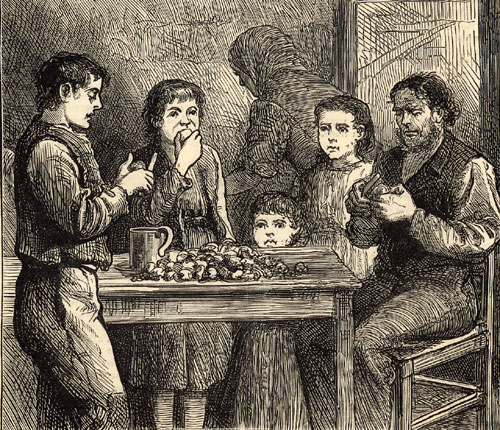
| Print collection of Maggie Land Blanck | |
| "Breakfast time", The Graphic, March 6, 1880 | |
| |
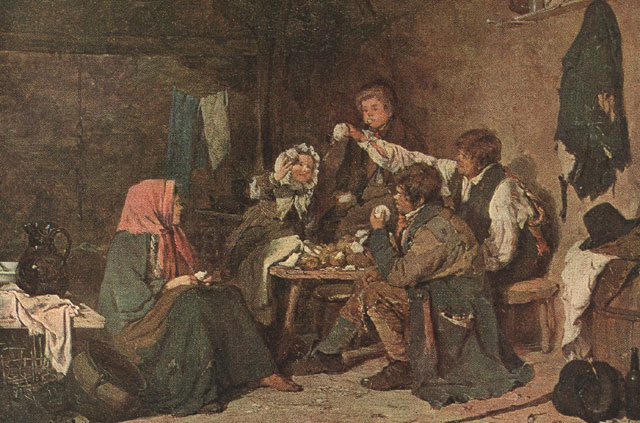
| Print from Tales of Irish Life and Character with Pictures by Erskine Nicol First Edition. Book collection of Maggie Land Blanck | |
| Praties and Point | |
| |
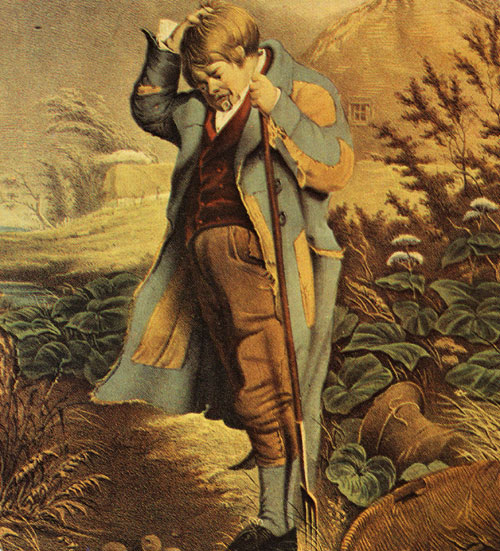
| Paper collection of Maggie Land Blanck
| |
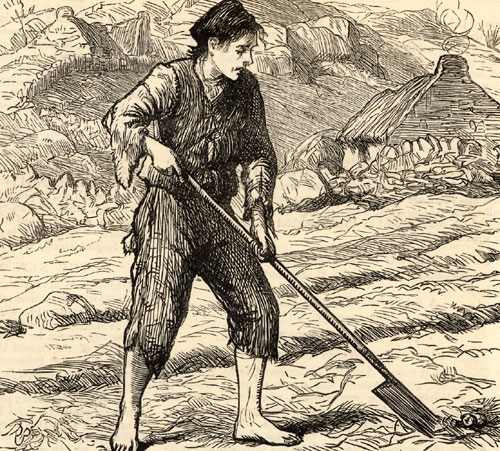
| "A poverty-stricken Irishman gathers his meager potato harvest" | |
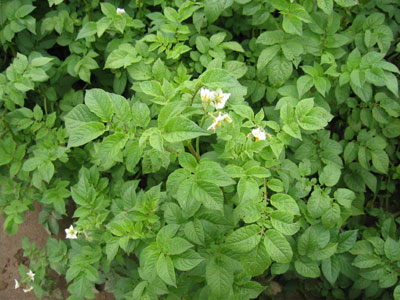
| Potato in bloom |
| Photo collection of Maggie Land Blanck | |
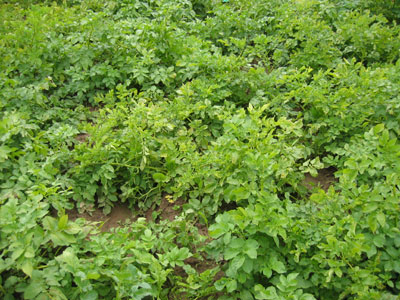
| Potato field. |
| Photo collection of Maggie Land Blanck | |
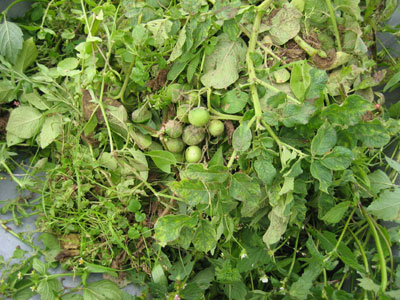
| Green potatoes that have been thinned from the potato beds. |
| Photo collection of Maggie Land Blanck | |
| ||
| Print collection of Maggie Land Blanck
| ||
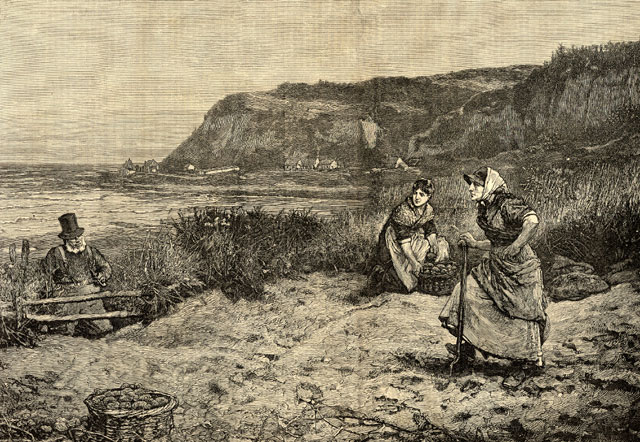
| "The Widow's Acre" From a Painting by G. H. Boughton, A.R.A. Harper's Weekly, December 6, 1879
To read the article that was published with the above print, click
HERE
| ||
| |
| Stoddard lectures Ireland, 1901 | |
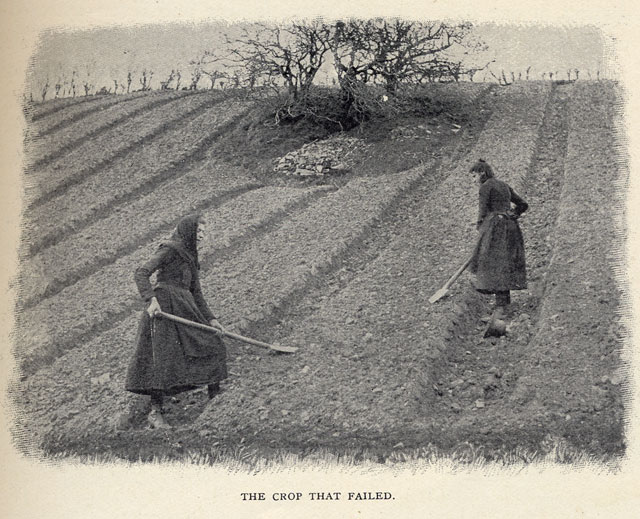
| "The crop that failed"
Women preparing the "lazy-beds". Four feet wide strips are fertilized with manure. A trench is dug on either side. In the wet climate of Ireland the trench provides drainage. The potato "seed" is planted in rows in the four feet strips. Ciaran Walsh (who is not related to the Walshes of Ballinrobe and whose family were Welsh mercenaries who settled in Kilkenny, around Ballyhale) emailed in April 2006 to say that this photo was taken by a Belfast photographer named RJ Welch and was "part of a photographic record of improvements being undertaken by the Congested Districts Board." "The women breaking clods are are the Misses McAllister, tilling their father's field near Terioch Post Office, Armoy, Co. Antrim. The original glass plate is held in the Ulster Museum." | |
| |
| print collection Maggie Land Blanck | |
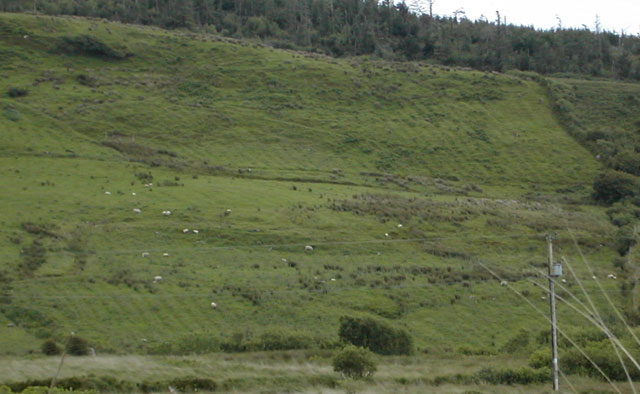
| Another image of the lazy beds from The Graphic , March 6, 1880 | |
| |
| Photo collection of Maggie Land Blanck, June 2004
| |
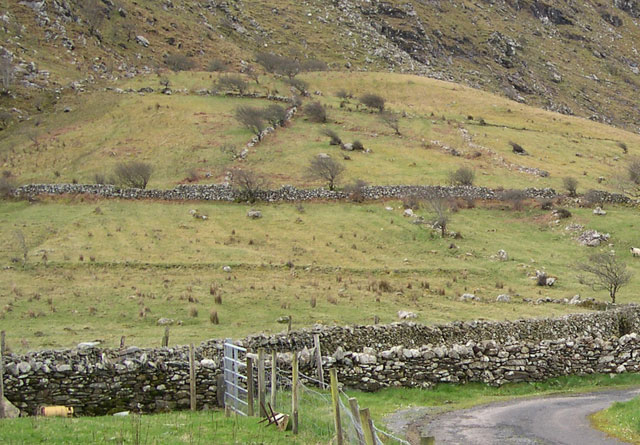
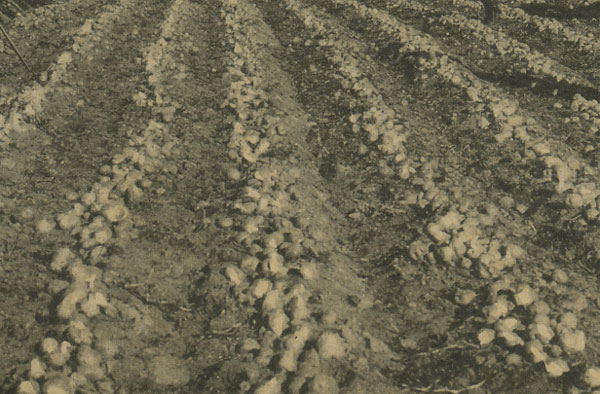
| The ridges visible in this photo (particularly at the top right and lower left) are the remnants of the lazy beds. | |
| |
| Photo Ed Land, March 2005
| |
| Another image of the remnants of the lazy beds. | |
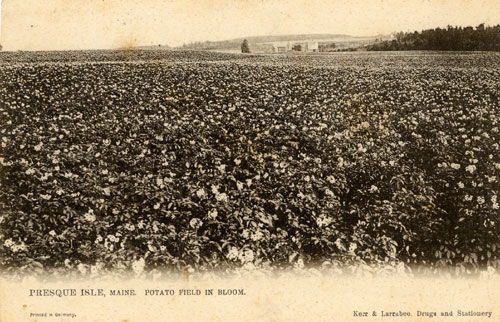
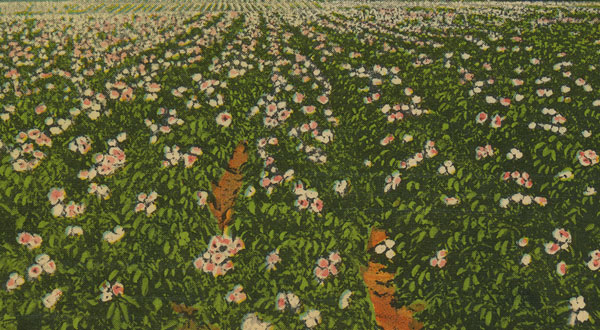
| Potato fields in bloom in, Maine; I have not been able to find any pictures of the potato fields in bloom in Ireland. | |
| |
| Postcard collection of Maggie Land Blanck, June 2004 Description of the potato fields in bloom from The Famine by Liam O'Flaherty. .....the potato plants grew to an enormous sized and their luxuriant foliage, dotted with beautiful white and pink blossoms, made Black Valley look like a flower garden. | |
| |
| Postcard collection of Maggie Land Blanck, June 2004 | |
|
| Postcard collection of Maggie Land Blanck
|
| Potato digging in Maine. Again I cannot find any images of the potato crop in Ireland.
|
| |
| Print collection of
Maggie Land Blanck, Great Britain and Ireland
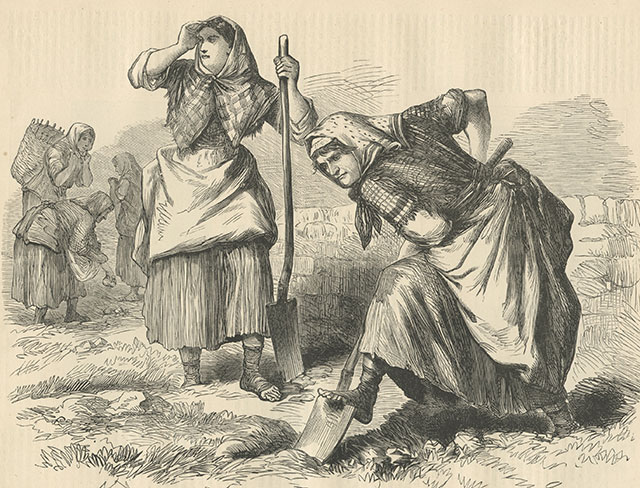
WOMEN DIGGING A FIELD FOR A CROP OF POTATOES IN THE HUNDRED-ACRE BOG, ROSCOMMON COUNTY, IRELAND
| |
| |
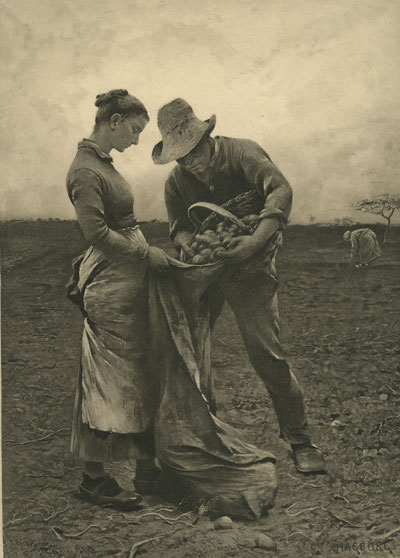
| Agust Hagborg (1852-1925) Print collection of
Maggie Land Blanck August Hagborg was a Swedish artist so this most likely represents a potato harvest in Sweden. | |
|
| Print collection of Maggie Land Blanck
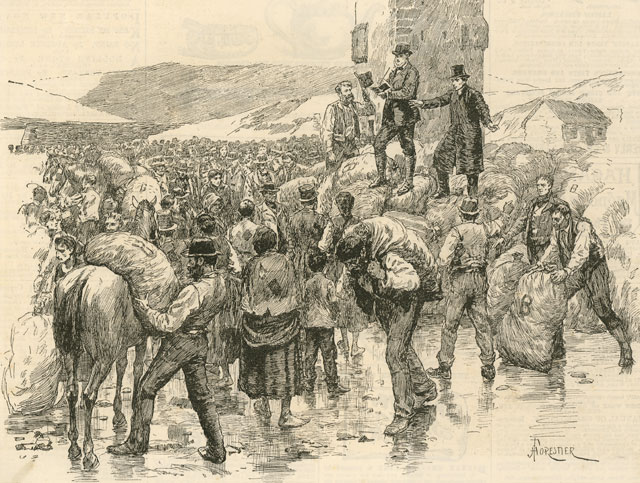
DISTRIBUTING SACKS OF SEED POTATOES IN CLARE ISLAND
The Illustrated London News, April 24, 1886
"In the whole of Ireland, there are 538,000 poor tenants of very small holdings whose average rent is under £6, and this means nearly three millions of human beings dependent for subsistence on the precarious crops of potatoes and oats, or rye in some places, grown in those western districts from the poorest soil, among bogs and rocks, where a bad season, like that of last year reduces them to positive starvation.The potatoes being distributed in this scene are "seed" potatoes. Hopefully they were not eaten by the starving population but planted for the next year's crop. |
|
| Print collection of Maggie Land Blanck
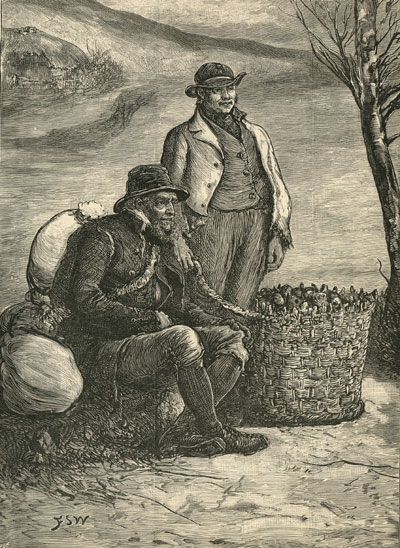
CARRY HOME SEED POTATOES
The Illustrated London News, April 28, 1888
|
|
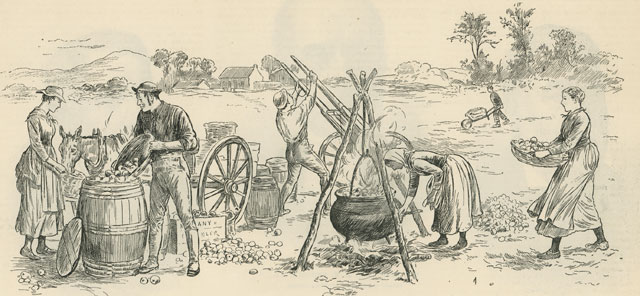
| Print collection of Maggie Land Blanck Boiling and packing partially diseased tubers, THE ILLUSTRATED LONDON TIMES October 25, 1890 |
|
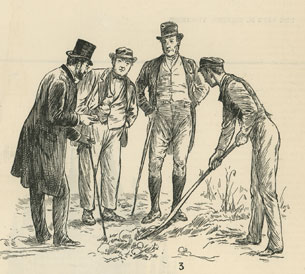
|
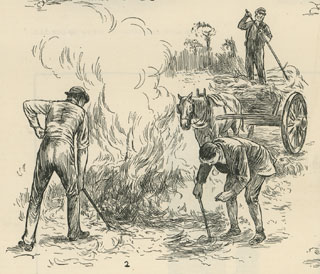
| Print collection of Maggie Land Blanck Burning Stalks and Poor Law Inspection: Investigating Potato Blight, THE ILLUSTRATED LONDON TIMES October 25, 1890 | |
|
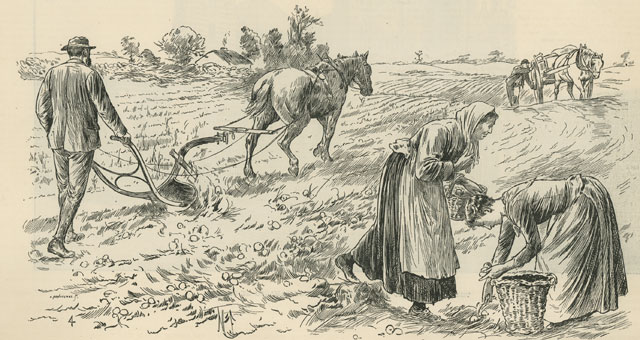
| Print collection of Maggie Land Blanck Ploughing Out Potatoes, THE ILLUSTRATED LONDON TIMES October 25, 1890 |
| |
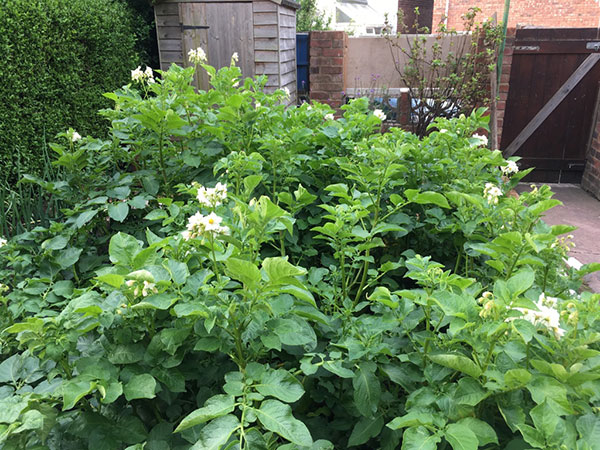
| Photo by William Collins July 2019 In July 2019 William collins wrote: "I grew a crop of Lumpers in my back garden this year just to see what the land would have looked like in early summer 1846. The flowers smelled lovely, must have been quite a sight when the whole countryside was in full bloom." | |
|
|
| |
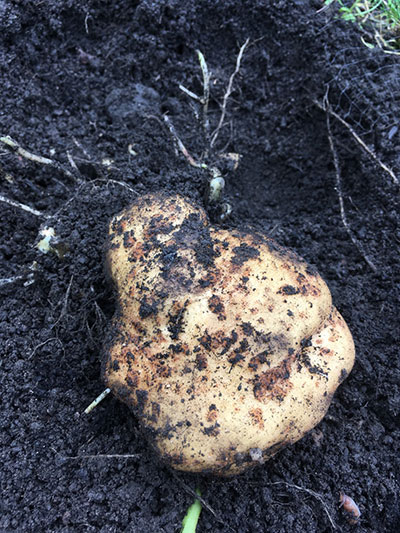
| Photo by William Collins July 2019
| |
|
|
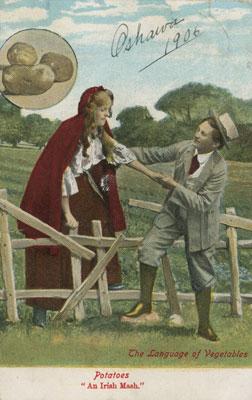
Potatoes
"An Irish Mash"
 |
Poteen
|
|
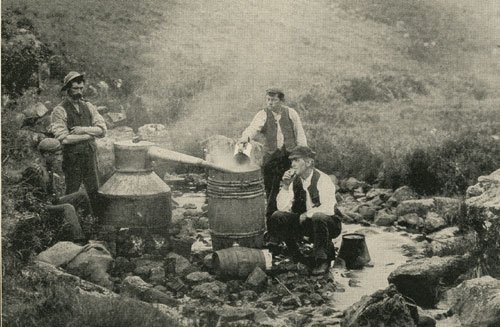
Photo collection of Maggie Land Blanck
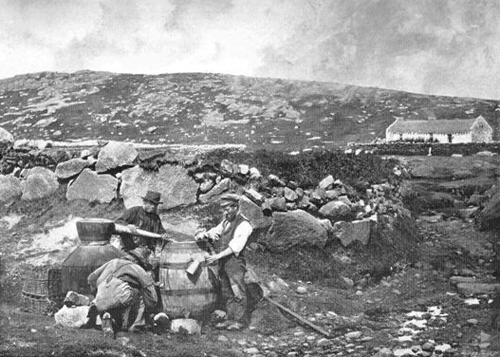
Poteen is made from barley or potatoes. It is one of the most potent alcoholic beverages in the world. Also known as moonshine, poteen or homemade whiskey, was outlawed in Ireland in 1661. The purpose of the law was not to save the peasant from some potential harm from the homemade brew but to levy a tax on whiskey. The Irish ignored the law and went ahead making poteen for generations. | |
 |
|
|
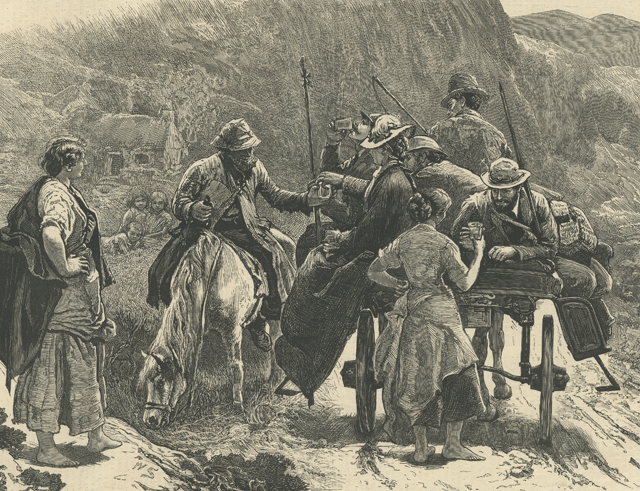
Print collection of Maggie Land Blanck
THE WESTERN HIGHLNADS CONNEMARA — POTEEN | |
| |
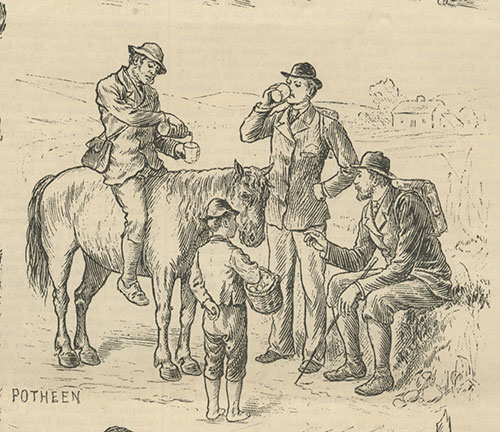
| Print collection of
Maggie Land Blanck, Illustrated Sporting and Dramatic News October 18, 1879
POTTEN, AND ARTIST TOUR IN IRELAND | |
| |
| Courtesy of Peter Manning Illicit Still from Sights and Scenes in Ireland, 1908 | |
| Images of Other Crops | |
| |
| Postcard collection of Maggie Land Blanck
| |
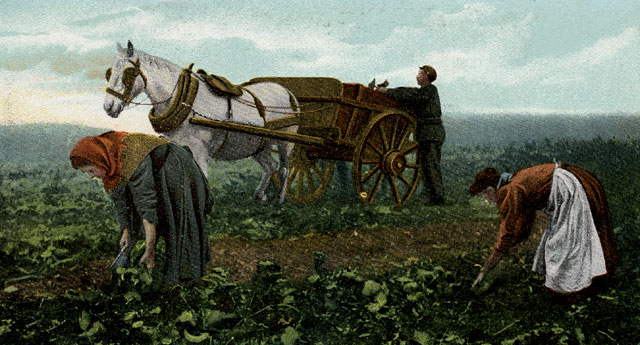
| "Irish farm scene-Topping the turnips"
No date | |
| |
| Postcard collection of Maggie Land Blanck
| |
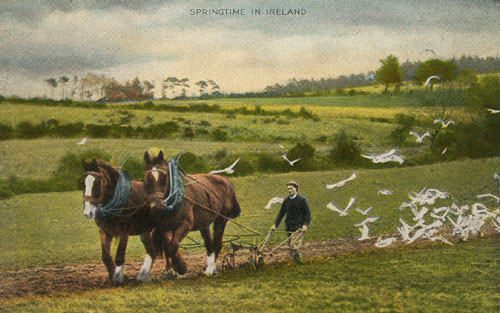
| "Springtime in Ireland"
No date | |
| |
| Postcard collection of Maggie Land Blanck
| |
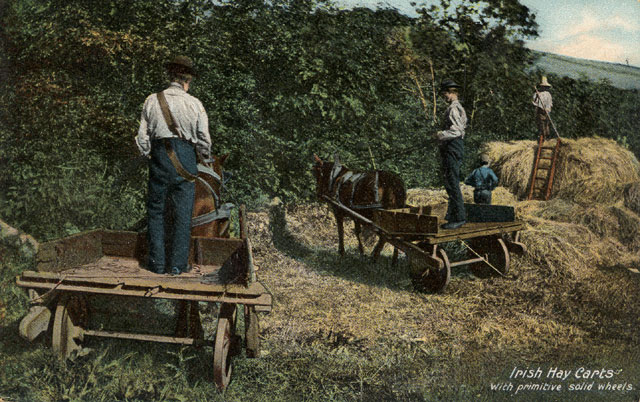
| "Irish Hay Carts With primitive solid wheels" No date | |
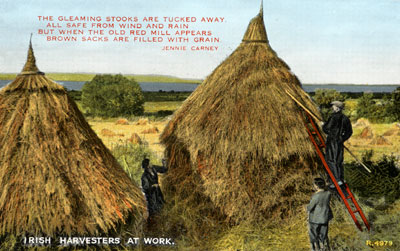
| "Irish Harvesters at Work"
Posted 1958 |
| Postcard collection of Maggie Land Blanck
| |
 |
|
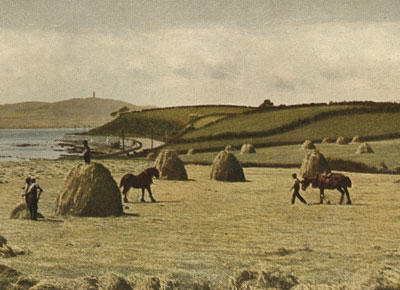
| Print collection Maggie Land Blanck | |
In February 20012 Brendan McSherry of the Louth County Counsel wrote:
"This photo was taken on the north-western part of the Ards peninsula in County Down, looking across the north-western end of Strangford Lough towards the memorial tower on top of Scrabo hill, just to the south-east of Newtownards."
| |
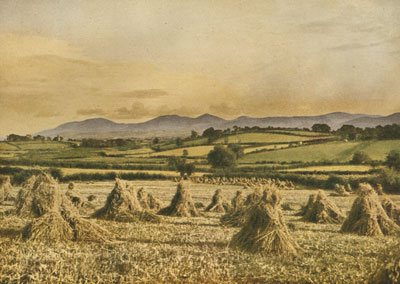 |
I believe that this is a picture of a harvested flax field.
|
| Print collection Maggie Land Blanck | |
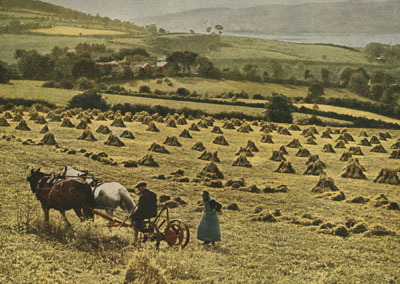 |
I believe that this is also a picture of a harvested flax field.
|
| Print collection Maggie Land Blanck | |
| For more information on Linen and Flax go to Flax | |
| |
|
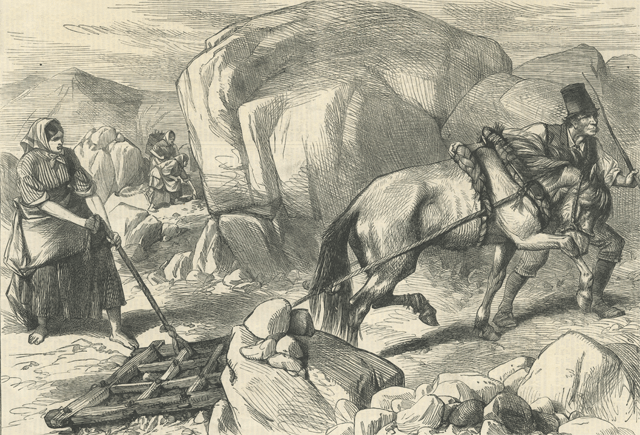
Print collection Maggie Land Blanck SKETCHES IN IRELAND; HARROWING UNDER DIFFICULTIES, MOUNTAIN FARM IN COUNTY MAYO Illustrated London News Jan 17, 1880
"MOUNTAIN FARMING IN MAYOMayo contains some mountainous tract of land with summits above 2,000 feet.
"The lowland districts have a rich loamy soil, with a limestone subsoil, but the greater part of the land consists of barren moors.......incumbered (sic) with hugh rocks either protruding through the thin leathery turf from the mass of granite that lies beneath, or else scattered in loose heaps and detached fragments over the hillside.""The difficulty of ploughing, harrowing, or in any way properly cultivating " this type of land can be imagined. This "sketch" represents a farm close to Pontoon Lough on the road between Castlebar and Ballina. "Some good soil is to be found in the crevices and hallows between the masses of rock; and here are poor little cabins, built of turf and stones, inhabited by hard-working families, who grow potaooes and even oats in small patches of ground, wherever the boulders will let them put it to seed. There is seldom pasture for a cow, but they usually contrive to keep a pig. The harrow for the oat-field, as our illustration shows, is an implement of the rudest make, and it has to be guided, or lifted over the stones, by the wife's hand which holds it with a rope of straw. The horse, most likely borrowed or hired for the day, is led by her husband, and so they make shift to do the work. | |
| If you have any suggestions, corrections, information, copies of documents, or photos that you would like to share with this page, please contact me at maggie@maggieblanck.com |
| The People | |||
| Houses | |||
| Turf | Transportation | ||
| Odd Bits | |||
| JOHN WALSH | |||
| MATHIAS LANGAN | |||
| WALSH/LANGANS INTRODUCTION | |||
| HOME PAGE | |||
| Irish Life | |||
| Please feel free to link to this web page. You may use images on this web page provided that you give proper acknowledgement to this web page and include the same acknowledgments that I have made to the provenance of the image. Please be judicious. Please don't use all the images.
You may NOT make use any of the images or information on this web page for your personal profit. You may NOT claim any content of this web page as your original idea. Thanks, Maggie |
| ©Maggie Land Blanck - Page created 2004 - Latest update September 2019 |