Tenement Life in New York - Mayor Grace's Tour of Inspection 1881
Interior Italian Quarter
| New York City, Tenement Life |
| HOME - New York City |
|
My ancestors, Catherine Furst Schwartzmeier Lindemann, her daughters, Minnie Lindemann Goehle and Katherine Lindemann Beyerkohler Van Loo, Peter Goehle, the Walshes and the Langans lived in tenement apartments in Manhattan. The Lindemanns, Goehles and extended families lived on the Lower East Side which was a notorious tenement district. The word tenement conjures up images of extreme poverty. However the original meaning of the word was to indicate any type of permanent property held by one person and generally rented to another. The word evolved into a description of a large crowded apartment building especially in the poorer more squalid sections of a city. A overwhelming majority of immigrants spent some years in tenements before moving on.
|
| Catherine Furst Schwartzmeier Lindemann | Minnie Goehle | Peter Goehle |
| Langans in New York City | Walshes in New York City | |
|
Life in the Tenements While all tenements before central heating and air conditioning were cold in the winter and roasting hot in the summer not all tenements contained the dirty horrible living conditions with high death rates as portrayed by some of the social reformers. The reformers were, in fact, depicting the worst scenarios, as reformers often do in presenting their case. While horrible conditions did occurred in the tenements there was frequently quite significant prejudices on the part of the social commentators. Many of them, for instance, were temperance advocates who frowned on the German-American's love of his larger and the Irishman's love of his whiskey. There was a frequent lack of understanding of the culture of the most recently arrived Americans. Images of the tenements show chimneys. They generally had a wood or coal burning fireplace/stove in the kitchen.
Life in the tenements was hard. Heating and cooking were done by wood or coal burning stoves. Early tenements had very dark hallways as lighting was only from a sky light and/or glass transoms in apartment doors. Even the advent of the air shaft next to the stairway did not substantially increase the light and air in the tenement hallways. It wasn't until the Tenement act of 1901 that lighting was required in halls. Gas lighting was initially installed but electric lighting followed quickly behind. Structurally New York City tenements were generally of two types: - smaller houses of three or four floors that may have originally been one family and were converted into three or four family dwellings - larger buildings constructed as tenements that were typically five or six floors with four families to a floor. In the oldest and poorest tenements water had to be obtained from an outside pump, frequently frozen in winter. The privy was in the back yard. Later buildings generally had a sink and "water closet" in the hall on each floor. Newer and better class tenements had sinks in the kitchen. They were all "cold water". Water for washing dishes and clothes and for taking baths was heated on the stove. It should be pointed out that the water heater did not come into fashion in the US until after 1889. Wealthier people had servants to heat their water. Many of the larger tenements had a housekeeper, often a widow, who received free rent in exchange for maintaining and cleaning the halls stairs and sweeping the sidewalk in fount of the building. As a result many of these larger tenements were remarkably clean. While most tenements were crowded, the majority of tenement apartments were as clean as soap and elbow grease could make them. Many of the tenements built between 1879 and 1901 were very attractive buildings. The brick facades were often decorated with elaborate tin moldings, terracotta inserts, and a network of beautiful wrought iron fire escapes. I am constantly amazed, while walking on the Lower East Side, how pretty some of the old buildings are. A typical tenement image is of multiple lines of laundry flapping merrily in the breeze - which is both a pleasant sight in and of itself and an indication of the industry and cleanliness of the inhabitants. While some neighborhoods were comprised of a heavy percentage of a given ethnic group most tenements contained a wide variety of nationalities and the smells (good and bad) of the diverse cuisines filled the air. What made a tenement a "tenement" was the location and how recently the immigrants had arrived. Similar size apartments in better neighborhoods were called "flats". The cheapest apartments were in the attic (more stairs to climb). A vast majority of families lived in a four room apartment: - kitchen, two bedrooms and a parlor. In large families the kitchen and parlor might be converted into additional sleeping space at night. Children slept multiples to a bed - which clearly helped with the heat issue in the winter time. In nicer homes there may have been a carpet on the floor, lace curtains on the window, and pictures on the wall of the parlor. Some even had a piano. In the summer time, when the heat was very intense, people often slept on the fire escapes and/or roofs. Most tenements in the lower east side were in multi-use neighborhoods and situated close to factories, docks, slaughterhouses, and power stations which provided employment to some in the area. Convenient to get to work but with it meant living with increased air pollution, high noise levers, foul air and obnoxious smells. There were frequent issues with vermin: mice, rats, roaches. For many years pigs roamed the streets. The major means of transport was horse cart and the animals were kept in the neighborhood. Their manure not always removed from the street. Ground or lower floor apartments were darker and noisier but had the advantage of not as many stairs. Rent was the major expense for most families. In 1892: - two rooms in an attic cost $3 to $ 5 per month - three rooms (kitchen and two bedrooms) cost $6 to $12 per month - four rooms as described above cost $12 to $16 per month In 1903 Work magazine reported: "Today it is said that nine-tenths of the population of Manhattan Island are dwellers in tenements, and that one-half of them move from one to six times a year."People moved from apartment to apartment with some frequency. As their financial conditions improved they sought out better housing. As it worsened they many have been forced into cheaper quarters. If their position improved substantially they moved to newer areas of the city where the neighborhoods were mainly residential and the apartments buildings had more amenities or to the outer boroughs where there was more greenery. Eventually, many moved to the suburbs or the country on Long Island, upstate New York or New Jersey - and were replaced in the city apartments with the latest immigrant population. See 88 - 90 Sheriff Street now or at the bottom of the page for a study of one infamous tenement in New York.
Note: My focus is on the German and Irish immigrants
because my ancestors were German and Irish.
I had not paid any real attention to the Italian and Jewish
immigrants until I started researching some churches in the
Lower East Side. Some of the "missionaries" in these churches seem appallingly
prejudice and very unChristian in their outlook.
"The neglected children of our foreigners, crowded in dark and
unwholesome tenement houses, furnish an ever increasing army of young criminals.
The presence of foreigners is exerting a blighting influence on our American Sabbath.
The shops and stores are in full operation on the Lord's day. The
streets are crowded with push-cards and eager venders are loudly
shouting their wares. Pleasure excursions, dance halls and theaters
do an enormous business on Sundays.........
The bigotry and ignorance of some of our foreigners surpasses belief.
During the past summer the Polish Jews in New York have been intensely
excited because they believe that Christian missionaries seek to
brand their children with the sign of the cross."
By the reverent W. T. Elsing
New York City Mission Monthly, Volumes 12-13, 1899
The Tenements - Interiors The following images show a range conditions in the New York city tenement houses.
|
|
|
|
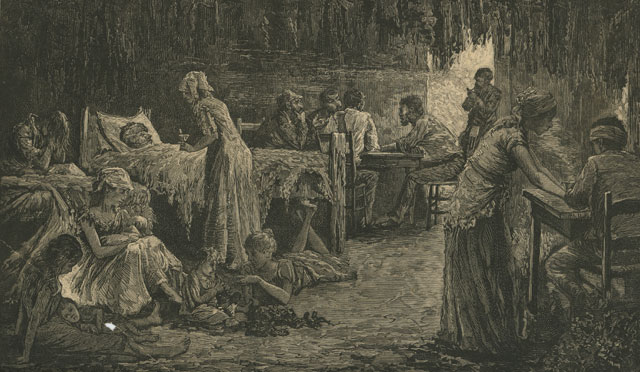
| Harpers weekly October 15, 1881,
drawn by W. St John Harper, collection of Maggie Land Blanck Tenement Life in New York - Mayor Grace's Tour of Inspection 1881 Interior Italian Quarter | |
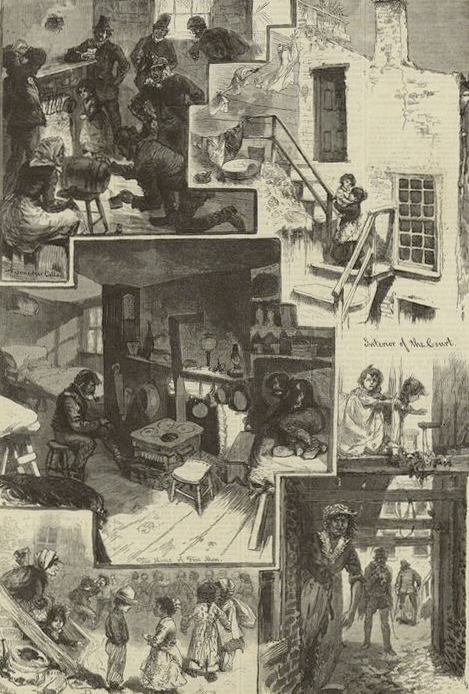
| Tenement life in New York - sketches in "Bottle Alley" (1879) |
| New York Public Library, ID 809686 | |
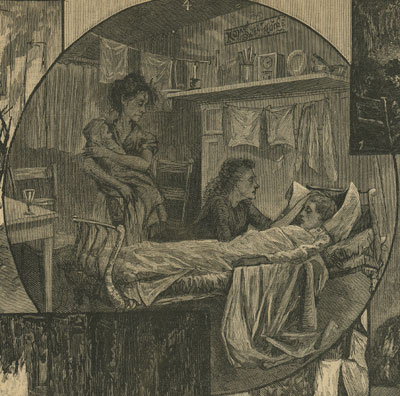
| Tenement Life in New York - Mayor Grace's Tour of Inspection 1881
"Sick Child" The sign above the shelf says: "HOME SWEET HOME" The already crowded condition are acerbated by the need to hang laundry up to dry indoors. This must have been a common occurrence in stretches of wet weather, particularly if there was illness in the house. |
| Harpers weekly October 15, 1881, drawn by W. St John Harper, collection of Maggie Land Blanck | |
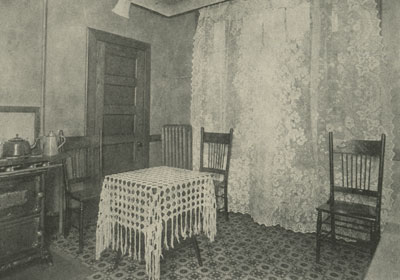
| Space was at a minimum - consequently furnishings were at
a minimum. Notice, however, in this and the next image that there are lace curtains on the window and some attempts at decoration. |
| Unknown publication, Collection of Maggie Land Blanck | |
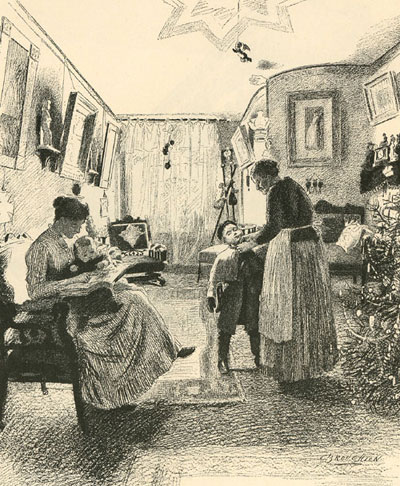
| The Christmas tree at the edge of the picture could indicate a German American
family. The older woman helping to dress the boy could be a servant or a grandmother. It was very common for multiple generations to live together. Also, even some of the less well-to-do had servants.
|
| Scribners June 1892, Collection of Maggie Land Blanck, artist, C Broughton
"The Bright Side of Life in a Tenement House" from "Life in New York Tenement-Houses", as seen by a city missionary dated 1892 | |
|
|
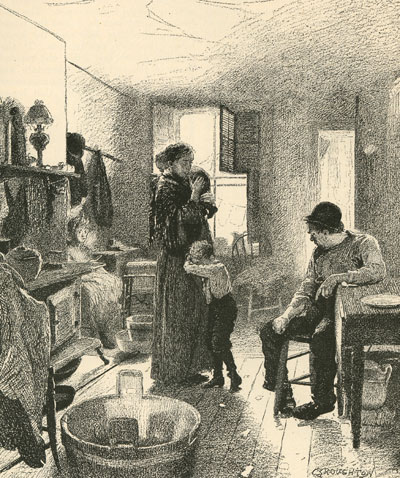
| Scribners June 1892, Collection of Maggie Land Blanck, artist,
C Broughton
"The Dark Side - under the Same Roof" from "Life in New York Tenement-Houses", as seen by a city missionary 1892 I suppose that the man sitting dejectedly at the tale could be taken as a drunk or at least unemployed (All of the articles I have found about the tenements make reference to alcohol as a problem for the poorer classes.).* (See note below) Other than the patent difference in the clothing and furnishings the physiological implications are obvious:
See Temperance
| |
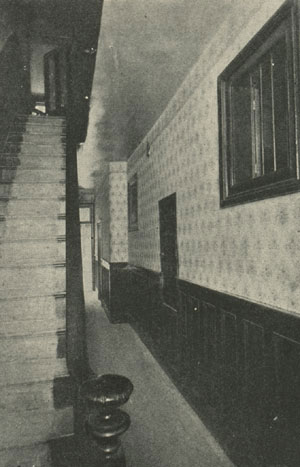
| Notice the window in the hall which gives some light into the living quarters which were
otherwise too deep into the building to receive any light. Conversely, at night the widow might give some light from the apartment to the hall.
|
| Collection of Maggie Land Blanck | |
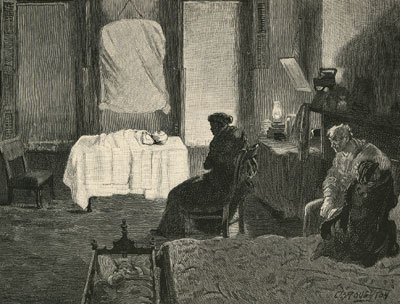
| In addition to showing another interior, this image also depicts the home wake.
Rich and poor alike had home wakes - the funeral home did not exist before the 20th century.
|
| Scribners June 1892, Collection of Maggie Land Blanck, artist, C Broughton
"Poverty and Death" from "Life in New York Tenement-Houses", as seen by a city missionary dated 1892 | |
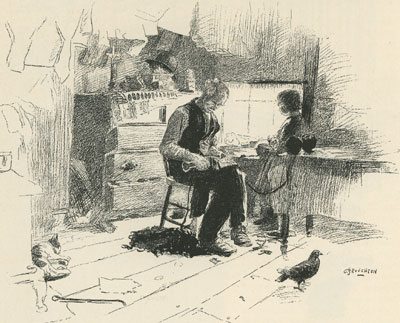
| "A Grandfather Cutting Carpet-rags" from Life in
New York Tenement-Houses" as seen by a city missionary, dated 1892
|
| Scribners June 1892, collection of Maggie Land Blanck This very sweet sketch illustrates several points:
| |
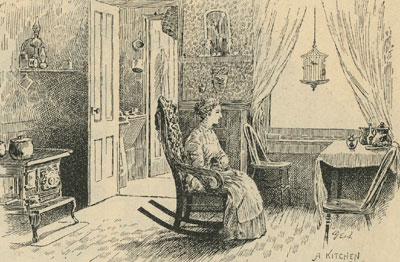
| A kitchen in an improved tenement.
|
| Cosmo 1890, Co-Operative Housekeeping in Tenements by
Elizabeth Bislands, collection of Maggie Land Blanck
| |
|
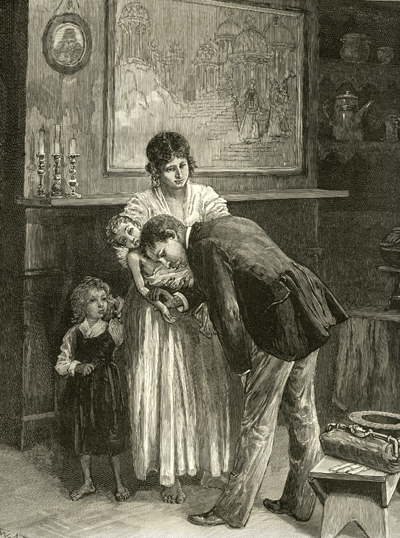
A BOARD OF HEALTH DOCTOR IN A NEW YORK TENEMENT Notice the bare feet of the women. |
| HARPER'S WEEKLY AUGUST 10, 1889,
collection of Maggie Land Blanck
| |
| These images depict a variety of financial circumstances in tenement dwellings. | |
|
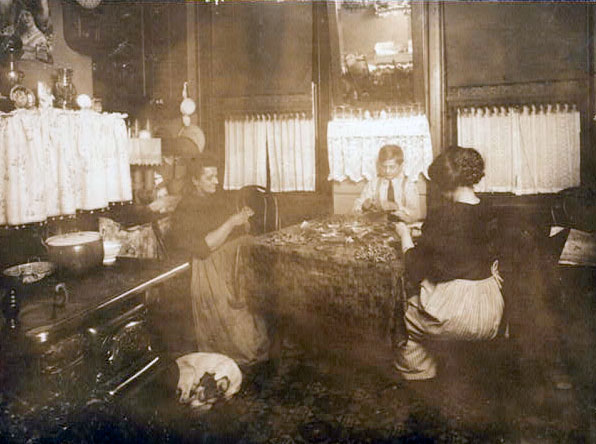
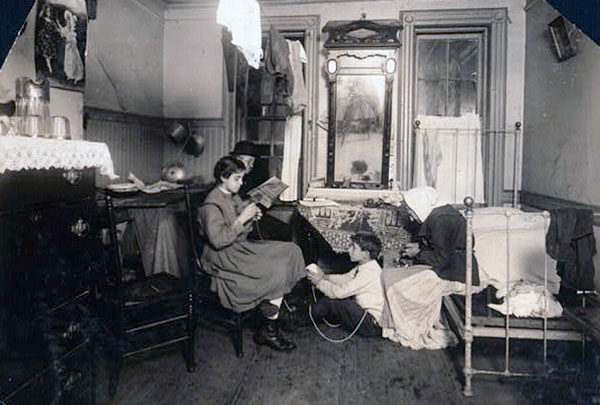
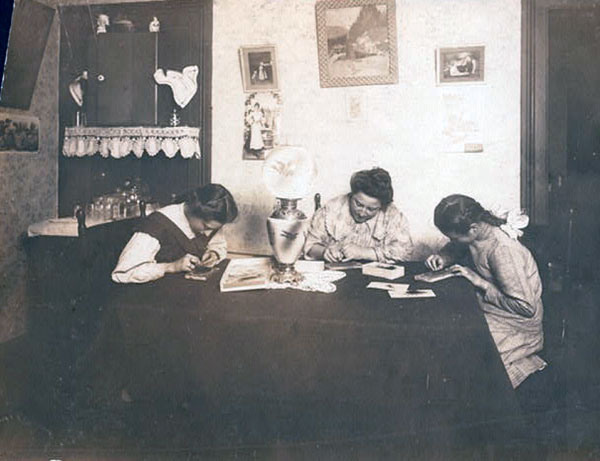
The following three images were taken to illustrate the evils of child labor. But they also reveal other aspects of immigrant life such as attempts at niceties like lace curtains and lace bureau scarves, framed pictures and/or mirrors, family photos, and nicknacks of various sorts. Notice the dog asleep in the first image. The issue of child labor is complicated. From time immemorial working-class children have learned their trades from helping their parents or being apprenticed to a master tradesman.
| |
|
|
| Library of Congress
| |
|
|
| Library of Congress
| |
|
|
| Library of Congress
| |
|
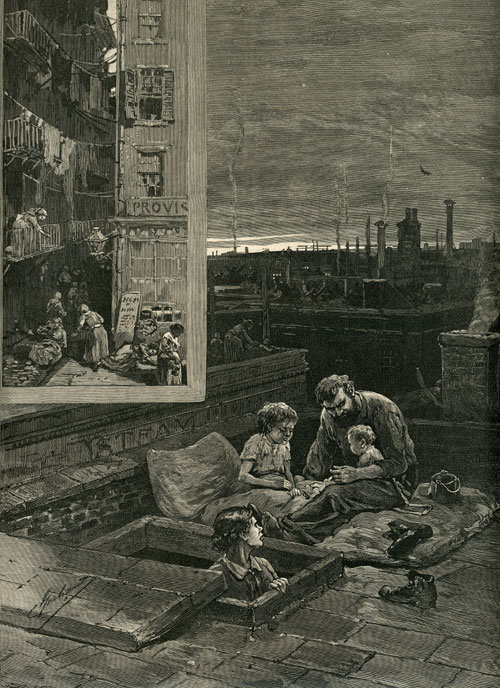
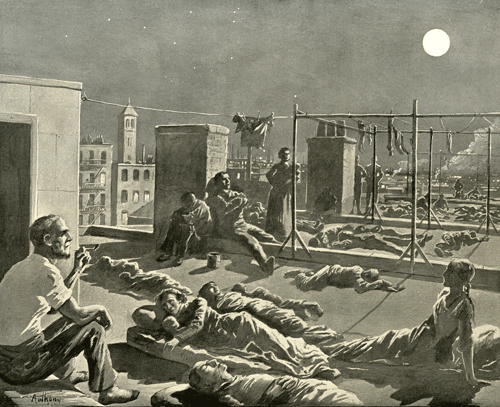
The Tenement Roof The roof was a place to escape the heat of the summer night.
|
|
|
| Harper's Weekly, August 1, 1885, Collection of Maggie Land Blanck
On The Roof of A Tenement House | |
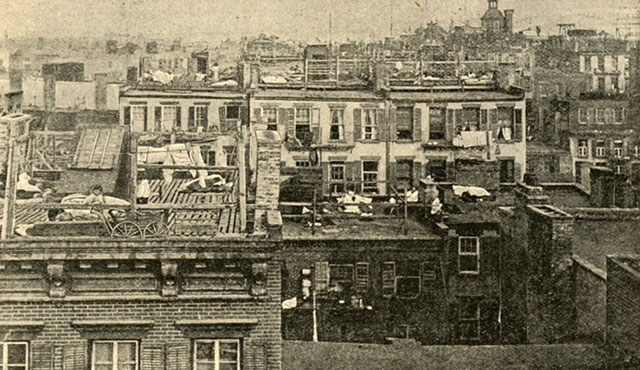
|
|
| Harper's Weekly, date unknown, Collection of Maggie Land Blanck, 2013
General View of Roofs | |
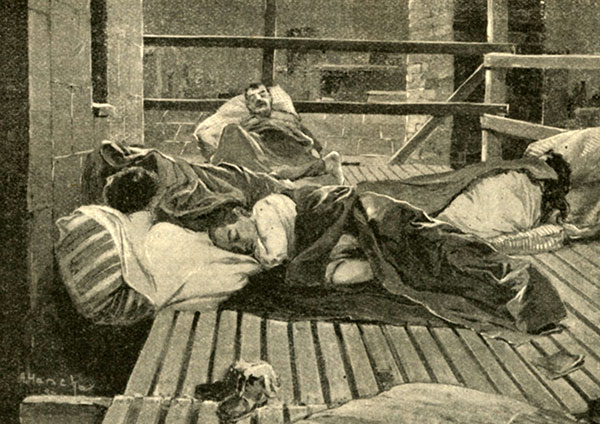
|
|
| Harper's Weekly, date unknown, Collection of Maggie Land Blanck, 2013
Improvised Beds on the Roof | |
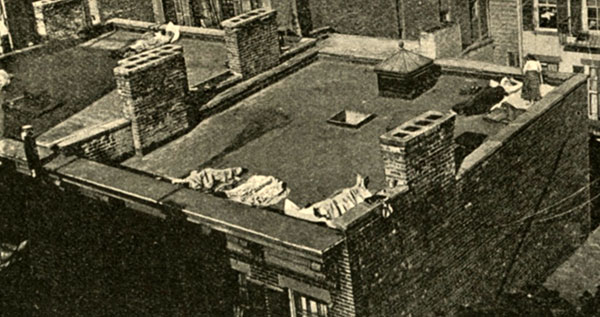
|
|
| Harper's Weekly, date unknown, Collection of Maggie Land Blanck, 2013
Looking Down on a Roof | |
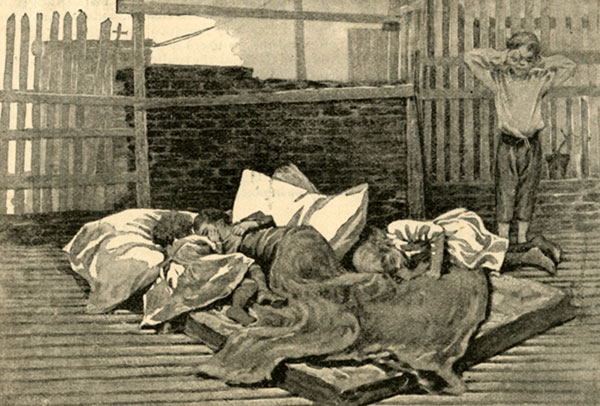
|
|
| Harper's Weekly, date unknown, Collection of Maggie Land Blanck, 2013
An Open-Air Nursery This image illustrates not only the concept of sleeping on the roof but that of sharing a bed. Family beds were a very common practice throughout the world and practiced by all social levels until relatively recently.
| |
|
|
| The New Metropolis, 1899, cut from book, Collection of Maggie Land Blanck | |
|
Every Inch of Space Used to Squeeze in Buildings. Many tenement buildings were dark and airless. The following map and image show just how closely the buildings were packed together. |
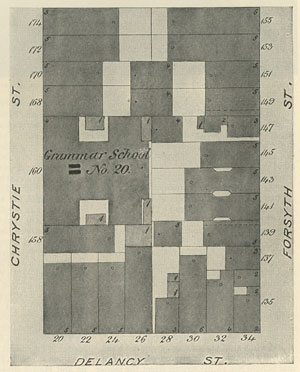
| This plan of the Chrystie Street School and neighborhood shows the form of the
tenement buildings. The grey is the building and the lighter areas indicate yards. The lots were 100 feet deep by 25 feet wide. This image shows pre 1879 buildings (with no air shafts) and post 1879 buildings (with air shafts). Notice that #s 20, 22, 24 and 26 Delancy Street are solid blocks of buildings while the air shafts (the white shapes) can be seen at # 141, 143 and 145 Forsyth St. Notice how small most of the "yards" are. Surrounded by so many tall buildings they were general dark. 168 and 170 Chrystie and 149 and 151 Forsyth have rear tenements. That is, a front building and a back building with a yard in between. Rear tenements had the worst reputations. The numbers 1, 2, 3, 4, 5 and 6 indicate the number of stories to a given building.
|
| Century Sept 1894, Collection of Maggie Land Blanck | |
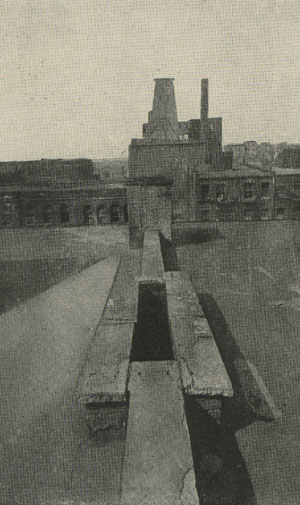 |
"The Top of a "Dumb-Bell" Opening One foot wide by six feet long, the sole source of light and air for sixteen rooms where thirty or forty people sleep."
|
Good Tenements For A Million People, the Story Of New York's Successful
Fight For Better Housing by Emily Wayland Dinwiddie circa 1909 publication unknown,
collection of Maggie Land Blanck.
Between 1879 and 1901 the dumbbell tenement was the most common type of construction:
For twenty years the "dumb-bell" was practically the only type of tenement building constructed on Manhattan Island. There are in existence to-day more than ten thousand of these homes. They are ordinarily five, six, or seven stories high. On the entrance-floor are frequently two shops with three room apartments in the back. In the centre is a long, dark, very narrow entrance-hall. On the upper stories are four families to a floor. Here on each side of every hall are seven rooms, extending back from the street to the yard. The families in the front usually have four rooms each; families in the rear have three. A front apartment has one room opening on the street; back of this are three rooms with windows on an air-shaft twenty-eight inches wide. The rear apartments have one room opening on a yard ten feet deep, and two rooms on the twenty-eight-inch -wide air shaft. Needless to say, the air shaft rooms, front and back are dark except on the top floor. The shafts are "stagnant wells of foul air", "conveyers of noise, oder, and disease, and when fire breaks out serve as inflammable flues."In 1901 the "New Law" was passed that required more air and light in newly constructed buildings. In 1909 the New York City Tenement Hose Department reported 96,000 windowless rooms in New York City. However, due to new housing laws, one forth of the city population lived in tenements with light and air. By 1909 the city was rid of the worst of the slums. Advances in housing and sanitation reduced and in some cases completely eliminated diseases like infant mortality, cholera, small pox, and typhus.3 3"Good Tenements For A Million People , the Story Of New York's Successful Fight For Better Housing" by Emily Wayland Dinwiddie circa 1909 publication unknown | |
| Tenements - Exteriors
|
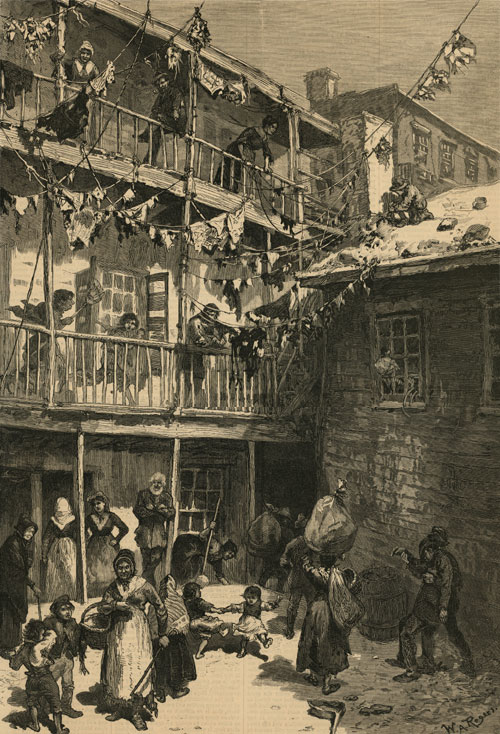 |
An extreme example of the poorer class of tenement house. "Tenement Life in New York - Rag-pickers Court, Mulberry Street" 1879 |
| Harper's Weekly, April 5, 1879,
Drawn by William A Rogers, Collection of Maggie Land Blanck
Clothes in tatters, laundry in shreds, men idling about, children running wild, mothers beating their children, a obvious drunk - and yet - a man helping the drunk, two little children dancing merrily, a woman with a broom who appears to be cleaning up, and the industrious rag pickers carrying there wares. | |
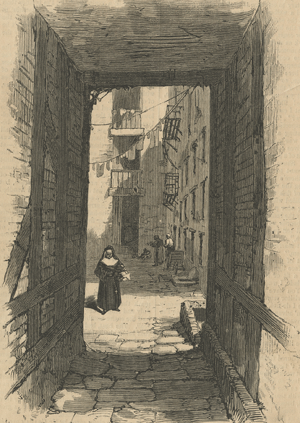 |
Entrance to an Alleyway, Cherry Street |
| Harper's Weekly, March 29, 1879, | |
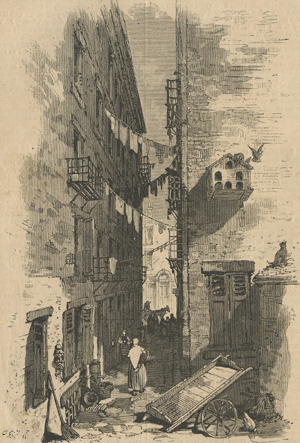 |
West Gotham Court, Cherry Street
|
| Harper's Weekly, March 29, 1879,
Gotham Court was built in 1850 to rescue the poor and unfortunate from the evils of the older tenements. However, only 10 years after it was completed Jacob Riis reported that 61 of 138 children born there in a three year period had died before the age of one. The building was torn down in 1895. The Harper's article says there was a frontage of 30 feet on the street. The building was 300 feet deep and "is divided practically into two buildings by a partition wall extending all the way from front to rear". One division had a court on the west side and the other had a court on the east side. These "courts were", in fact, alleys. The ground floor apartments visited by the reporter were "small, dark and dirty" "at noon on a cloudy day" were "as dark as early evening elsewhere". The upper floors were brighter but just as small and dirty. Seventy out of every 100 deaths in the city occurred in tenements. Childhood illness and death were rampant. Dr. STEPEHN SMITH, an authority on this question, says: "One-half the deaths of the city are of children under the age of five years of age. Since 1872 the deaths in New York have been 32,647 of whom 16,188 were under the age of five years. The mortality is not the sum total of the damage. Where there is one death here are seventy-five cases of sickness"The worst months were July and August with over half the number dying during those months. Half of the died form "foul air diseases". Notice the bird house and the cat. | |
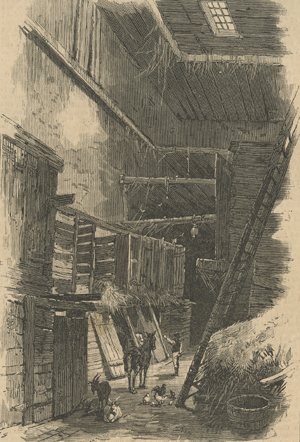 |
Stage of the Old Chatham Theatre now used as a stable
"Here Uncle Tom's Cabin was first presented in New York, and many a favorite actor played his part. The sky-light still remains, and some of the machinery, but there is little else to remind one of the old play-house." |
| Harper's Weekly, March 29, 1879, | |
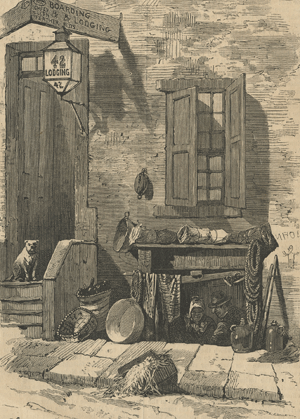 |
Lodging House and Junk Shop, Cherry Street 42 Cherry Street is between Catherine and Market Streets between the Brooklyn Bridge and Manhattan Bridge. "This is one of the oldest houses in New York, having been built by a Dutch family nearly two hundred years ago. It was made from Holland brick, so well cemented together that a year ago, when the front was being strengthened, the workmen had the greatest difficulty in tearing down a portion of the front of it so it could be removed." |
| Harper's Weekly, March 29, 1879,
Gotham Court on Cherry Street had been a model tenement built in | |
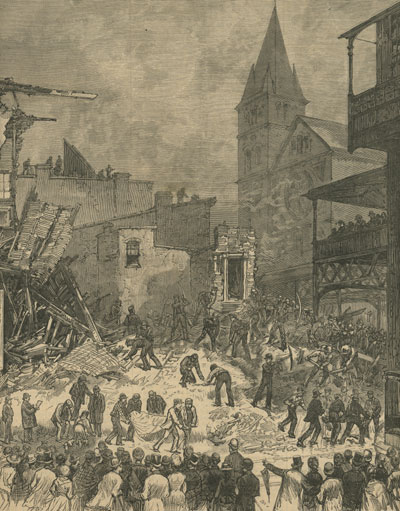 |
The 1881 Grand Street Tenement house Disaster |
| Harper's Weekly, November 19, 1881, Drawn by Graham and Thulstrup, Collection of Maggie Land Blanck
Not all the blame for the decrepit living conditions of the tenements should fall on the inhabitants themselves, the landlords held some responsibility - or lack thereof. Two tenements on Grand and lower Fifth Avenue collapsed despite tenant complains: " Two months ago the occupants of the house remarked that something was wrong. When trains passed on the elevated railroad, or heavy wagons went along Grand Street of South Fifth Avenue, it vibrated to an extraordinary degree. Furniture got out of place, articles left on tables fell from them, window casings bulged, and doors could not be closed or opened. Six weeks ago, at night, several persons in the house were startled by a crack and a jar, and discovered a yawning rent in the party wall. One of the tenants spoke to the landlord and insisted that a complaint be made to the proper authorities, and that the building should be repaired."No repairs were made and the tenants were not ordered out. The article does not mention loss of live and property. The image does show several men carrying a stretcher with what appears to be a body covered with a sheet. | |
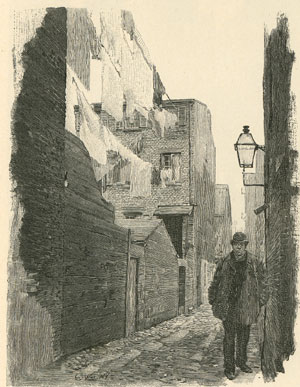 |
An example of the poorer class of tenement house. Social reformers did put pressure on the city and city housing laws were passed that greatly improved the lot of the tenement dweller. |
| Scribners June 1892, Collection of Maggie Land Blanck
"Pig alley" from "Life in New York Tenement-Houses" as seen by a city missionary, 1892
| |
 |
|
|
Century September 1910,
Collection of Maggie Land Blanck
| |
| |
|
|
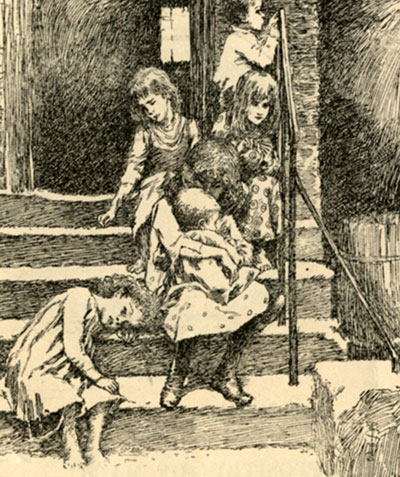
| Harper's Weekly, date unknown, Collection of Maggie Land Blanck, 2013
On the Front Steps See also Children | |
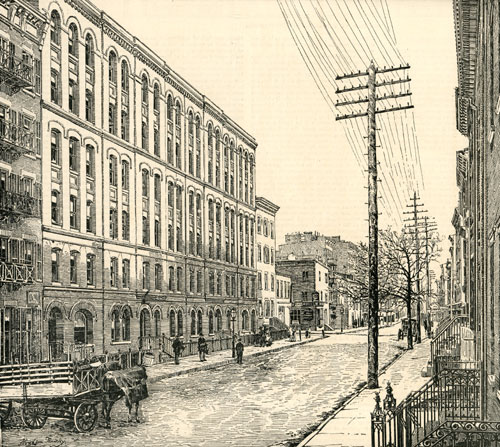 |
Model Tenement-houses in Cherry Street, New York |
|
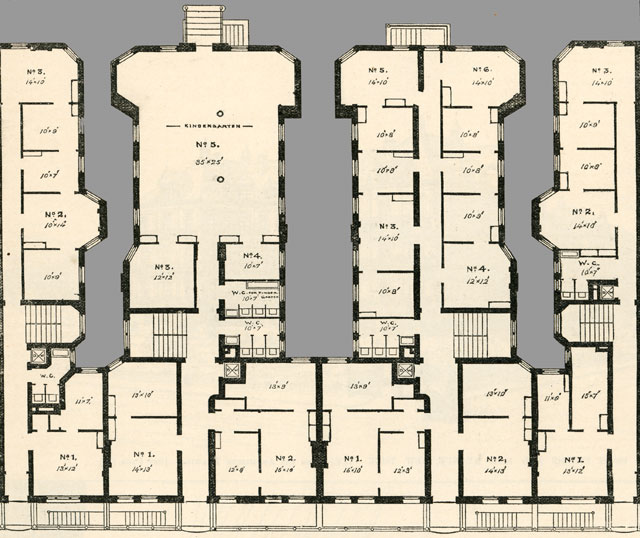
Harper's Weekly January 14, 1888, collection of Maggie Land Blanck This tenement apartment at 340, 342 and 344 Cherry Street was erected by the Tenement-house Building Company a group of "public spirited and philanthropic" citizens to try and address some of the worst issues of tenement housing. It opened in 1888 and boasted a laundry room and bath rooms (rooms with bath tubs) on the lower level as well as a kindergarden on the first floor. Each floor contained a WC (water closet) that was shared by two or more families. All rooms had windows, none were smaller than 10 feet by 8 feet and each apartment contained at least one room that was at least 12 feet by 12 feet. There was no dark narrow hallway, all having widows and gas light at night. Some apartments had running water. Rents were from $6 to $15 per month. This area of Cherry Street no longer exists. It became the site of the first New York City superproject, the Vladeck Houses - 24 six-story buildings which were started in 1930 and completed in 1941. | |
 |
|
|
Harper's Weekly January 14, 1888, collection of Maggie Land Blanck
| |
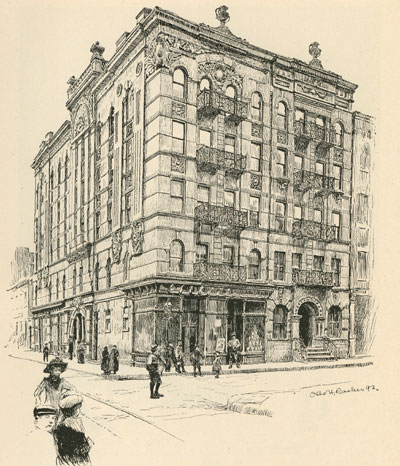
| "A New Tenement of the Better Sort- One of Many Recently Erected
by
Private Enterprise" from Life in
New York Tenement-Houses" as seen by a city missionary, 1892
|
| Scribners June 1892, collection of Maggie Land Blanck
| |
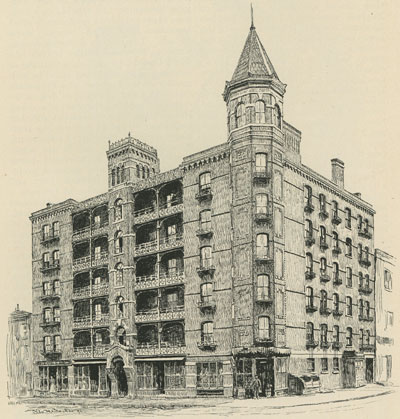
| "The Monroe Model Tenement" from Life in
New York Tenement-Houses" as seen by a city missionary, 1892
|
| Scribners June 1892, collection of Maggie Land Blanck
| |
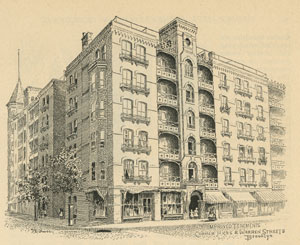
| Improved Tenement corner of Hicks and Warren Streets,
Brooklyn. Another example of well designed tenement housing. This building still stands.
|
| Cosmo 1890, Co-Operative Housekeeping in Tenements by
Elizabeth Bislands, collection of Maggie Land Blanck Tenements Improvements Housing laws did improve the lives of tenement dwellers and some wealthy real estate investors put their money in tenement housing. By 1890 new tenement buildings were being constructed to address some of the worst issues of tenement life. Between 71 and 72 on First Avenue a six story building was erected around a courtyard so that every room had a window. The apartments themselves had running water and contained three to four "good sized" rooms with closets. The building contained elevators for coal and garbage and an ash chute. The halls were warmed in winter and lit all year. Each tenant had a space in the cellar to store his coal. In addition there was a bath room on the ground floor of each section that contained bath tubs with hot and cold running water. The rent was from $6 to $13 per month.1 1Cosmo 1890 Co-operative Housekeeping in Tenements
| |
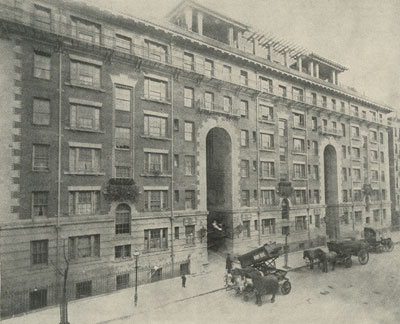 |
"A Low-Priced Model Tenement That Yields a ProfitWhere the poor save a large percent of their fuel bill by purchasing their coal by the ton collectively instead of individually by the basket. It is on East Thirty-first Street, New York. This building had a "Sun Parlor" on the roof.
|
| Good Tenements For A Million People, the Story Of New York's Successful Fight For Better Housing by Emily Wayland Dinwiddie circa 1909 publication unknown, collection of Maggie Land Blanck. | |
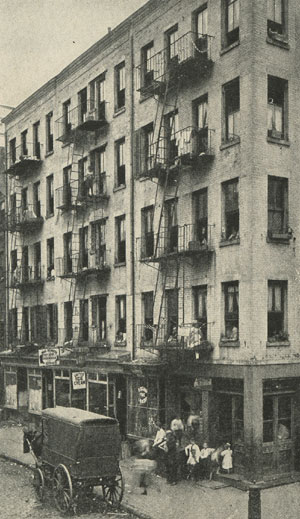 |
"325-329 Water Street, New York.
Changed from a den of disease and vice to a decent place to live in, by a model landlord, Miss Ellen Collins. The house yields 5.5 per cent income."2Tenement House Law of 1901 - for new buildings, all halls and rooms had to have light and air and "Privacy is secured by requiring individual sanitary accommodations for each family" - A euphemism for a private toilet. 2 The Tenement House Law of 1901 could not necessitate that all 80,000 old tenement buildings be torn down but did require improvements - halls be lighted and ventilated, every family had to have a fire escape and "decent sanitation facilities". 2 2Good Tenements For A Million People, the Story Of New York's Successful Fight For Better Housing by Emily Wayland Dinwiddie circa 1909 publication unknown
|
| Good Tenements For A Million People, the Story Of New York's Successful Fight For Better Housing by Emily Wayland Dinwiddie circa 1909 publication unknown, collection of Maggie Land Blanck. | |
| Back Yards
Light shaft |
| Discomforts of Tenement Life
| |
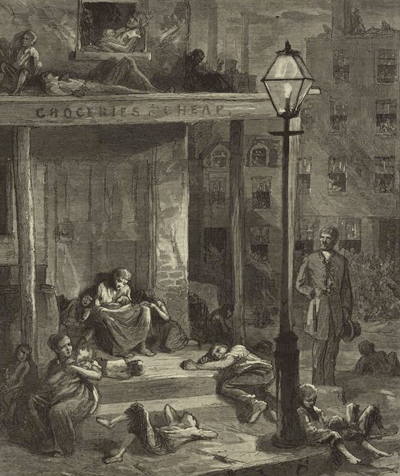
|
AMONG THE TENEMENT HOUSES DURING THE HEATED TERM -
JUST BEFORE
DAYBREAK Harpers Weekly 1878 |
| New York Public Library ID 809927
| |

|
New York City - The recent "heated term" and its effect upon
the population of the tenement districts A night scene on the East Side -
from sketch by a staff artist.
Frank Leslie's illustrated newspaper, Aug. 12, 1882, p. 393. |
| Library of Congress | |
| Crowding There are a lot of reports in books and the popular press about the extremely crowded conditions in the tenements. "Those who live in the country, where there is abundant room for all, can scarcely conceive of 500 people living in one house. And yet more than that number of residents were counted some time ago in a house two doors from Camp Memorial Church."There is no question that many immigrant families were large and tenement conditions were crowded. However, there also may have been some overstating by reform minded individuals. There were reportedly hundreds of rag pickers living at 88 - 90 Sheriff Street. Yet when I investigated that address I found only a few families. See 88-90 Sheriff Street
| |
| The Tenement Family |
|
|
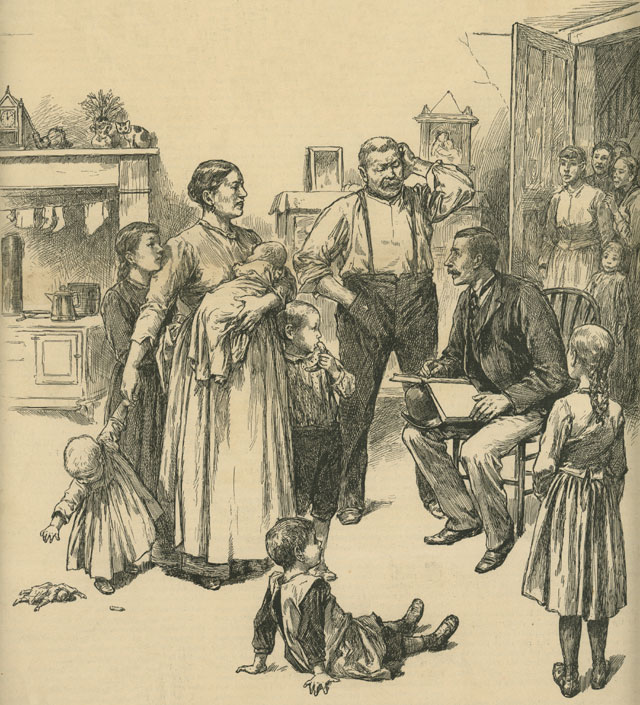 |
|
| Frank Leslie's Illustrated Newspaper, June 14, 1890, Collection of Maggie Land Blanck, artist C Broughton - engraved by H.W. Peckwell
"The Census - An Enumerator collecting statistics in the German District on the East Side, New York City" | |
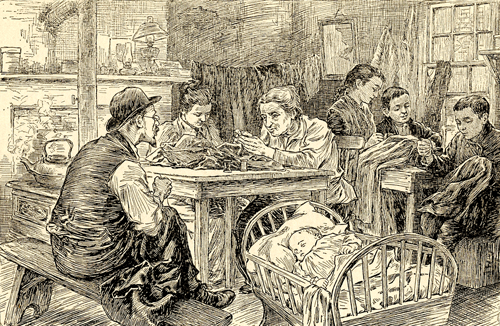 |
|
| Scribners October 1896, Collection of Maggie Land Blanck THE NEW YORK WORKING GIRL "The Enemies of the Working Girl" The title of the image makes reference to the numbers of families who did piece work at night and/or or using underage children as laborers. "Working girls" of the time were trying to get improved working conditions and wages through unions and strikes. | |
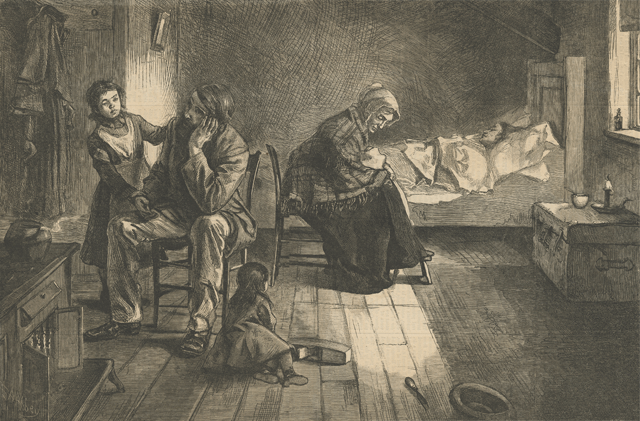 |
|
| Harper's Weekly January 13, 1877, Collection of Maggie Land Blanck ONE MORE MOUTH TO FEED Based on the tools lying on the floor this new father was a carpenter. The old woman holding the baby is a possible reference to multi-generations living together as was the case of the Goehle family when they were on Sheriff Street in 1890. There was and economic panic in 1873 which resulted in a four year depression. The economy began to improve in 1878. | |
| Eviction Eviction was a common fact of a lifestyle that was often hand to mouth. An illness or death in the family could result in a significant reduction in income and an inability to pay the rent. Widows with small children were particularly susceptible to eviction. Assistance often came in the form of family friends and neighbors taking up a collection to tide the family over.
|
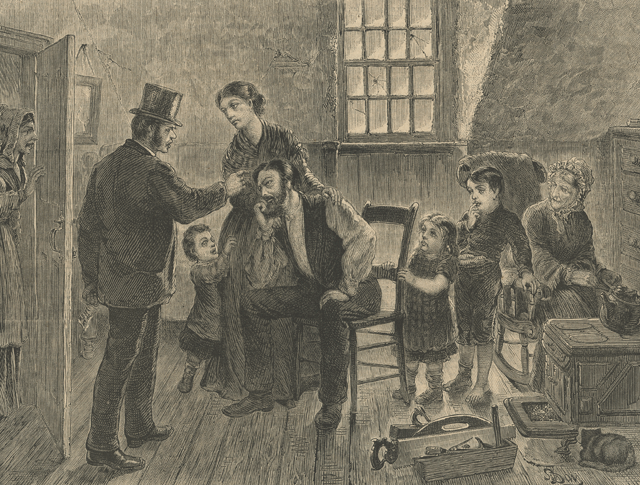 |
| Harper's Weekly December 20, 1873, Collection of Maggie Land Blanck,
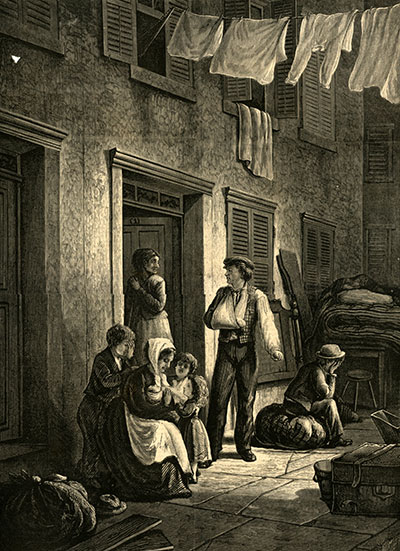
HARD TIMES - RENT DAY " Our illustration on page 1140 presents one of the many sorrowful incidents of the life of the poor during hard times like the present, when work is scarce, and every penny that can be earned is required to buy the fuel and food necessary to keep cold and hunger from the door. Hundreds and thousands in great cities like New York, unable to find steady employment, are at the present time suffering for want of common necessaries of life. The coal, the food, the clothing, without which they would perish, consume their chance and scanty earnings, and the dreaded rent-day to often finds them without the means to prevent their being turned out into the streets, or forced to take refuge in some wretched tenement garrett or cellar, wholly unfit for human beings to life in. Fortunate are the poor who have compassionate landlords willing to wait for their rent until better times come round again.The tools on the floor indicated that this father was a carpenter. There was a financial "panic" in the fall of 1873. The Stock Market closed for ten days starting on September 20. It took years for the economy to recover. Construction slowed, wages were cut and real estate values fell. This image seem to portray a multi-generational family. |
 |
| Harper's Weekly May 2, 1874, Collection of Maggie Land Blanck,2013
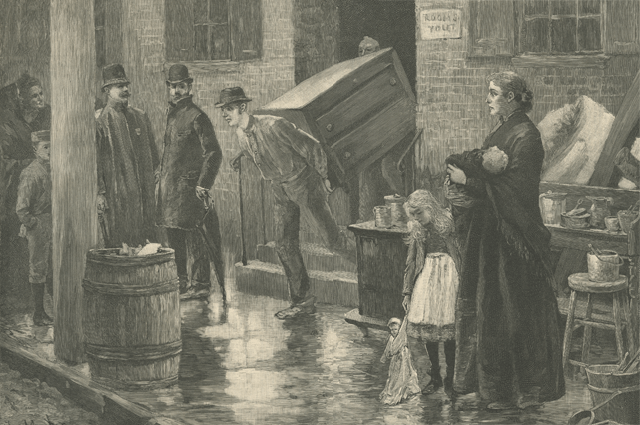
TURNED OUT There was no workman's compensation. If the breadwinner was hurt, he (or she) would be out of work. The landlady has "turned out" this father, mother and their five children and all their possessions.
|
 |
| Harper's Weekly February 1, 1890, Collection of Maggie Land Blanck,
AN EVICTION IN THE TENEMENT DISTRICT OF THE CITY OF NEW YORK |
 |
| Scribners June 1892, Collection of Maggie Land Blanck, artist C Broughton - engraved by H.W. Peckwell
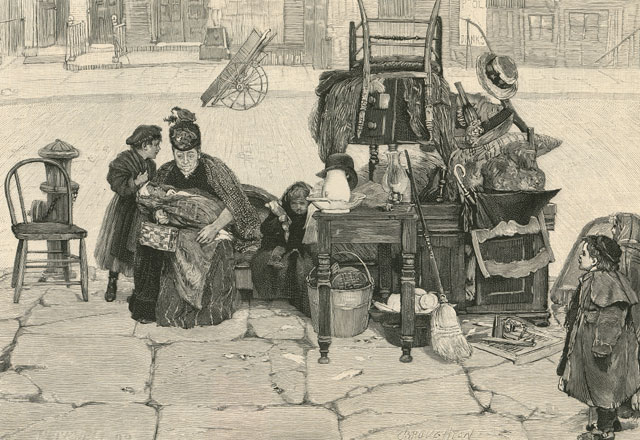
"Evicted - on the Sidewalk" from Life in New York Tenement-Houses" as seen by a city missionary, 1892 This poor lady, her baby and two small children are out on the streets with their meager possessions. |
|
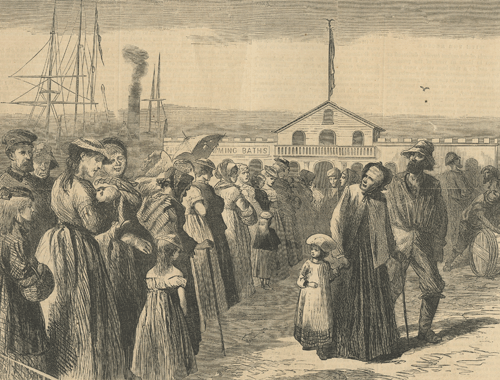
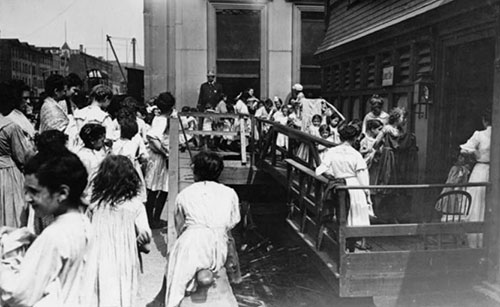
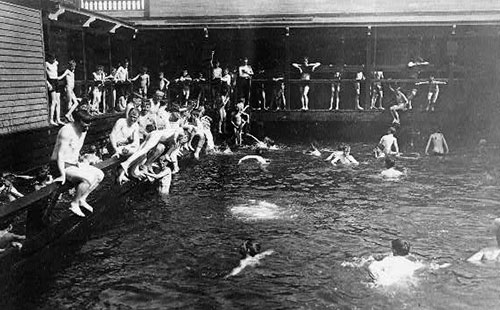
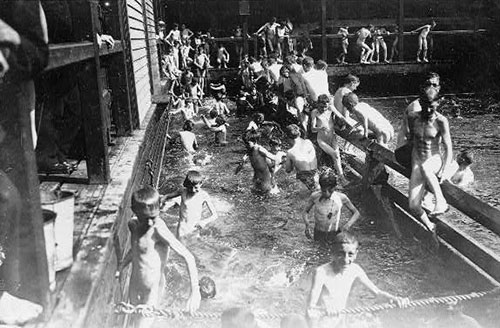
Bathing Bathing, even among the upper classes, was not popular before the late 1800s. As health authorities began to become aware of the need for public hygiene, bathing was encouraged for all classes and in 1895 state legislature mandated the availability of public baths in cities of 50,000 or more. A majority of tenements in the 1890s did not have indoor plumbing. Those apartments with running water had only cold. In some tenements the only water came from a faucet in an unlit hall way and some tenements had only one facet per building, supplying up to fifty tenants. Bathroom, when available, where most likely no more than one per floor and shared by several tenants. The common bath frequently did not include a tub or shower. In 1905, there were areas in New York where 36 baths were shared by at least 2,500 families and in some blocks there are as many as 800 families and no bath at all. Tenement bathing usually took place in the kitchen in a dish pan, the sink, or a portable tub. To make bathing available to the tenement dwellers the city build public baths. The first public bath in Manhattan was opened on 326 Rivington Street in 1902 and in five months accommodated 224,876 bathers, about three times as many men as women. In 1905 there were 7 public baths in the Manhattan, five were under municipal management and were absolutely free, the other two charged a minimum fee for soap and a towel. There were four more baths under construction and one in the planning stage. In addition there were floating baths along the river. These were as much swimming pools as places to wash, thus combining recreation and public hygiene. The floating baths were a kind of wooden wharf enclosing a swimming pool that allowed the river water to flow through. In 1902 the floating baths were used by 5 or 6 million in the summer season. Some young men braved the dangers of the rivers by jumping off the docks to take a summer swim.
| |
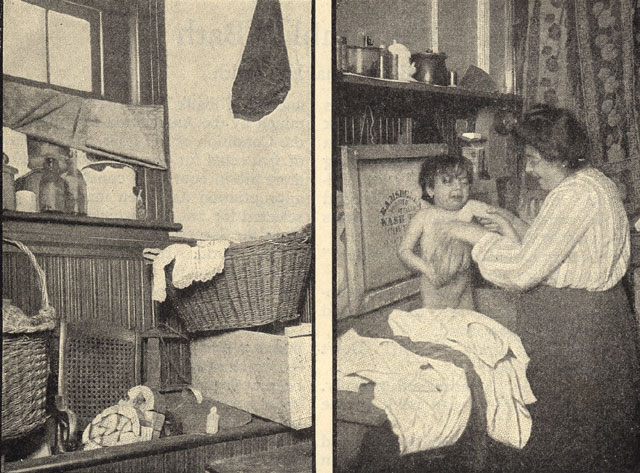 |
| Outlook 1905, Collection of Maggie Land Blanck |
|
A Tenement Bath
|
|
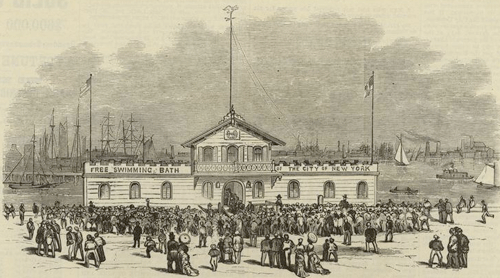
| New York City - "Boys' day" at the Free Swimming-Bath at the foot of Fifth Street, East River (1876) Leslies Magazine |
| New York Public Library, ID 805641 | |
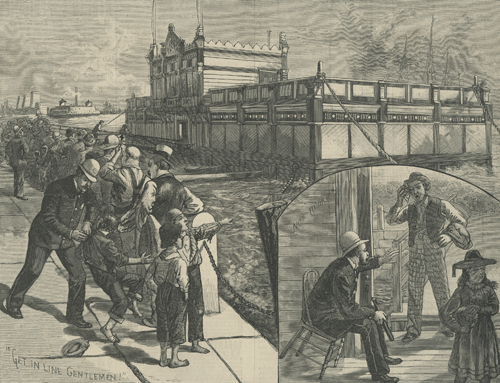 |
| Harpers Weekly June 1883, Collection of Maggie Land Blanck |
|
OPENING OF THE FREE BATHS IN NEW YORK The baths were open from mid June to mid October |
|
| |
| Harper's Weekly, collection of Maggie Land Blanck
THE WOMEN'S DAY AT THE FREE BATH-HOUSES- WAITING FOR ADMITTANCE Harper's weekly August 3, 1872
| |
| |
| Library of Congress
Ladies Day at the city Baths
| |
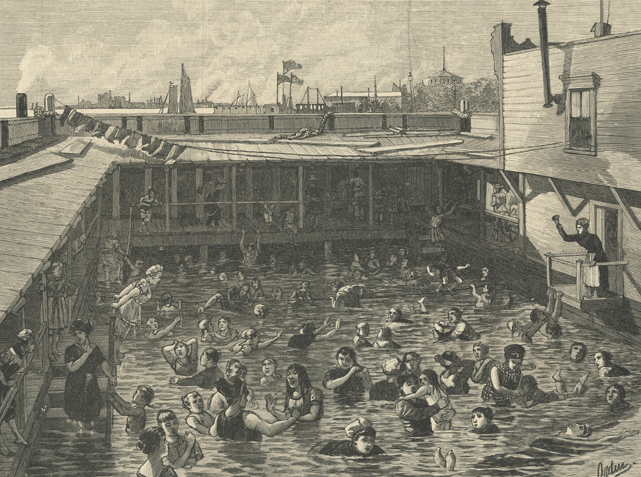 |
| Harpers Weekly September 2, 1882 Collection of Maggie Land Blanck |
|
Women's Day at A New York Swimming Bath- Drawn by H. A. Ogden
|
|
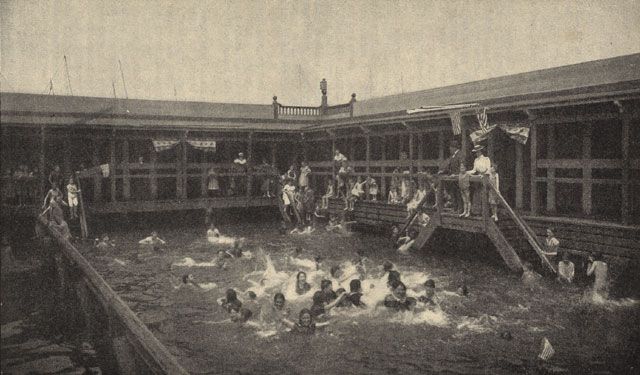 |
| Outlook 1905, Collection of Maggie Land Blanck |
|
A New York Floating Bath
|
|
| |
| Library of Congress
Mens Day at the city Baths
| |
| |
| Library of Congress
Mens Day at the city Baths
| |
 |
| Outlook 1905, Collection of Maggie Land Blanck |
|
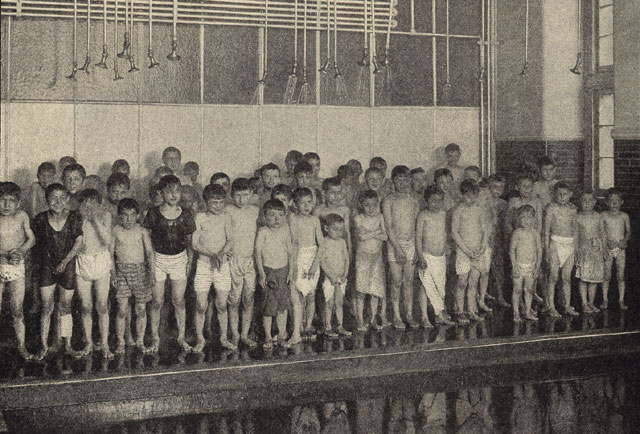
The Shower Bath in Public School 147, New York While the article includes this photo, very little was said about the use of showers in public schools. The children do appear to be standing in front of a swimming pool.
|
| |
|
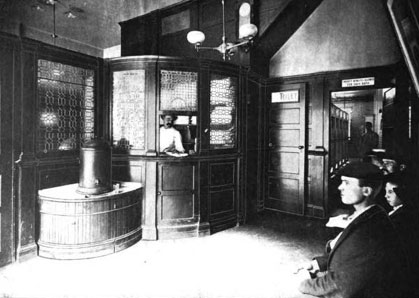
Waiting room in the Public Baths 1899-1900. The baths cost 5 cents, including soap and a towel. This bath had 17 shower heads for men, 6 shower heads for women, 3 tubs for "old women" and children. In July 1900 17,803 people made use of the facilities. (The tenement house problem: including the report of the New York ..., Volume 2 By New York (State). Tenement House Commission)
|
| |
| Library of Congress
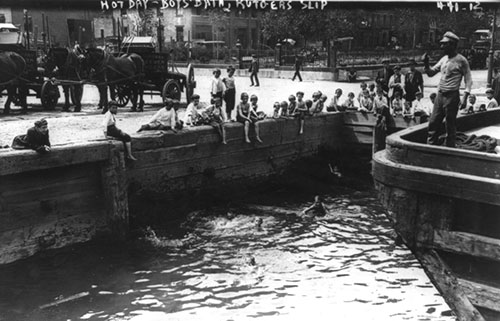
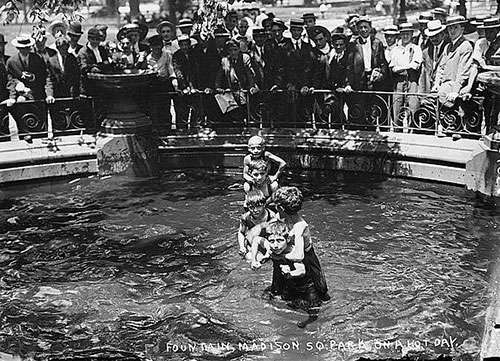
While not "officially" a bath, boys had the advantage of cooling off (and maybe getting a little clean) by jumping off any pier, into any river or fountain.
|
| |
| Library of Congress
|
|
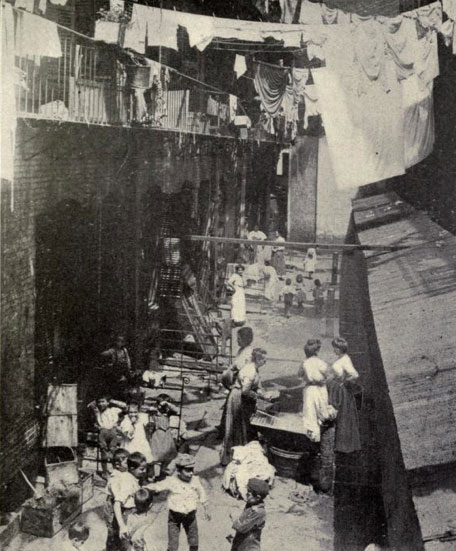
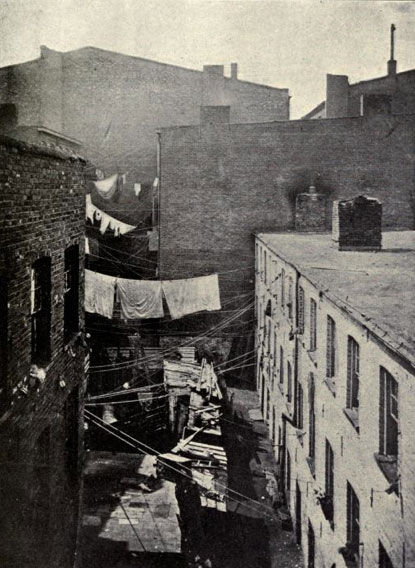
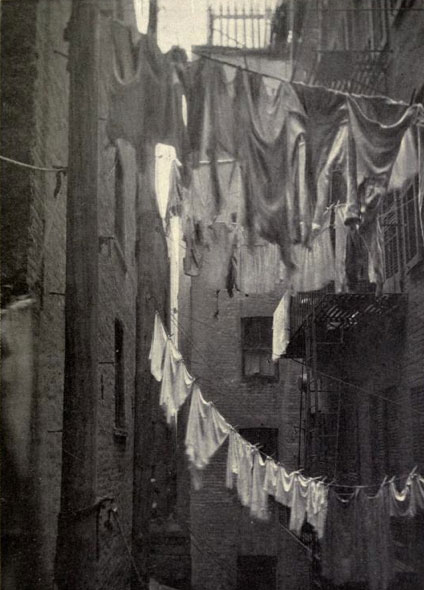
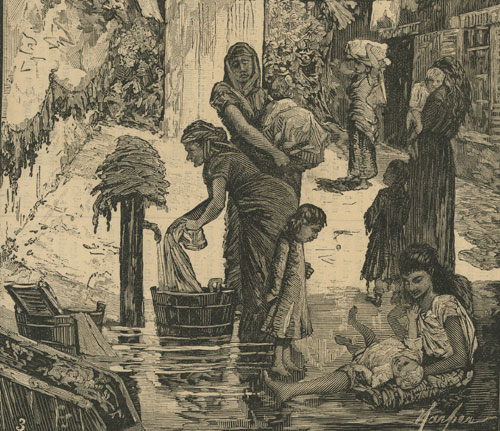
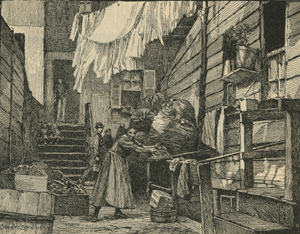
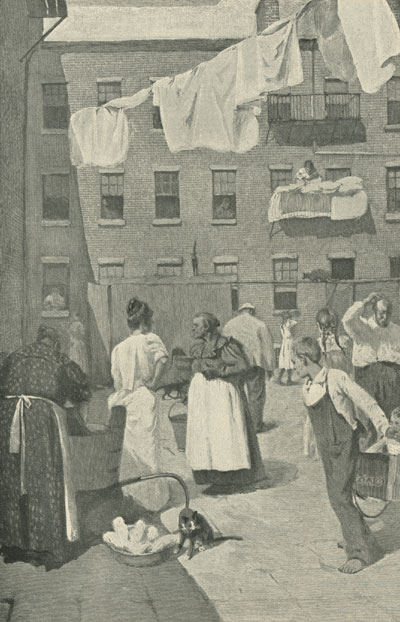
Laundry With all the talk about how dirty the tenement district was it is very impressive how many images of the tenements show laundry on the line - outside if the weather permitted inside if it was inclement.
|
|
Court yard, Roosevelt Street Tenement Life in New York - Mayor Grace's Tour of Inspection 1881 |
| Harpers weekly October 15, 1881,
drawn by W. St John Harper, collection of Maggie Land Blanck
| |
| "Washing among the Mulberry Street Tenements"
|
| Cosmo 1890, Co-Operative Housekeeping in Tenements by
Elizabeth Bislands, collection of Maggie Land Blanck
| |
|
| Century 1899, Collection of Maggie Land Blanck |
|
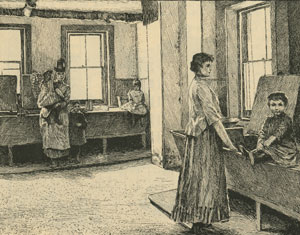
| Co-Operative Wash-Room |
| Cosmo 1890, Co-Operative Housekeeping in Tenements by
Elizabeth Bislands, collection of Maggie Land Blanck
| |
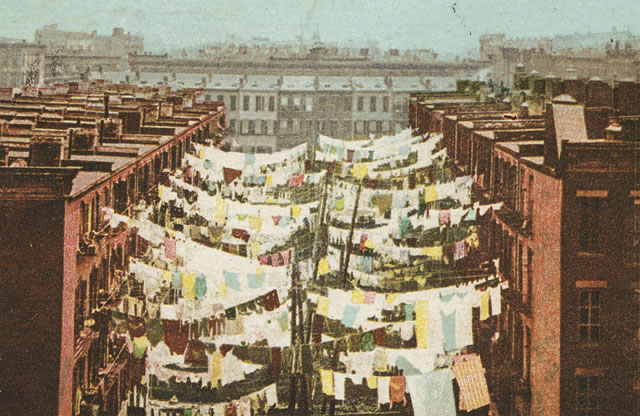
|
|
| Postcard collection of Maggie Land Blanck Yard of a Tenement, New York copyright 1900, posted 1906. | |
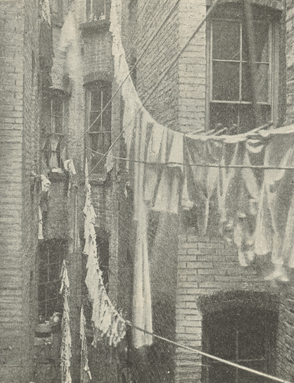
|
|
| Collection of Maggie Land Blanck, Riview, June 1900 The New York Tenement-House Commission by Jacob A. Riis
"Air-Shaft in an East-side Tenement | |
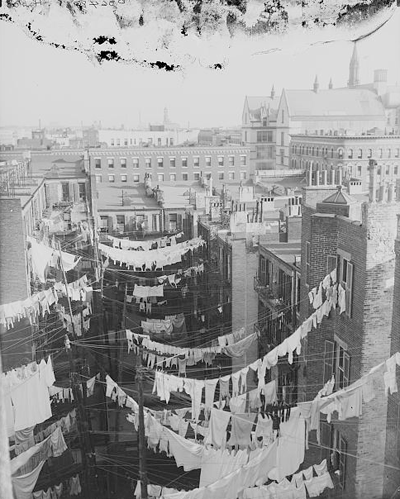
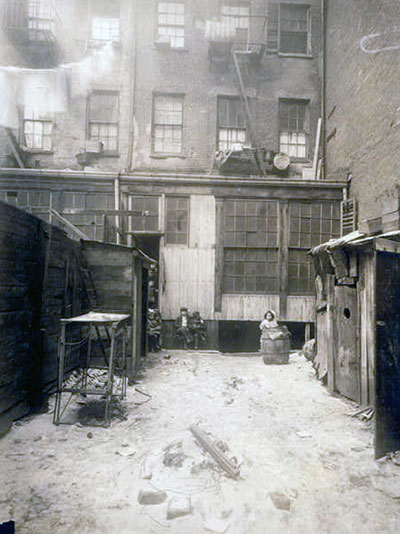
| Yard of tenement, New York, N.Y. between 1900 and 1910 |
| Library of Congress
| |
|
The Privy
|
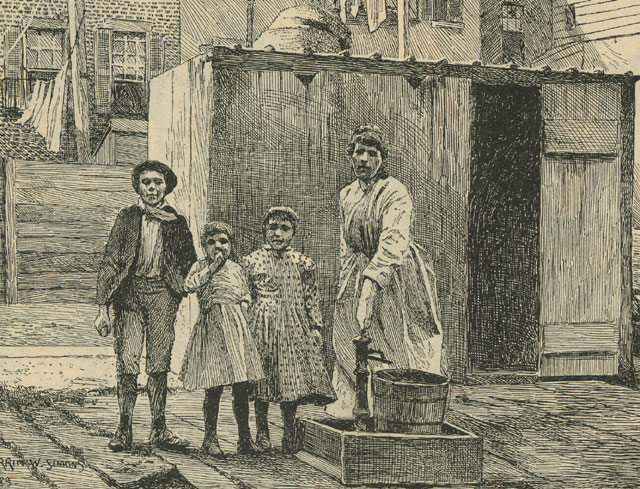
|
|
| Cosmo 1890, Co-Operative Housekeeping in Tenements by
Elizabeth Bislands, collection of Maggie Land Blanck "The Water Supply for Three Ludlow Street Tenement Houses 1890" While there is a lot of discussion in the literature of the period about washing of persons, washing of clothes, water in court yards and water in apartments, there is almost no mention of toilets (or lack thereof). Other than the occasionally mention of a chamber pot almost nothing is said. While this image is entitled "the water supply" the toilets in the background may not have been supplied with water. In other words, they may have been old-fashioned pit outhouses (AKA privies). Interestingly a lot of archaeological work has been done on the lives of tenement dwellers in New York as a result of excavating these old privies because people threw or dropped a variety of items in the privy. One of the most notorious tenement areas in New York was the infamous "Five Points", site of the "Gangs of New York". A lot of information about the lives of the people who live in Five Points has been obtained from the excavations of the privies in the area. My son, Damian Blanck, worked for several years on the Five Point project and helped build the web site which can be seen at The Five Points Site Unfortunately, the majority of the 850,000 artifacts found at Five Points were housed in the basement of Six World Trade Center which was destroyed on 9/11/01 when the facade of Tower One fell on it. Only 18 articles from the collection survived because they were on loan at the time. So the only remnants are the images on the web site and in some publications. Other outhouses, called school sinks, were rows of cubicles over a concrete vault which was connected to a common waste system. The system was periodically sluiced with water which flushed the wasted into a public sewer line. In 1901 the law in New York required 1 indoor toilet for every two apartments. See Plumbing Supply.com - The history of plumbing in America | |
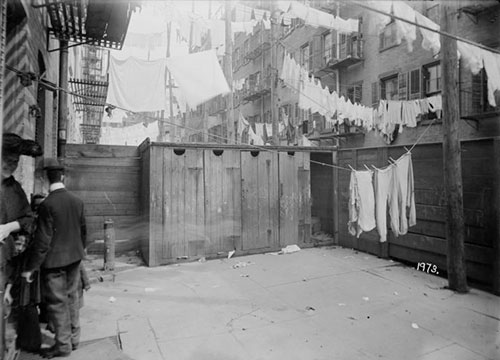
| |
| NYPL Digital Gallery ID1576442
Outhouse and laundry NY tenement back yard 1904 | |
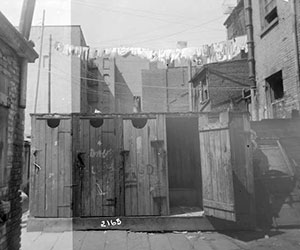
| |
| NYPL Digital Gallery ID1576443
Outhouse and laundry NY tenement back yard 1905 | |
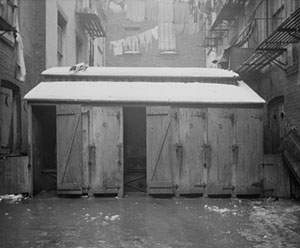
| |
| NYPL Digital Gallery ID1576427
Outhouse and laundry NY tenement back yard 1902 | |
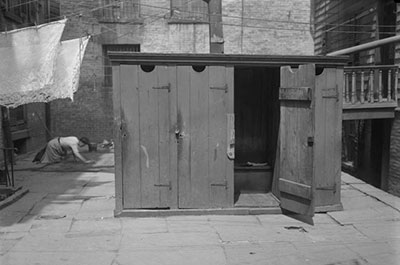
| |
| NYPL Digital Gallery ID1576448
Outhouse and laundry NY tenement back yard 1905 There is a women in the background on her knees scrubbing a rug and there are white lace curtains hanging on the line. | |
|
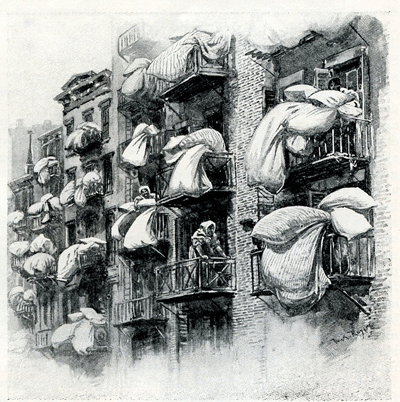
Cleaning
|
|
|
| Harper's 1898, Collection of Maggie Land Blanck Feather Bed Day | |
|
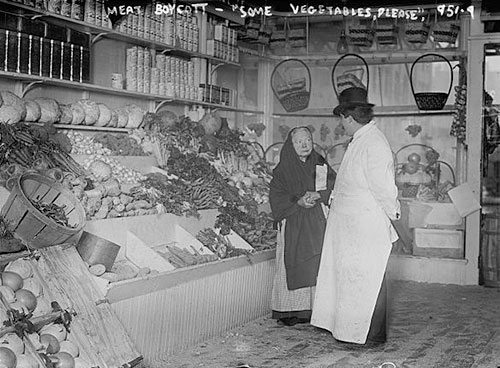
Food and Shopping Most tenement dwellings did not have refrigeration until the 1930s. In the summer time it was necessary to shop frequently since the food would not keep. |
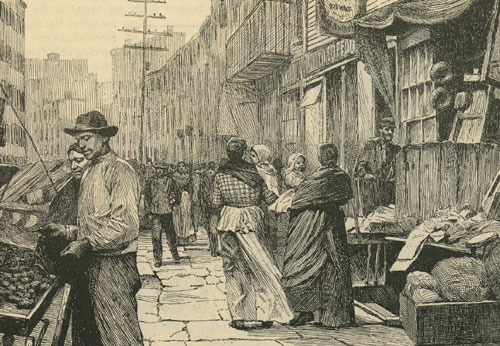
| Click on the image of Mulberry Street to see more images and get more information on street venders on the Lower East Side |
| |
| Library of Congress
Grocery store 1910.
| |
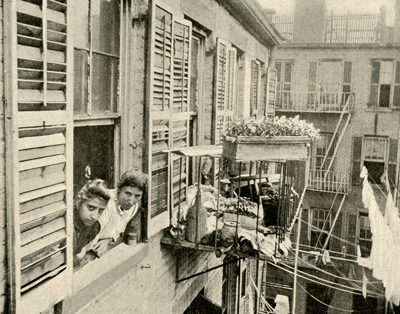 |
| Picture cut from Zeisloft's The New Metropolis, 1899, Collection of Maggie Land Blanck |
|
IN LIEU OF A REFRIGERATOR, THE FIRE ESCAPE IS UTILIZED FOR THE
DAY'S MARKETING
Information on Refrigeration in the Tenements by Herb I. Deutsch
See also
Butchers
|
|
|
Christmas
| ||
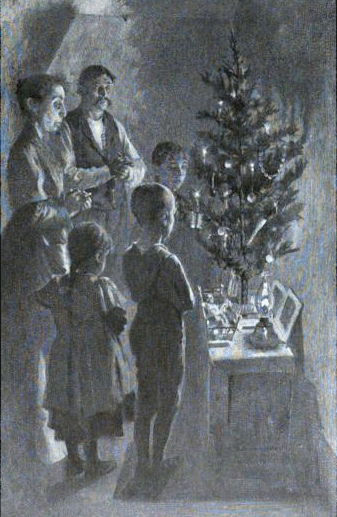 |
MERRY CHRISTMAS IN THE TENEMENTS |
| Jacob A Riis
| |
|
|
Pets The following images are also found in other sections of this page and other related pages. I gathered them together to illustrated the fact that people obviously kept pets including cats, dogs, and even apparently a pigeon. |
|
|
1892 Scribner
Harpers Weekly 1879
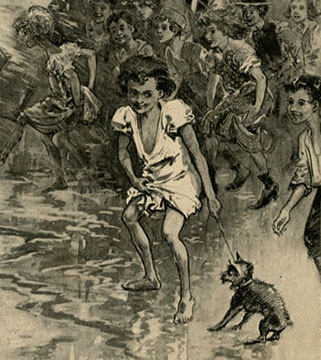
Harper's Weekly undated
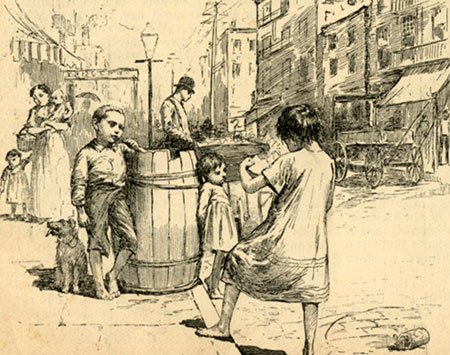
Harper's Weekly undated
Harper's Weekly December 20, 1873, Collection of Maggie Land Blanck, |
|
The Cliff-Dwellers of New York Lest we think that only the working poor lived in multi storied multi family dwellings - such buildings were also the home of the wealthy. However, there were some major differences. Everett N Blanke in the "Cliff Dwellers of New York" published in Cosmo in 1893 says the distinction between an apartment house and a tenement is "somewhat hazy" until one considers the etymology of the two words. "Tenement" is derived from the Latin verb "ternere" (to hold) and is the name properly given to a building that is designed to hold or to give shelter to the largest possible number of persons, at least possible cast to each individual tenant. "Apartment" however, is an anglicized derivation of another Latin verb, "partare" (to divide), and with equal propriety is applied to a dwelling house, of which the structural and social intent is to separate family from family and to gratify the desire for privacy that every household naturally feels, at the same time reducing the expense of that gratification to a low estimate,....... Economy, there fore, is the purpose of the tenement - comfort that of the apartment."The big difference is clearly in the comforts provided by the "apartment" buildings. The first "apartment" house, called Stuyvesant, was build in 1870. By 1893 New York contained 700 "apartment" houses. Nearly all of them were equipped with "electrical and steam appliances". This included the passenger elevator which made the upper stories of these building more - instead of less desirable - as the top floors of walk up tenements were. The easily accessible top floor was far away from the dust and noise of the street and nearer a cooling summer breeze. However, most of New York's wealthy left the city to spent the summer at their county or beach houses. Eclectic lighting was clean, odorless and constant. Steam heat was controlled by a thermostat enabling a constant temperature. The ordinary apartment consisted of seven to ten spacious rooms generally all on one level. Moreover, the wealthy had servants - maids, butlers, cooks and nursemaids - to take care of those nasty chores for them. Information from"The Cliff-Dwellers of New York" by Everett N Blanke, Cosmo 1893.
| ||
| "Life in New York Tenement-Houses as seen by a city missionary" by William T Elsing.
Several images and some information came from an article entitled "Life in New York Tenement-Houses as seen by a city missionary" by William T Elsing. There are numerous venders of historical images and articles who cut up old publication and sell them as individual items. Unfortunately, when I bought this article the name and date of the periodical were missing. I had tentatively dated the article to 1903 because Elsing makes reference to "The first bath was opened last August". Other sources refer to the first public bath opening in New York City on Rivington Street in 1902. Trying to give an exact date to Elsing's article, I looked on line. I can find several references to an article of exactly the same title attributed to Scribners June 1892. Unfortunately, I was not able to access the actual article. The reference to the baths opening a year before is confusing but I believe that the article I have is that from Scribners June 1892. William T. Elsing was a minister and social reformer whos name is connected in several publications with the well known social reformer, Jacob Riis. William T Elsing was born in 1852 in Holland. He was listed in the 1900 Census in Queens as a preacher with his wife Mary and two sons, Morris, age 17, and Warren, age 14 and a servant. In 1910 he was listed in Ward 19 Brooklyn, as a boarder, married, clergyman city mission, his wife was not listed. In 1920 he was in Manhattan, pastor church, age 69 widowed. | ||
| "Good Tenements For A Million People, the Story Of
New York's Successful Fight For Better Housing" by Emily Wayland Dinwiddie circa 1909
publication unknown
Several images and some information came from an article entitled "Good Tenements For A Million People, the Story Of New York's Successful Fight For Better Housing" by Emily Wayland Dinwiddie As with the William Elsing article this one came undated and the publisher unknown. It does refer to the New York City Tenement House Department report of 1909. Emily Wayland Dinwiddie born 1849 died 1947 was a social worker. | ||
| James Dabney McCabe Jr 1842-1883,
Lights and Shadows of New York, Sights and Sensations of the Great City,
1872 Talking of Wards 4, 5, 6, 7, 8, 9, 10 11, 13, 14, 15 and 17 in the 1870 census James Dabney McCabe Jr. says: The section of the city embraced in the wards we have named is filled with a class of buildings called tenement houses. The law classes all dwellings containing three or more families as tenement houses, but the true tenement house is an institution peculiar to New York. There are about 70,000 buildings in the city used for purposes of business and as dwellings, and of these, 20,000 are tenement houses, containing about 160,000 families, or about 500,000 people. This would give an average population of eight families or twenty persons to each tenement house in the city. In 1867 the number of tenement houses was 18,582.Note: See 88 -90 Sheriff Street for more information on the rag pickers of Lower Manhattan. MLB
The Board of Health, in one of their recent publications, express themselves as follows:"The worst class of tenement houses was those where a landlord had accommodations for ten families, and these buildings comprise more than half of the tenement houses of the city, and accommodate fully two-thirds of the entire tenement-house population. When the number of families living under one owner exceeded ten, it was found that such owner was engaged in the keeping of a tenement-house as a business, and generally as a speculator. It is among this class of owners that nearly all the evils of the tenement-house system are found. The little colony exhibit in their rooms, and in the little areas around their dwellings, extreme want of care. The street in front of the place was reeking with slops and garbage; the alleys and passage ways were foul with excrements; the court was imperfectly paved, wet, and covered with domestic refuse; the privies, located in a close court between the rear and front houses, were dilapidated, and gave out volumes of noisome odors, which filled the whole area, and were diffused through all the rooms opening upon it; and the halls and apartments of the wretched occupants were close, unventilated, and unclean. The complaint was universal among the tenants that they are entirely uncared for, and that the only answer to their request to have the place put in order, by repairs and necessary improvements, was, that they must pay their rent or leave. Inquiry often disclosed the fact that the owner of the property was a wealthy gentleman or lady, either living in an aristocratic part of the city or in a neighboring city, or, as was occasionally found to be the case, in Europe. The property is usually managed entirely by an agent, whose instructions are simple, but emphatic, viz., 'collect the rent in advance, or, failing, eject the occupants.' The profits on this sort of property, so administered, are rarely less than fifteen per cent., and more generally thirty per cent. upon the investment."The evils of the tenement house system are almost incalculable. It is the experience of all nations that barrack life is demoralizing, and the tenement house is but a barrack without the rigid discipline of a military establishment. Its inmates know no such thing as privacy. Home is but a word with them. They have habitations, but not homes. Within the same walls are gathered the virtuous and the depraved, the honest laborer and the thief. There can be no such thing as shielding the young from improper outside influences. They have every opportunity to become thoroughly corrupted without leaving the house. Decency is impossible. Families exist in the greatest amount of personal discomfort, and the children take every opportunity to escape from the house into the streets. The tenement houses every year send many girls into the ranks of the street walkers, and a greater number of young men into the ranks of the roughs and thieves. | ||
| The Street
| |
 |
|
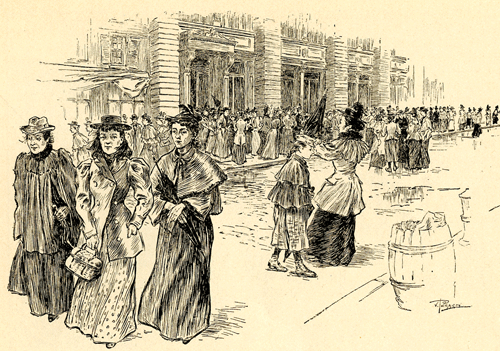
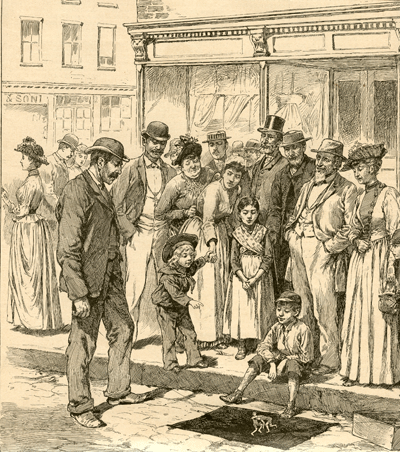
| Scribners Oct 1896, Collection of Maggie Land Blanck,
"In front of a Box Factory in Hester Street at Six O'clock" | |
 |
|
| Frank Leslies' Illustrated Newspaper, October 6, 1889 Collection of Maggie Land Blanck | |
 |
|
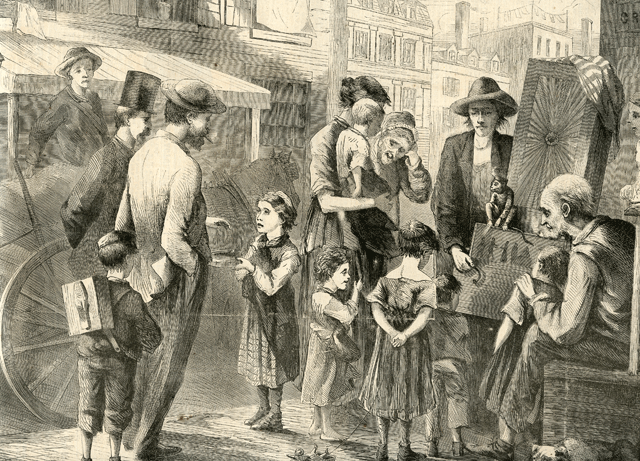
| HARPER'S WEEKLY NOVEMBER 17, 1866,
Collection of Maggie Land Blanck
STREET MUSIC - THE ORGAN GRINDER | |
 |
|
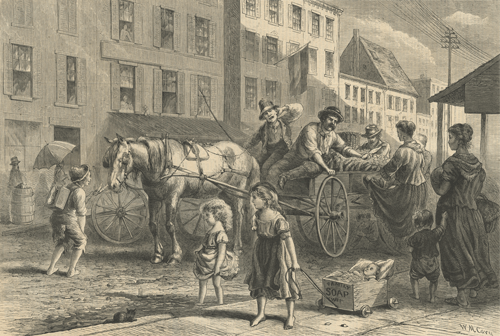
| Collection of Maggie Land Blanck. STREET VENDERS OF FRUITS AND VEGETABLES September 22, 1871 Harper's Weekly Street venders generally plied their wares among the poor. Frequently they were selling produce rejected by the more upscale markets. There was no such thing as a supermarket. The street venders made "the air hideous with their loud, uncouth cries".
| |
 |
|
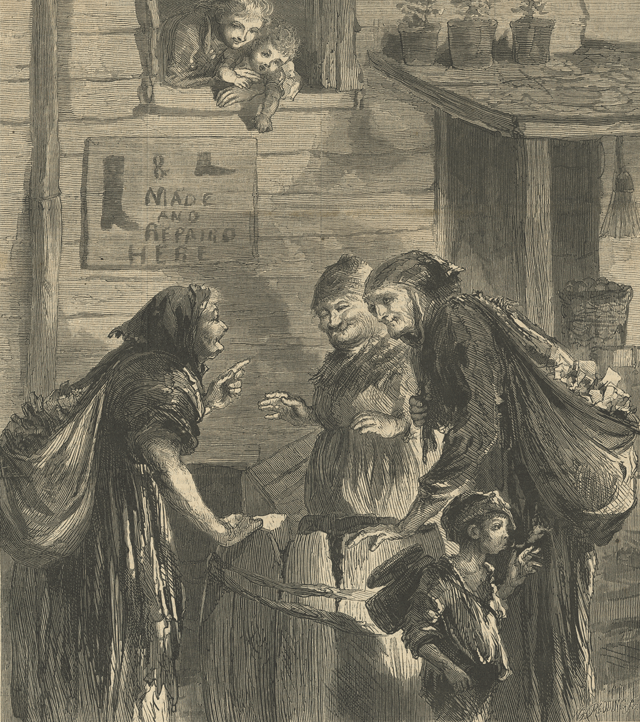
| HARPERS WEEKLY SEPTEMBER 8, 1877,
Collection of Maggie Land Blanck
THE GOSSIPS Notice the boy smoking. | |
|
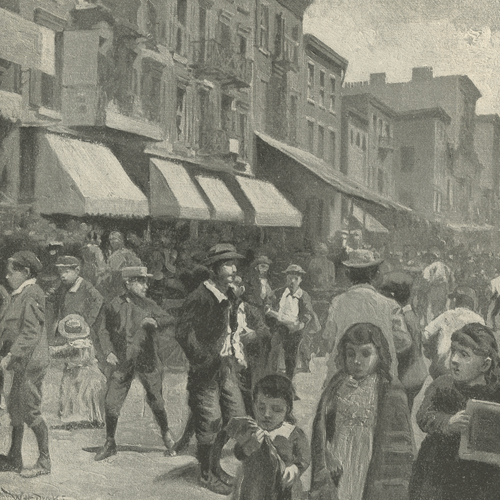 |
| Century September 1894, Collection of Maggie Land Blanck
|
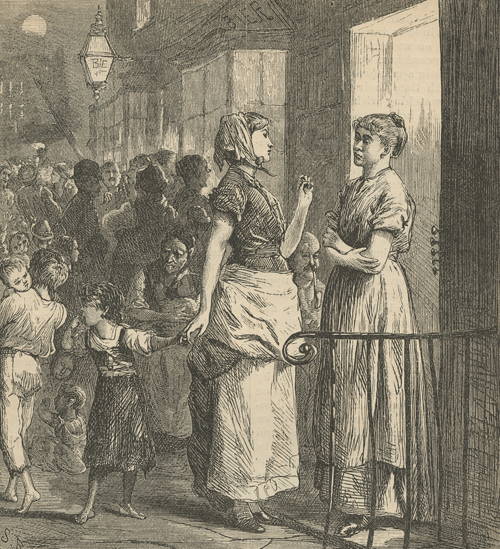 |
|
| HARPERS October 1878,
Collection of Maggie Land Blanck
Teutonic Regions in New York — Hot Summer Night In the days before Air Conditioning and TV people escaped the hot tenements and took to the streets which were very lively in the evenings. | |
| Labor Many tenement dwellers lived and worked in the same Space. | |
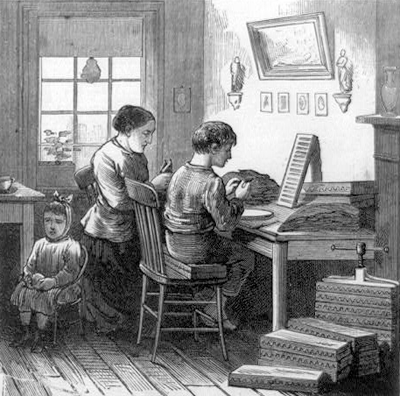 |
|
| Library of Congress,
Library of congress TENEMENT HOUSE CIGAR MAKERS Frank Leslie's Illustrated Newspaper, 1877 Nov. 3. | |
| Public Health
| |
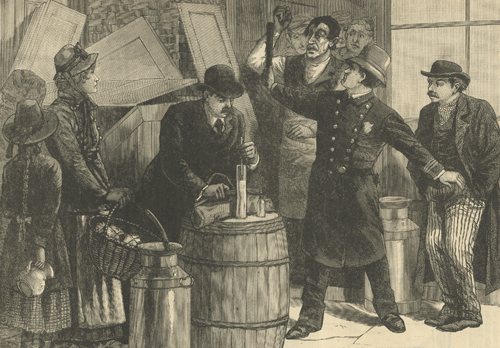 |
|
| Frank Leslie's
Illustrated newspaper 10 Dec 1887, collection of Maggie Land Blanck. THE MILK SUPPY OF CITIES AN INSPECTOR TESTING MILK AT A GROCERY ON THE EAST SIDE, NEW YORK CITY The New York City Board of Health tried to regulate and inspect milk, cream and other dairy products. A store keeper needed a permit to sell milk. If the conditions of the store were not satisfactory, the permit would be revoked. Concerns included: the adulteration of the milk with such things as water and chalk, bacteria in the milk, other contaminants like dirt and dust. In 1910 there were 13,000 stores and 4,500 wagons selling milk in New York City. Sometimes I buy an image that has been cut from a puplication and the related information is missing. This was the case with the above image. In April 2013 Ian Ellis was kind enough to write and let me know it was from Frank Leslie's Illustrated newspaper 10 Dec 1887. See Today in Science and US Milk Instector | |
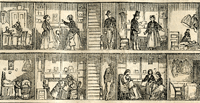
| Tenements As Seen in Frank Leslie's Illustrated Newspaper,
July 1, 1865
Click on image. |
 | |
| Children of the Tenements Click on image. |
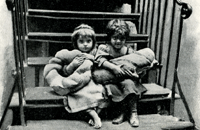 | |
| New York Immigration Pictures With only two exceptions, the Blanck/Land ancestors immigrated through New York City between 1849 and 1921. For pictures and information on immigration into New York City, click on the picture of immigrants in Castle Gardens in 1880 |
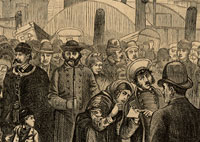
|
|
| |
| Contrasts in Life Style between the Haves and Haves Nots Click on image. |
 |
| Lower East Side Click on image. |
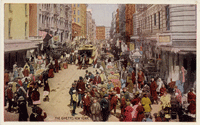 |
|
| |
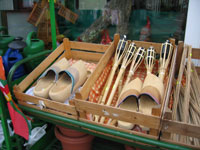
| Life in Germany Catherine Furst, Julius Lindemann, Peter Goehle, Henry Blanck, the Erxmeyers, the Petermanns were among the millions of German American immigrants. For images of life in Germany, click on the picture of the wooden shoes |
|
| The Lower East Side Tenement Museum has information on the 1901 Tenement House Art at The Tenement House Act by Andrew Dolkart | ||
| The Lower East Side Tenement Museum's home page is at Lower East Side Tenement Museum | ||
| Jerome Myers (1867-1940) painted images of the immigrant life of the Lower East Side. See Jerome Myers | ||
| Catherine Furst Schwartzmeier Lindemann | Minnie Goehle | Peter Goehle |
| Langans in New York City | Walshes in New York City | |
To see my collection of images of lower Manhattan go to
Lower Manhattan
| To see my collection of images of the immigration experience go to
Immigration
| To see my collection of images of the immigration experience from Ireland go to
Irish Emigration
| An infamous tenement
88 - 90 Sheriff Street
| Shopping and Street Venders
Shopping and Street Venders
| James Dabney McCabe Jr 1842-1883
|
|
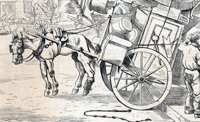
| May 1st Moving Day in NYC
May 1st was a day when many leases, both commercial and
residential, expired. Consequently the city was jammed with moving wagons.
|
 |
|
| |
| The Temperance Movement For early pictures representing the Temperance Movement in New York City |
 |
|
| |
| If you have any suggestions, corrections, information, copies of documents, or photos that you would like to share with this page, please contact me at maggie@maggieblanck.com |
| RETURN TO TOP OF PAGE |
|
Please feel free to link to this web page. You may use images on this web page provided that you give proper acknowledgement to this web page and include the same acknowledgments that I have made to the provenance of the image. Please be judicious. Please don't use all the images. You may quote up to seventy five words of my original text from this web page and use any cited quotes on this web page provided you give proper acknowledgement to this web page and include the same acknowledgments that I have made to the provenance of the information. Please do not cut and paste the whole page. You may NOT make use any of the images or information on this web page for your personal profit. You may NOT claim any content of this web page as your original idea. Thanks, Maggie |
| This page was created in 2008: Latest update, October 2013 |