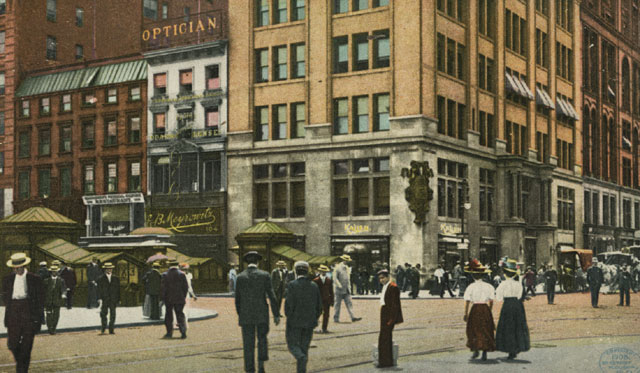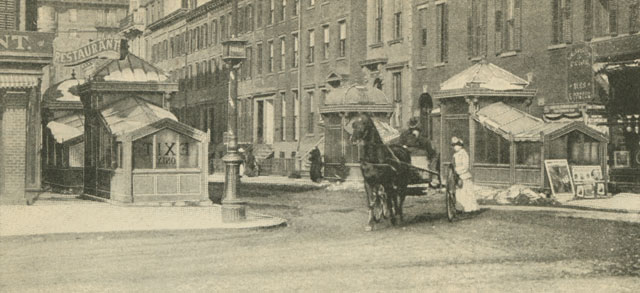
Not posted
| Lower Manhattan |
| HOME - New York City - Peter Goehle - Catherine Schawrzmeier Lindemann - Langans in New York City |
|
Lower Manhattan Everyone who came through the port of New York from the mid 1800s to 1891 entered officially though Castle Gardens in what is now Battery Park. Everyone entering the port of New York after 1891 liked, Mathias, Nappy, James and Bridget Langan, entered the States through Ellis Island. For more information on the immigration process click HERE. Catherine Furst Schwarzmeier Lindemann, Julius Lindemann, Minnie Lindemann Goehle, Catherine Lindemann Beyerkohler Van Loo and Peter Goehle all lived on the Lower East Side in "Little Germany". Early addresses for the Langans were along 2nd Avenue between 14th and 43rd Streets. This section includes pictures and information on Manhattan from Battery Park to below 34th Street. For information on
other parts of New York City go to:
| |
|
| Postcard collection of Maggie Land Blanck |
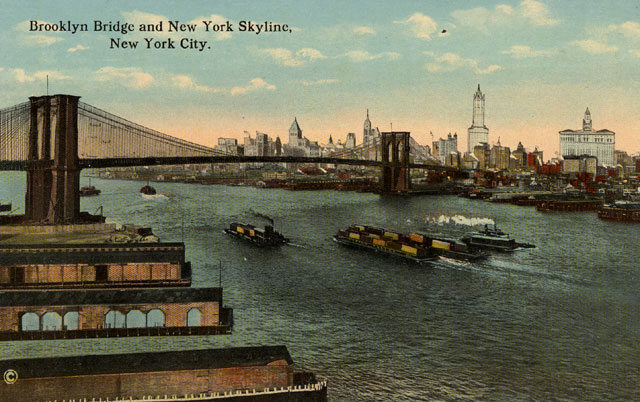
| Brooklyn Bridge and New York Skyline, New York City Not posted |
|
| Lower Broadway
| |
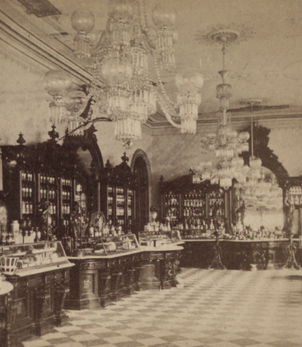 | |
| Wikimedia Commons, Interior of Helmbold's Drug Store, from Robert N. Dennis
collection of stereoscopic views, New York Public Library, Digital Library
Helmbold's Pharmacy, 594 Broadway Dr Henry T. Helmbold, born in Philadelphia in 1826 was a dealer in patent medicines. He came to New York from Philadelphia in 1863 where he opened a drug store at 594 Broadway (on the east side near Prince, between the Metropolitan Hotel and Niblo's Theater and opposite the San Francisco Minstrel Hall). According to a New York Times article of 1897 Helmbold's Pharmacy "became the wonder of the city". Helmbold made a huge fortune but was arrested as a "lunatic" in Philadelphia in 1877 and was committed to an asylum. He was released in 1885 but arrested again in New York in 1889. He died in an asylum in Trenton, New Jersey in 1894. He made and sold "Helmbold's buchu" a concoction of water, licorice root, alcohol, caramel, molasses, oil of peppermint and tincture of cubebs*. It supposedly cured disease of the bladder, kidneys weakness, nervousness, loss of memory, dimness of vision, lassitude of the muscular system and more. It cost $1.00 for a 3½ ounce bottle. *Cubeb piper cubeba is a pepper.
A DESCRIPTION OF THE STORE. | |
 | |
| New York Public Library, Digital Library ID 805271,
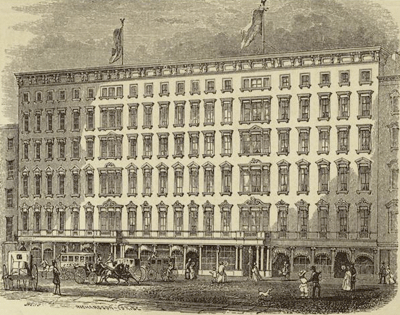
St Nicholas Hotel 1863 The St Nicholas Hotel was located between Mercer and Broadway below Spring Street. It fronted on Broadway.
"The St. Nicholas is one of the best houses in the city. It shows a handsome marble front on Broadway, with a brown stone extension on the same thoroughfare to Prince street, and extends back to Mercer street. | |
 | |
| New York Public Library, Digital Library ID 805282,
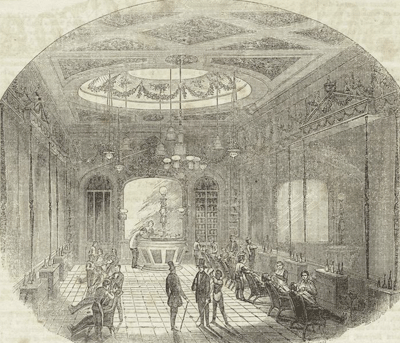
Interior View of Phalon's New Salloon, the the St. Nicholas Hotel (1853) | |
 | |
| New York Public Library, Digital Library ID G91F209_062F,
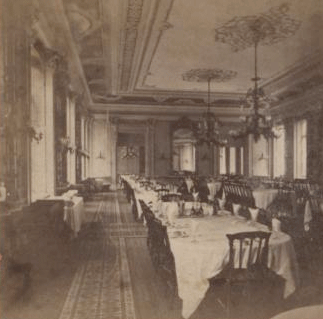
Dining Room of the St Nicholas Hotel. (1859?-1896) | |
 | |
| New York Public Library, Digital Library ID 800584,
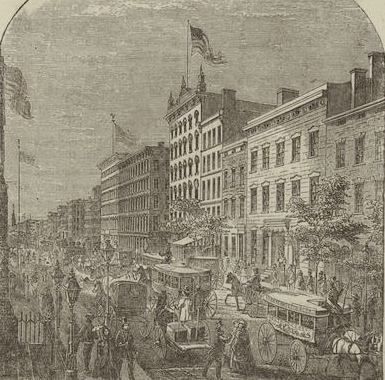
Broadway as seen from the St Nicholas Hotel, Sights and Sensations of the
Great City page 129
Broadway below Spring Street as seen from the St Nicholas Hotel, circa 1872
| |
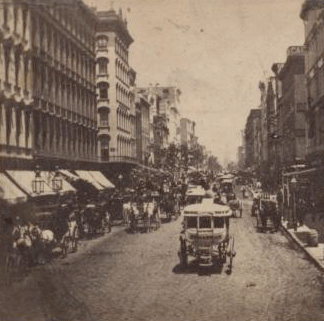 | |
| New York Public Library, Digital Library ID G91F84_018F
Broadway from opposite the St Nicholas Hotel, looking North. [Anthony's instantaneous views. No. 315] ([Ca. 1860])
| |
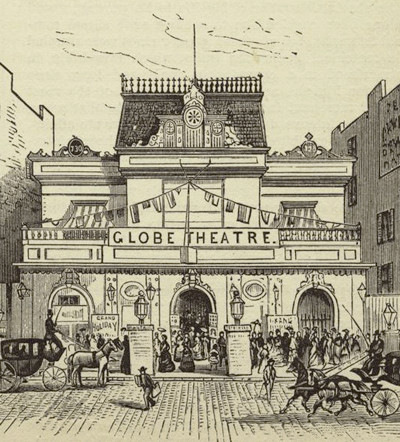 | |
| New York Public Library, Digital Library ID 809944
The Globe Theatre, Broadway, Opposite Waverley Place, N. Y. owned by Mr Steward (1876) The Globe Theatre was listed in the 1871 Almanac: "Globe Theatre, 728 Broadway, opposite Waverley Place, variety performances" Originally the Unitarian Church of the Messiah it opened as a theater called the Athenaeum in 1865. The names was changed many times. It was called the New Theatre Comique in 1881. It burnt in 1884 and was not rebuilt. | |
The World Almanac and Book of Facts 1871
listed the following places of amusement on or near Broadway and 14th or below:
" There are sixteen theatres in New York usually in full operation. Taking them in their order of location from south to north, they are the Stadt, the Bowery, Niblo's, Theatre Comique, the Olympic, Lina Edwin's, the Globe, Wallack's, Union Square, the Academy of Music, the Fourteenth Street, Booth's, the Grand Opera House, the Fifth Avenue, the St. James, and Wood's.Comments on the Olympic Theatre from "Lights and Shadows of New York Life: or, the Sights and Sensations of the Great City" by James Dabney McCabe, 1872: " The Olympic is a large, old-fashioned theatre, on Broadway, between Houston and Bleecker streets. It is devoted to pantomime, and is famous as the headquarters of the erratic genius who calls himself Humpty Dumpty." | |
| South Ferry | |
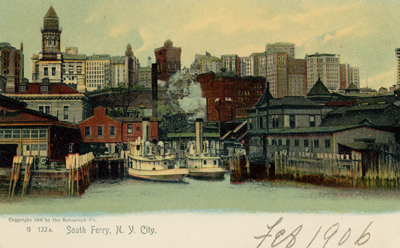 |
South Ferry, N.Y. City copyright 1905 |
| Postcard collection of Maggie Land Blanck | |
| Battery Park | |
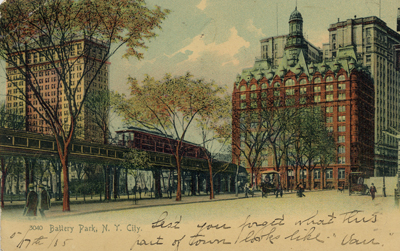 |
Battery Park, N.Y. City
Post marked 1905 |
| Postcard collection of Maggie Land Blanck | |
| The Financial District | |
 |
 |
| Postcard collection of Maggie Land Blanck | |
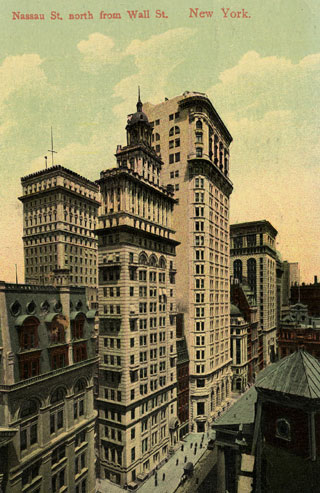
| Nassau St. north of Wall St., New York
Posted 1909 |
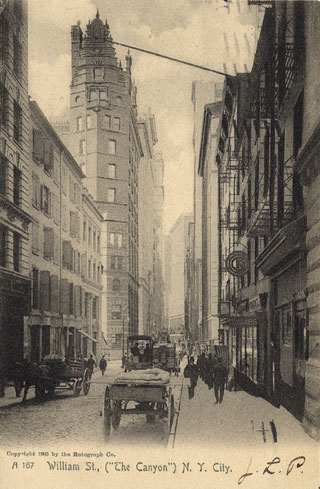
William's St., (The Canyon") N. Y. City
Posted 1906 |
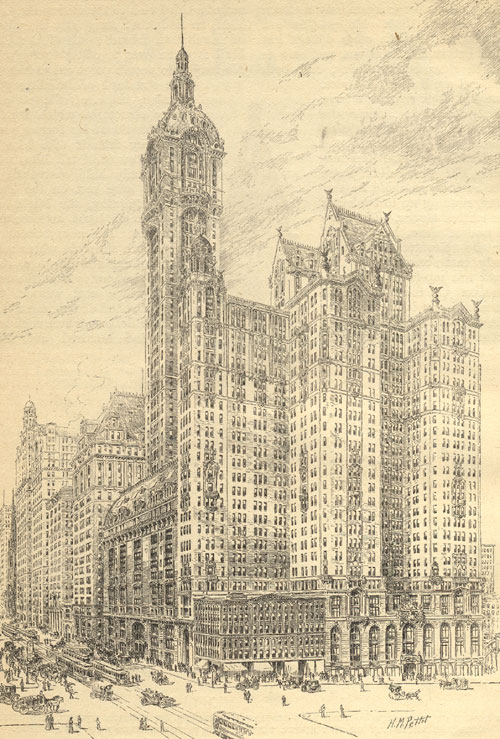 |
Broadway and Cortlandt Streets, New York 1908 |
| Munsey Magazine, 1908, collection of Maggie Land Blanck | |
| In the foreground the Building of the City Investing Company. At
No. 149 Broadway (Corner Liberty Street) the Singer Building was the highest
building in the world at that time, with forty seven stories and nine and a half acres of floor space.
Before the late 1890s an easy way to get to the upper floors and restrictions in building materials limited the construction of tall office and apartment buildings. While elevators did exist, they were slow and run by steam. The upper floors of taller buildings were low rent and often occupied by the janitor. By 1899 building up to 12 stories with speedy and comfortable elevators were being built. By 1901 almost all of Manhattan south of city hall was occupied by tall office buildings. The Park Row Building for instance had 32 stories, 950 rooms, and elevators with a daily traffic of 25,000 people. The new taller buildings introduced "express" as well as local elevators. In the early 1900s one building quickly replaced another as "the tallest building in the world". | |
| Lower Broadway | |
 | |
| Harper's Weekly July 27, 1889, Collection of
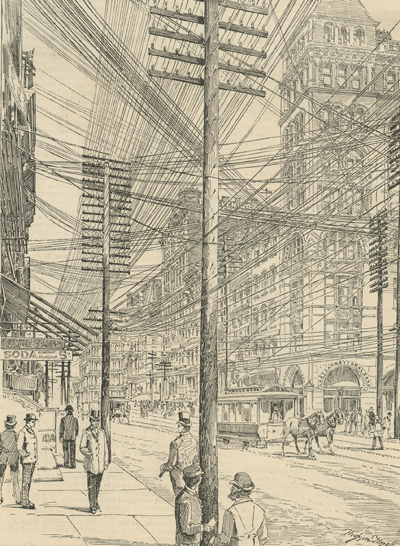
Maggie Land Blanck DISORDERLY WIRES ON LOWER BROADWAY ABOUT TO BE CUT DOWN The building to the right of the horse trolley is identified as the "Chatham National Bank" which was at 192 Broadway. | |
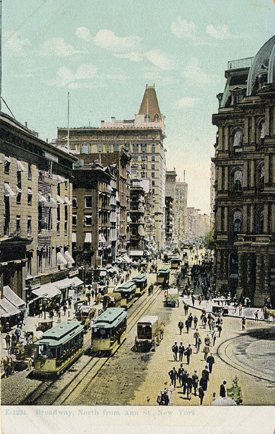 |
Broadway, North from Ann St., New York No date |
| Postcard collection of Maggie Land Blanck | |
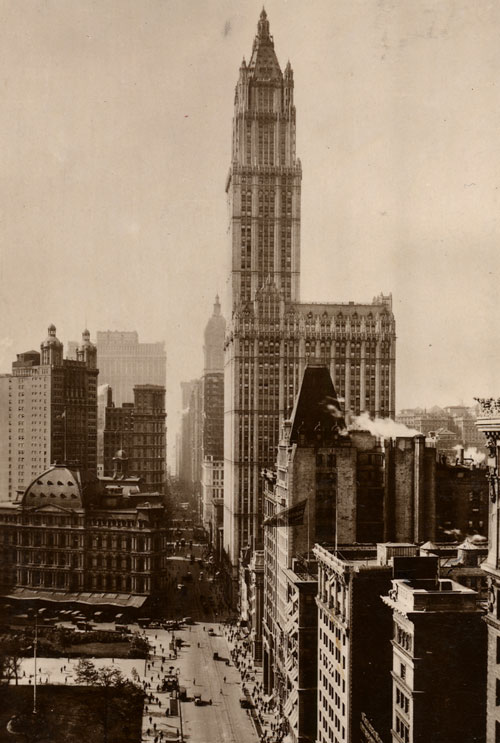 |
Broadway Downtown and Woolworth Building, New York No date |
| Postcard collection of Maggie Land Blanck | |
 |
Broadway Central Hotel, Broadway and Third Street, New York No date |
| Postcard collection of Maggie Land Blanck | |
| Around City Hall | |
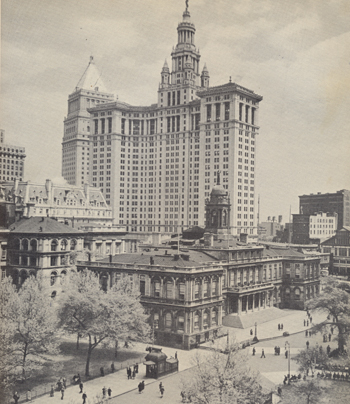
|
City Hall is the low building in the foreground.
The Municipal Building is the tall building in the background. The Municipal Building designed by McKim, Mead and White was built in 1914. |
| New York City, State, and Nation by Sol Holt, a 1955 Junior High School civics book. | |
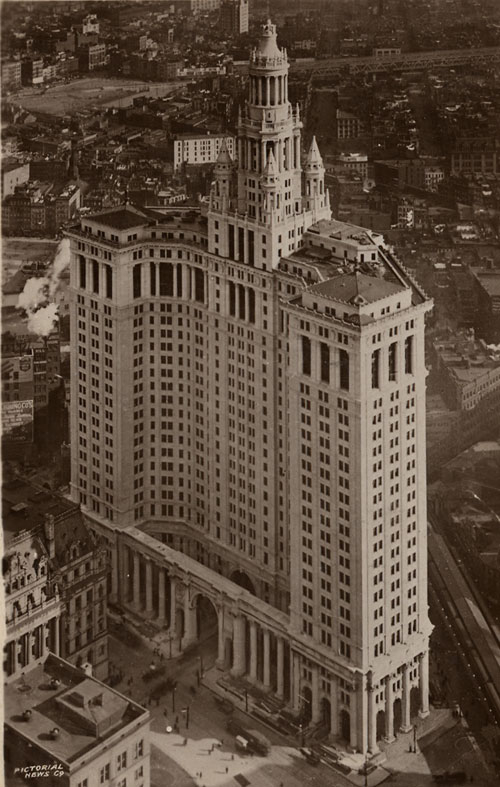 |
Municipal Building, New York No date |
| Postcard collection of Maggie Land Blanck | |
 | |
| Postcard collection of Maggie Land Blanck | |
|
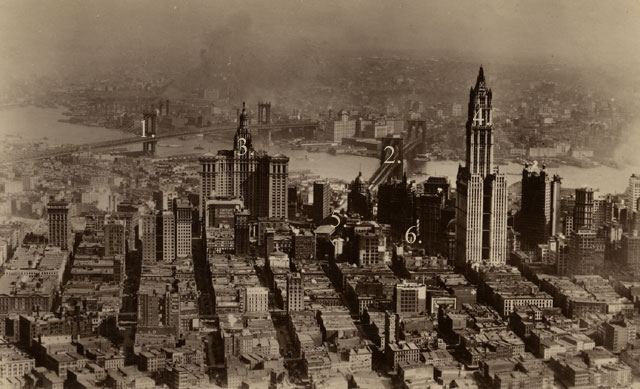
Downtown, New York, and East River Bridges, From An Aeroplane, New York Posted 1923
| |
 | |
| Postcard collection of Maggie Land Blanck | |
|
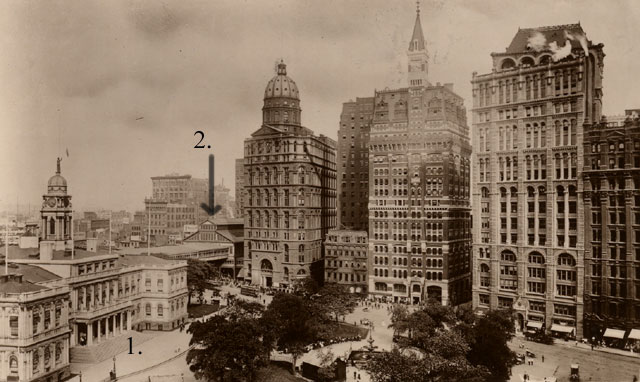
City Hall Park , New York Not posted
| |
 | |
| Postcard collection of Maggie Land Blanck | |
|
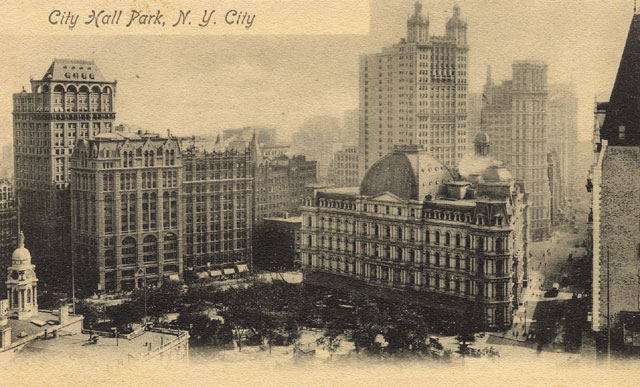
City Hall Park Not posted
| |
| Manhattan Entrance to the Brooklyn Bridge | |
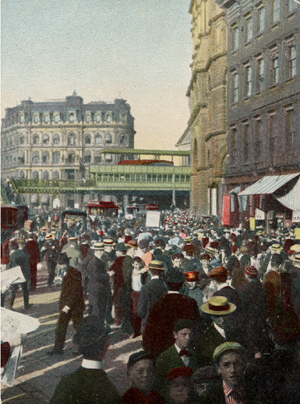 |
Jam at the Brooklyn Bridge during the Rush Hours, N. Y. City Posted 1909 |
| Postcard collection of Maggie Land Blanck | |
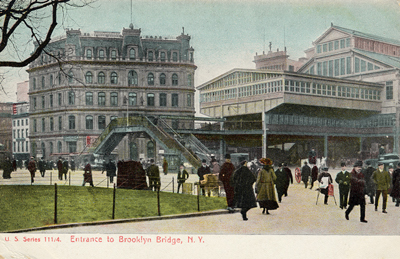 |
Entrance to Brooklyn Bridge, N. Y No date |
| Postcard collection of Maggie Land Blanck | |
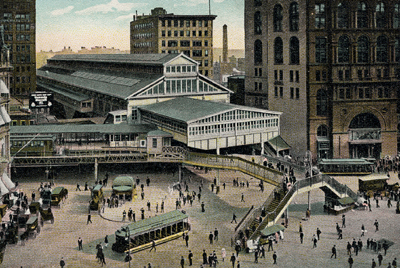 |
Entrance to Brooklyn Bridge, N. Y No date |
| Postcard collection of Maggie Land Blanck | |
| The Skyline From Brooklyn | |
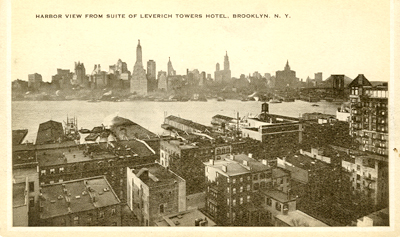
|
Harbor View From Suite Leverich Towers
Hoter, Brooklyn, New York No date |
| Postcard collection of Maggie Land Blanck | |
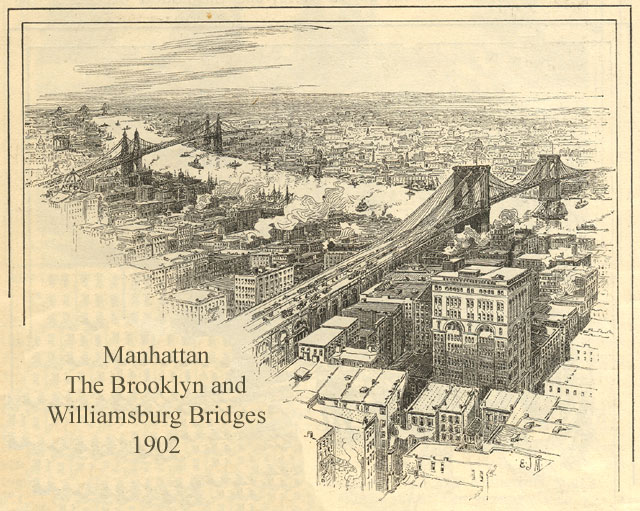 |
| Munsey magazine 1902, collection of Maggie Land Blanck |
| Today the FDR runs along the water's edge between the Brooklyn Bridge and the Williamsburg Bridge.
Just east of the FRD are the Alfred E. Smith Houses and Knickerbocker Village.
|
| Arial Views of Lower New York City Pre 1967. | |
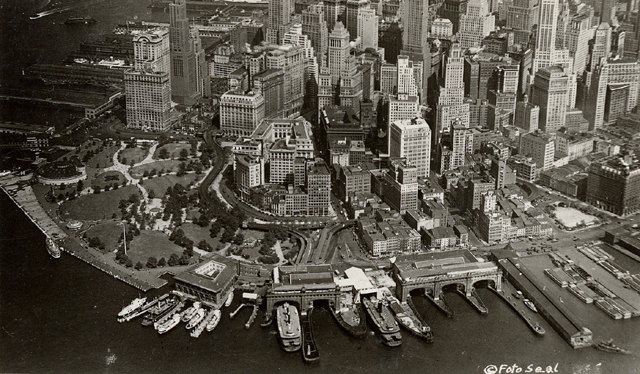
| |
| Postcard collection of Maggie Land Blanck | |
| Close up from the above photo
| |
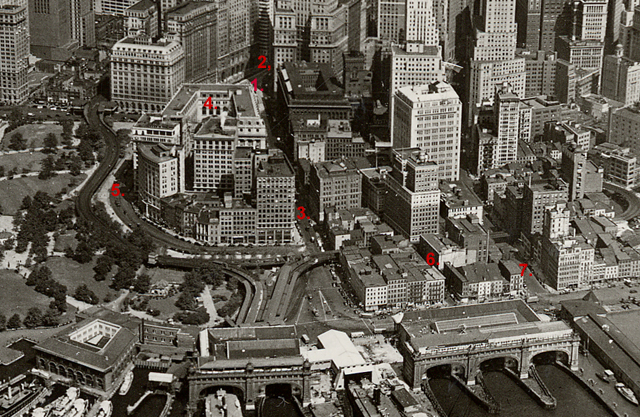
| |
Key:
| |
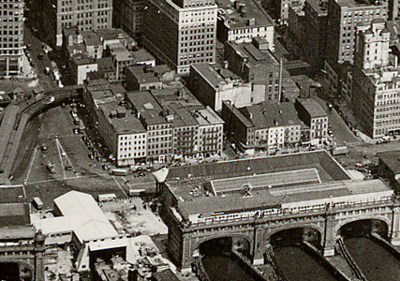
| A little closer view from the above photo of
Moore Street
| |
| |
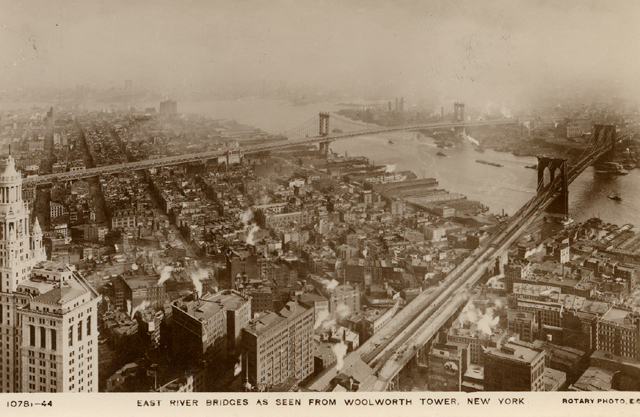
| East River Bridges As Seen From
Woolworth Tower, New York
No date The Brooklyn Bridge (at the right of the photo) took 14 years to complete. It was the longest, highest bridge in the world when it opened in 1883. The Manhattan Bridge (in the center of the photo) was completed in 1912. | |
| |
| Postcard collection of Maggie Land Blanck | |
| Lower East Side From the Harbor | |
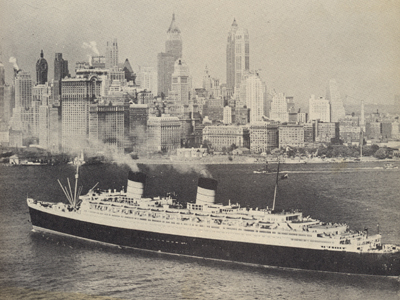 |
New York Harbor and the Queen Elizabeth |
| New York City, State, and Nation by Sol Holt, a 1955 Junior High School civics book. | |
| 23rd Street | |
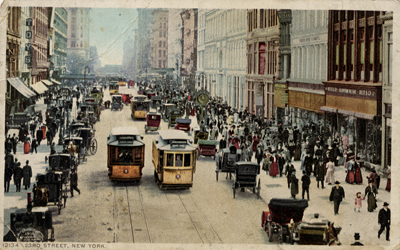 |
23rd Street, New York Postmarked 1914 |
| Postcard collection of Maggie Land Blanck | |
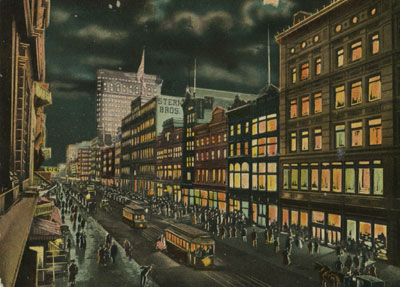 |
23rd Street, Shopping district by Night Postmarked 1907 |
| Postcard collection of Maggie Land Blanck |
|
|
| Postcard collection of Maggie Land Blanck Fourth Avenue and Twenty Eighth Street |
|
|
| Musey, April 1904, Collection of Maggie Land Blanck Fourth Avenue and Twenty Eighth Street |
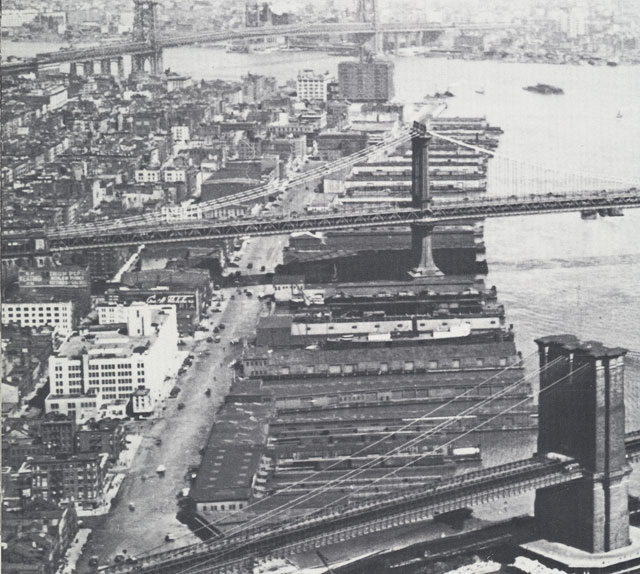 | |
| From A Picture History of the Brooklyn Bridge, Mary J Shapiro | |
|
The Brooklyn Bridge is at the bottom of the picture and the Williamsburg Bridge
is at the top.
The Manhattan Bridge, in the middle, runs into Canal Street.
| |
| Kleindeutschland (Lower East Side) Click on image. |
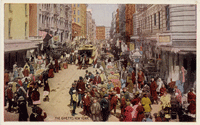 |
| To see images of life in the tenements of lower Manhattan go to
Tenement life
|
| If you have any suggestions, corrections, information, copies of documents, or photos that you would like to share with this page, please contact me at maggie@maggieblanck.com |
|
Please feel free to link to this web page. You may use images on this web page provided that you give proper acknowledgement to this web page and include the same acknowledgments that I have made to the provenance of the image. Please be judicious. Please don't use all the images. You may quote up to seventy five words of my original text from this web page and use any cited quotes on this web page provided you give proper acknowledgement to this web page and include the same acknowledgments that I have made to the provenance of the information. Please do not cut and paste the whole page. You may NOT make use any of the images or information on this web page for your personal profit. You may NOT claim any content of this web page as your original idea. Thanks, Maggie |
| © Maggie Land Blanck - page created 2008 - latest update, November 2011 |