| Armenians in Turkey - Customs, Dress & Food |
| HOME - The Azarians and Related Pages - Perkinik |
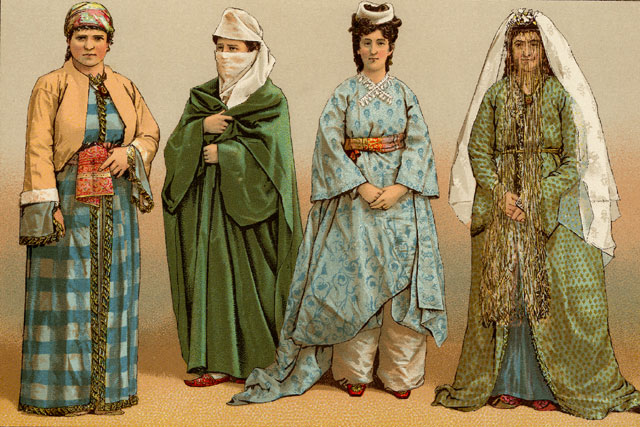
| Women's Dress - Armenians in Turkey |
| |
| Print collection of Maggie Land Blanck
| "Female attire Turkey"
|
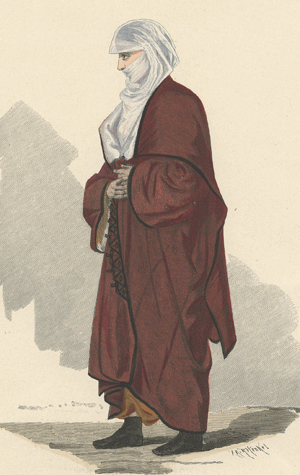 |
| Collection of Maggie Land Blanck
"Armenische Frau aus Konstantinopel" (An Armenian woman of Constantinople) |
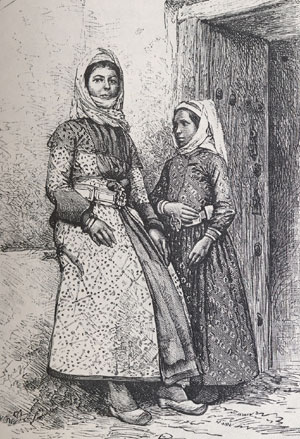 |
"Armenian Women late in the Late 19th century"
|
| From The Armeninas by Adriano Alpago Novella, 1986 | |
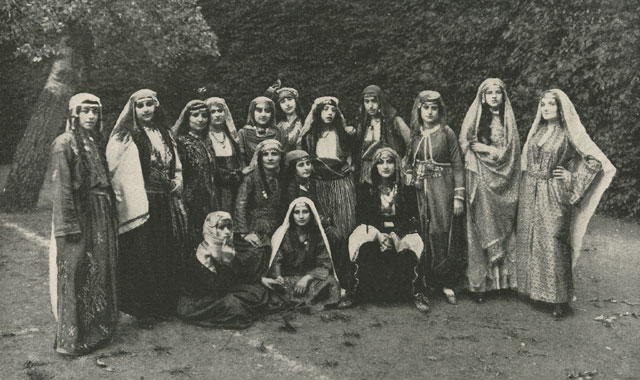 | |
| National Geographic October 1915. Collection of Maggie Land Blanck | "ARMENIAN GIRLS, CONSTANTINOPLE, 1914, REPRESENTING VARIOUS TYPES OF ARMENIAN PEOPLE"
In the villages woman's work included carrying the wood and water.
|
| Armenian Men in Turkey | |
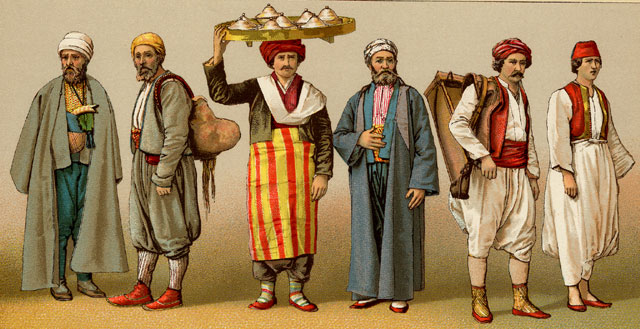 | |
| Print collection of Maggie Land Blanck
| "Male attire Turkey"
|
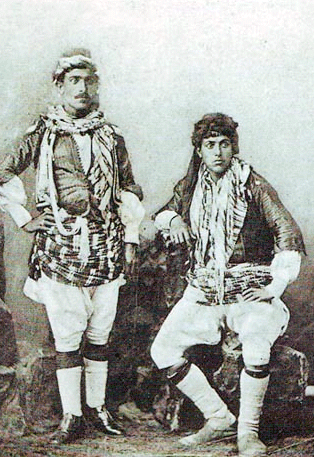 | |
| January 2012
"Armenian costumes. Men from Sebastia" | |
| Family - Armenians in Turkey | |
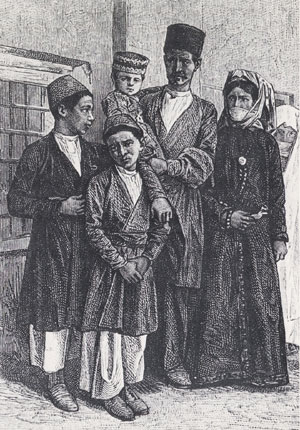 |
An Armenian Family in the late 19th century
|
| From The Armeninas by Adriano Alpago Novella, 1986 | |
| Armenians in Constantinople | |
 |
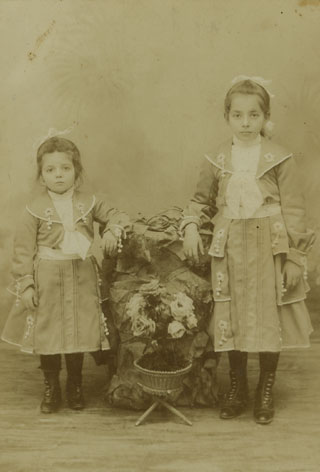 |
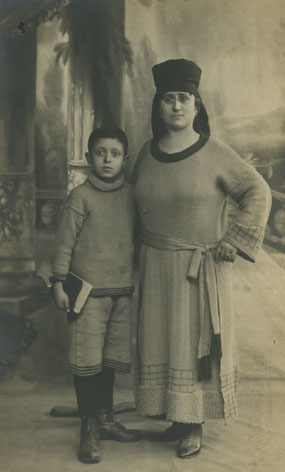
| Photo collection of Maggie Land Blanck | |
| Many Armenians in Constantinople lived and dressed as Europeans. There is no identification on the photo on the left. It sold on eBay as an Armenian mother and her son. The two young girls were photographed by Raphael Khndamian Photographe Kadi-Kcuy. | |
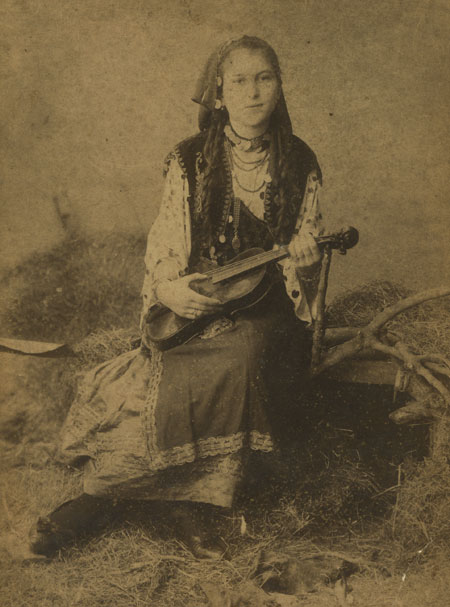 | |
| Photo collection of Maggie Land Blanck | Tchobanian Freres Atelier de Peinture, Yusek Galdirim, En Face Du Voivoda, No. 75
Galata, Constantinople While this young woman had her picture taken in Constantinople she dressed in a traditional style. |
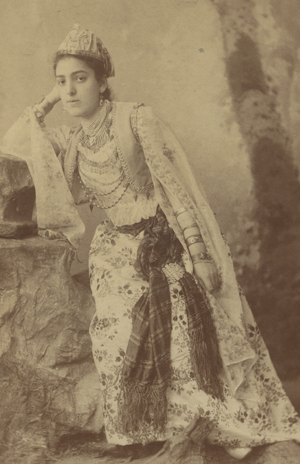 | |
| Photo collection of Maggie Land Blanck | This young woman also choose to dressed in a traditional style. |
| Armenian Weddings | |
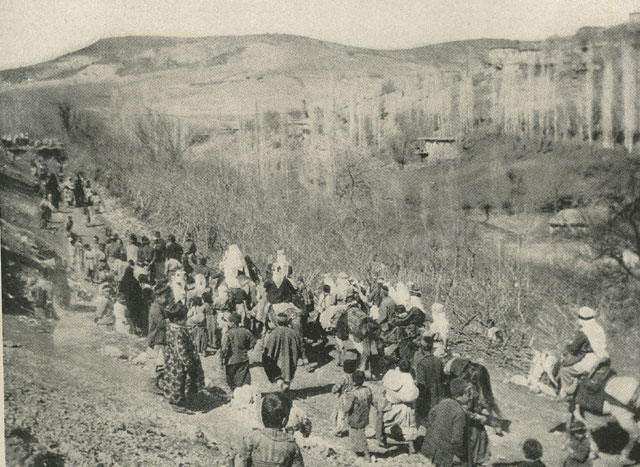 | |
| National Geographic October 1915. Collection of Maggie Land Blanck | "ARMENIAN BRIDAL PROCESSION"
|
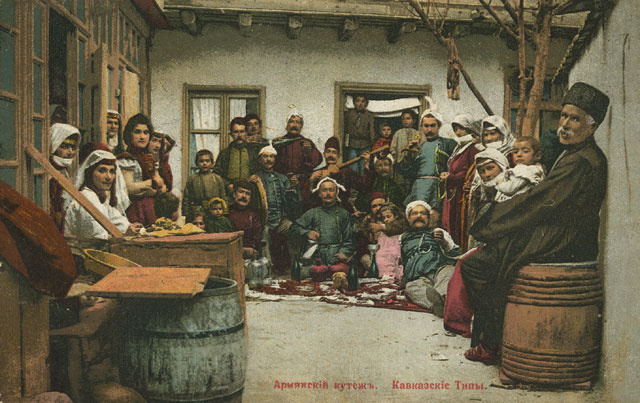 | |
| Postcard collection of Maggie Land Blanck | "Armenian Wedding" |
| Family | |
|
The traditional Armenian family was
structured along patriarchal lines.
When a son married he brought his bride to his father's house.
Multi generations lived together in one house.
| |
| Armenian Village Life | |
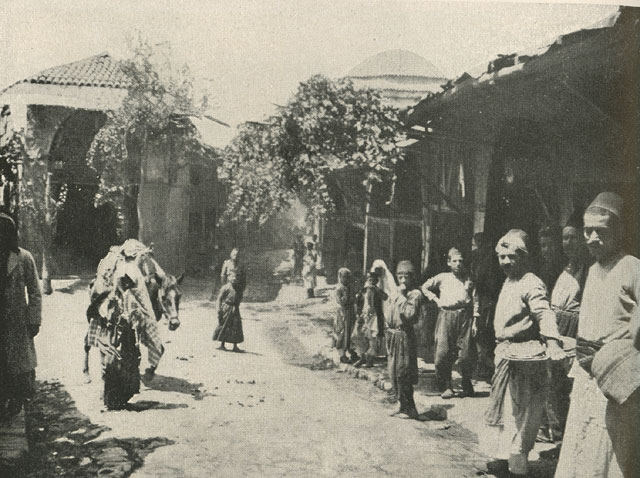 | |
| National Geographic October 1915. Collection of Maggie Land Blanck | "A STREET SCENE IN THE CITY OF MARASH" Marash, a city not far from Aleppo, had a large Armenian population. |
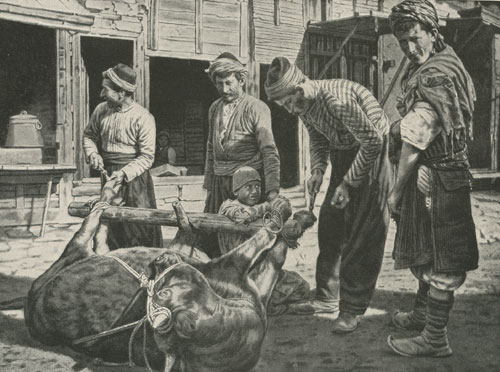 | |
| National Geographic October 1915. Collection of Maggie Land Blanck | "SHOEING AN OXEN ON THE VILLAGE MAIN STREET"
|
| Transportation | |
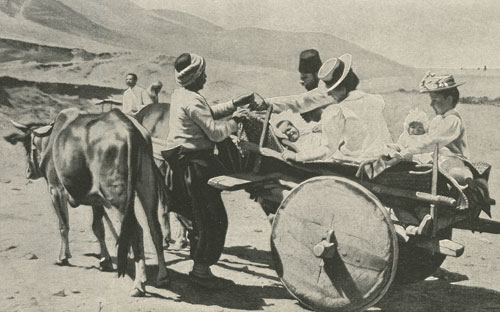 | |
| National Geographic October 1915. Collection of Maggie Land Blanck | "THE MOST COMMON VEHICLE IN ARMENIA" |
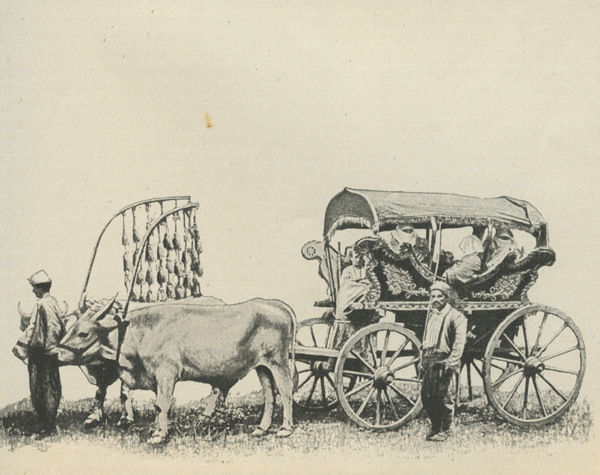 | |
| Collection of Maggie Land Blanck Turkish Carriage, Outlook October 4, 1902 | |
| | |
| Dancing | |
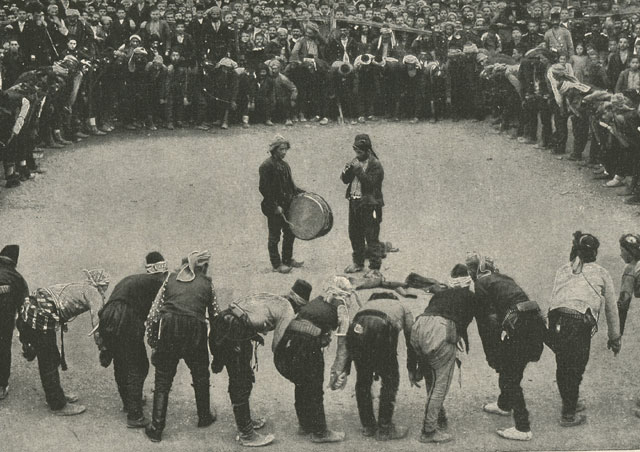 | |
| National Geographic October 1915. Collection of Maggie Land Blanck | "ARMENIANS DANCING" "The Armenian national dance is not such a thrilling affair as the fox trot, neither does it have the stately grace of a Virginia reel. It reminds one more of arrhythmic "Ring around the Rosey" |
| Le Tour du Monde
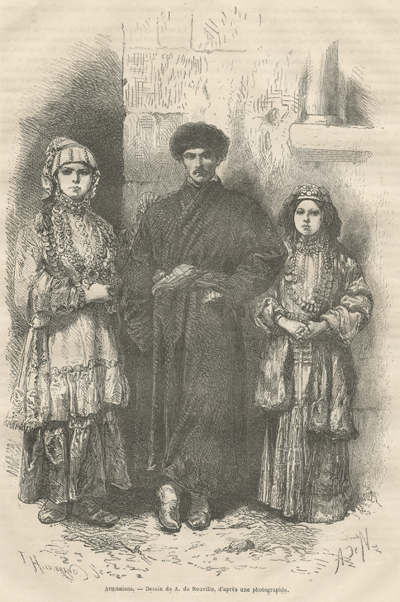
Jane Dieulafoy traveled to the East with her husband three times between 1881 and 1886. While there she took numerous notes and photographs which were published in the review Le Tour du Monde . |
|
 |
| Collection of Maggie Land Blanck
Armeniens — Dessin de A. De Neuville, d'apres une photographie, page 176. |
 |
| Collection of Maggie Land Blanck
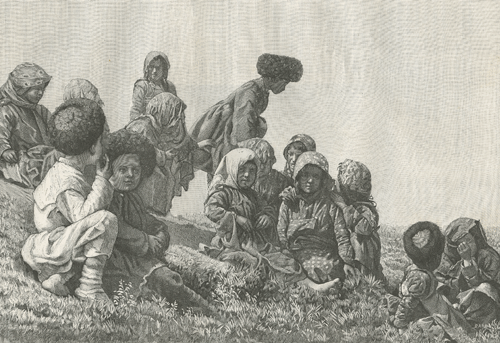
Les curieux (voy p. 414 &mdash Dessin de Ronjat, d'apres une photographie [the curious] |
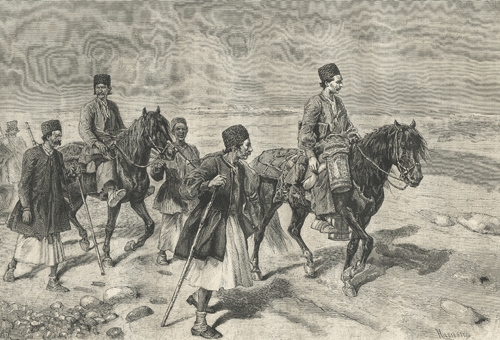 |
| Collection of Maggie Land Blanck
L'abdar — Dessin de Tofani, d'apres une photographie de Mme Dieulafoy
|
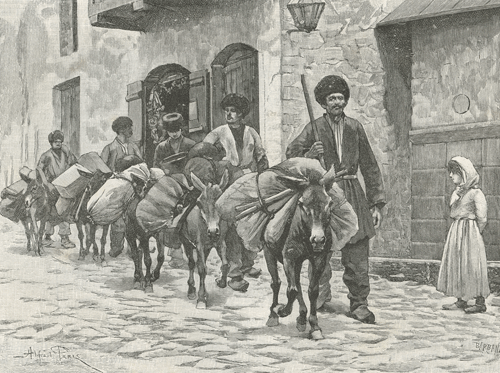 |
| Collection of Maggie Land Blanck
Caravane d'anes — Dessin d'A Paris d'apres une photographie [Caravan of donkeys] |
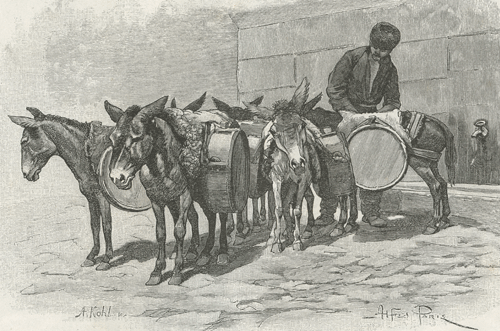 |
| Collection of Maggie Land Blanck
Anes porteurs d'eau — Dessin d'A Paris d'apres une photographie Donkeys carrying water |
|
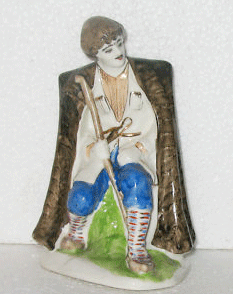
Animals Horses, buffalo, cows, donkeys, sheep, goats, dogs, cats, and chickens were kept by the Armenian peasant. Shepherds Pirkinik 1855: "We found the brother of the Archbishop who was himself grazing innumerable flocks that are their only form of wealth." Men tended the sheep and other live stock. They also did the shearing and weaving of cloth. Woman milked the sheep and livestock, made the butter and cheese and wove carpets. Armenian shepherds wore a very distinctively shaped cape. |
|
 |
|
| Food Wheat, millet, barley and rye were cultivated. Vegetables included: potatoes, tomatoes, squash, cucumbers, turnips, peas and beans. Honey was a staple. Yogurt! Pilaf! |
|
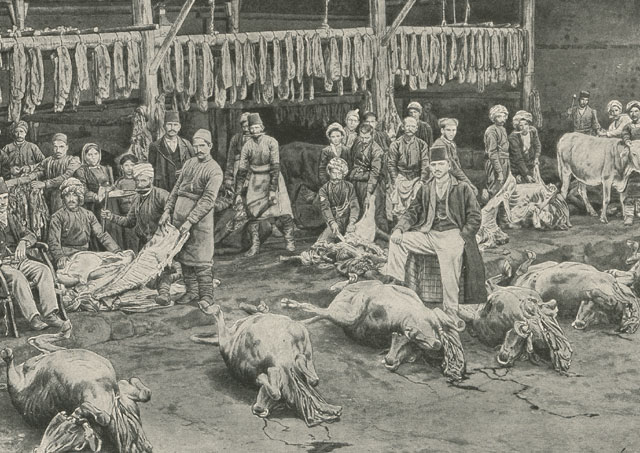 | |
| National Geographic October 1915. Collection of Maggie Land Blanck | "ARMENIANS PREPARING "BASTOURME" BEEF DRIED IN THE SUN" "Bastourma is a traditionally dry-cured and air-dried prime cut beef topside. After completion of the initial drying process, the product is coated with a specially prepared paste of oriental spices mixed with a generous amount of garlic. Bastourma has its origin in Turkey and Armenia and has become known and well appreciated in all Muslim countries." If you would like to buy some on line go to B-B Products, Bastourma
|
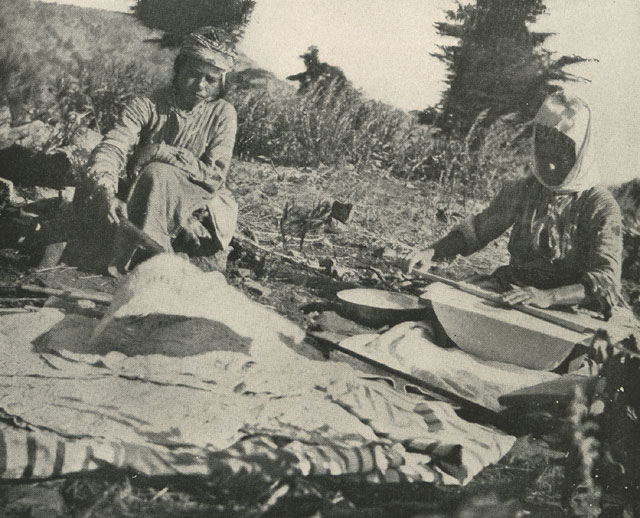 | |
| National Geographic October 1915. Collection of Maggie Land Blanck | "ROLLING OUT BREAD AS THIN AS BLOTTING-PAPER AND BAKING IT ON A DISC OF SHEET IRON " This bread is called Lahvosh. If you would like to try some you can buy it on line at Valley Lahvosh |
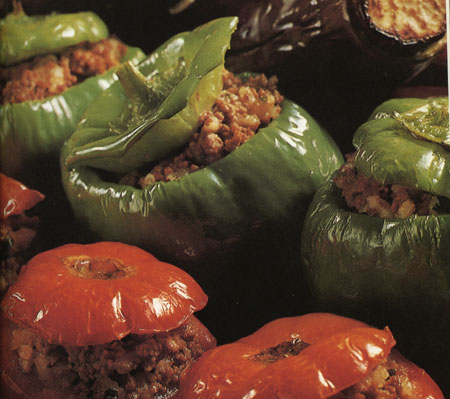 | |
| The Complete Middle East Cookbook, Tess Mallos. cookbook collection of Maggie Land Blanck |
Dolma (stuffed vegetables)
A traditional Armenian dish is stuffed vegetables, called dolma. The following recipe is from Tom's mother, Alice Azarian Blanck.
Tomatoes, remove pulp and use top as lid Filling:
1 lb. ground beef or lamb Mix ingredients together thoroughly in bowl. Fill each vegetable lightly with the mixture and place side by side in a deep pan. Put lids on vegetables that have them. Others can be placed in pan with ends together to keep stuffing in. When all the vegetables are in the pan cover them with a heavy plate. Add water up to plate level. You can substitute some tomato sauce for some of the water. Bring to boil and simmer for about 1 hour or until rice is cooked. Serve hot.
|
|
Armenian Merchants An 1879 description of the village of Pirkinik states "the inhabitants are farmers or muleteers". An article from 1888 says the "men are muleteers and traverse Asia Minor in all directions." See more muleteer images under Le Tour du Monde above.
|
|
 | |
| Armenian Massacres and Turkish
Tyranny, 1896, Collection of Maggie Land Blanck
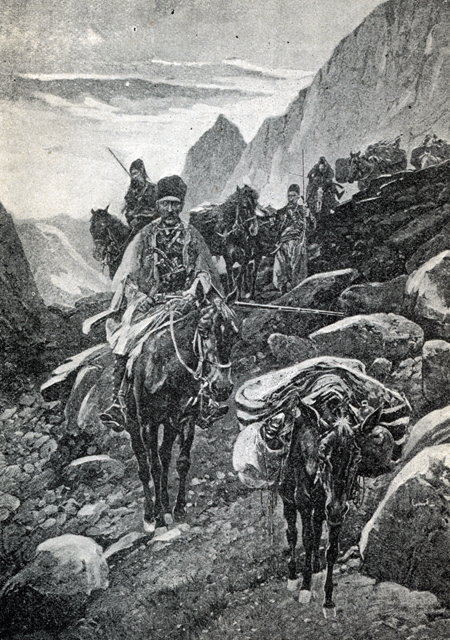
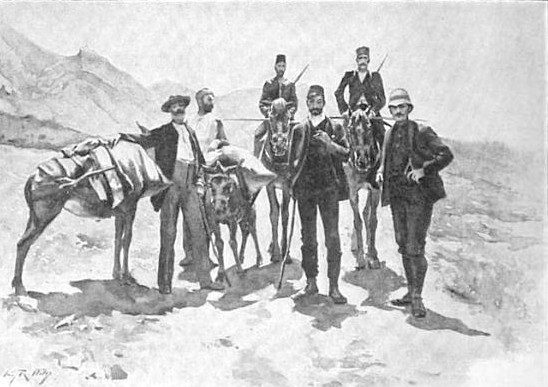
MOUNTAIN ROAD IN ARMENIA
..on applying directly to the Pasha we exchanged our Armenian muleteers, whom we knew of old to be very quarrelsome fellows, for a good-natured set of Kuzulbashes... " By Bueh revivals as these, travelling becomes almost a work of supererogation. Here, safe from the matchlock of the Turcoman and the bullet of the Kurd, we may see the facsimiles of Persepolis and Nineveh. Here are the ruins past which the Armenian muleteer, bringing the riches of Astracan to barter for the silks of Ispahan, spurs faster lest he be hailed by the Ghouls who (may the Prophet curse them!) harbour in such places. Even the Armenian muleteer so far overcame his fear of the Kurdish robbers as to indulge in one of his accustomed funeral dirges; but it stopped short, never to go again, when we came in sight of the Kurdish encampment. The poor fellow instinctively grabbedhisdonkeys about their necks, as though they were about to plunge over a precipice. The zaptiehs dashed ahead with the mutessarif's letter to the Kurdish chief. We followed slowly on foot, while the Armenian and his two pets kept at a respectful distance in the rear. | |
 | |
|
The Armenian muleteer carried the expeditions food and baggage on his mules.
| |
|
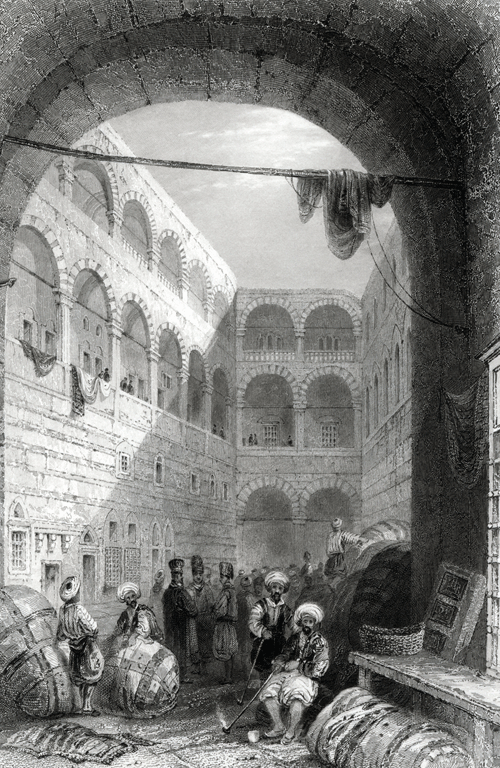
Caravans Ancient historic trade routes, know as the Silk Road, brought silks and spices from the China, through Asia Minor, to the west. There was not just one "road", but many routes. Sivas was a major cross road for traffic going east and west and north and south. Camel caravans and mule caravans traveled about 30 or 40 kilometers a day taking an average of 8 to 10 hours. Caravanserais (also called khan or han) were built a appropriate distances to accommodate the travelers.
|
|
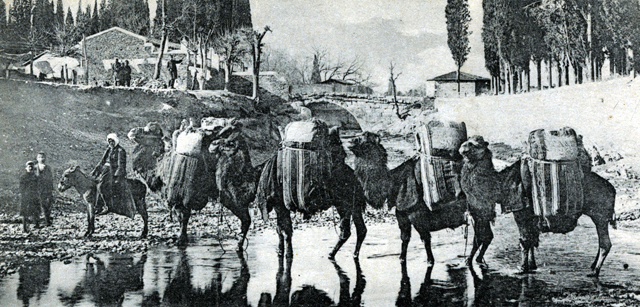 | |
| Collection of Maggie Land Blanck, 2011
| |
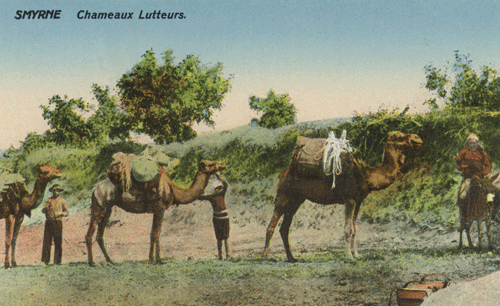 | |
| Collection of Maggie Land Blanck, 2011 Smyrne Chameaux Lutteurs
| |
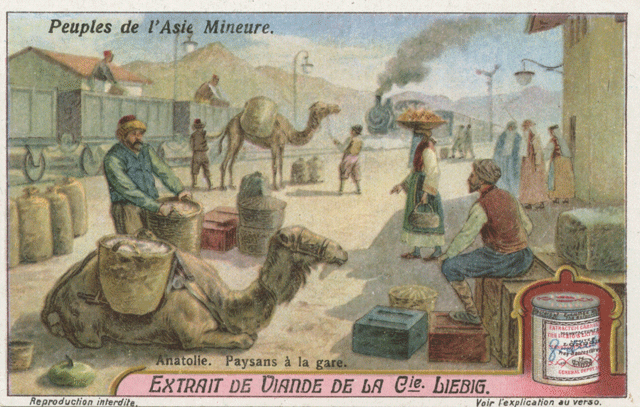 | |
| Collection of Maggie Land Blanck, 2011 Peuples de l'Asie Mineure. Anatolie. Paysans a la gare. [People of Asia Minor. Anatolia. Peasants at the train station] With time railroad lines were built reducing the numbers of animal caravans. | |
 | |
| Collection of Maggie Land Blanck, 2011
A PUBLIC KHAN See Sivas for images of the remains of hans in that city.
| |
|
Armenian Images 1895 The Illustrated London News of October 12, 1895 ran an article on the "Armenian Crisis" and devoted a page to images of the Armenians of Anatolia. |
|
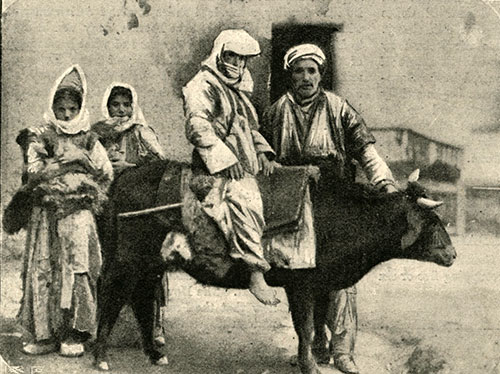 | |
| Collection of Maggie Land Blanck, 2012, Illustrated London News Oct 12, 1895 ARMENIAN PEASANTS COMPELLED TO GO TO RUSSIA FROM KURDISH OPPRESSION | |
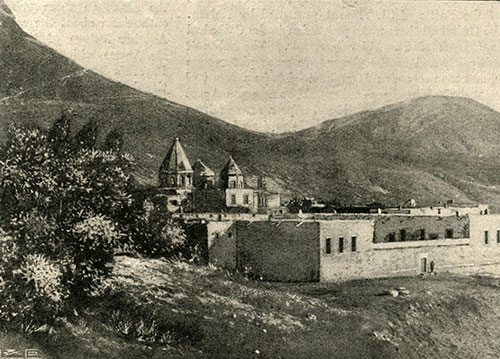 | |
| Collection of Maggie Land Blanck, 2012, Illustrated London News Oct 12, 1895 ARMENIAN MONASTERY, VARAK, NEAR VAN | |
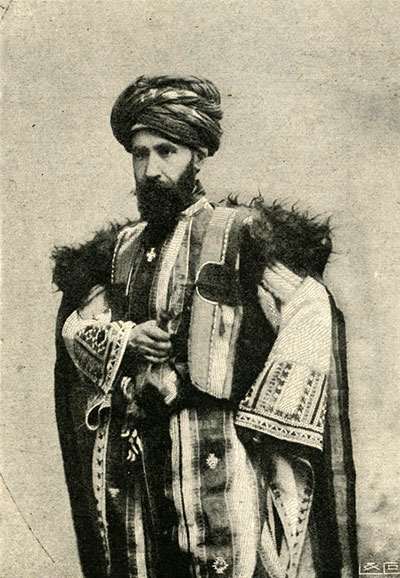 | |
| Collection of Maggie Land Blanck, 2012, Illustrated London News Oct 12, 1895 ARMENIAN MOUNTAINEER OF SHADOKH | |
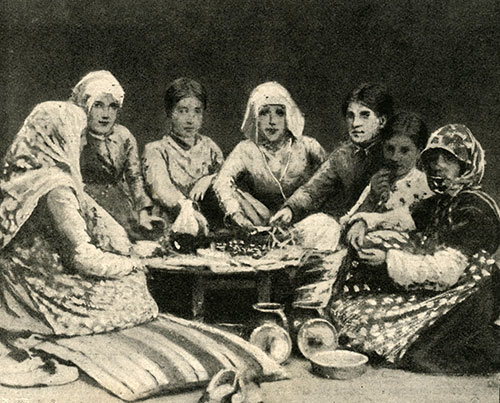 | |
| Collection of Maggie Land Blanck, 2012, Illustrated London News Oct 12, 1895 TYPES OF ARMENIAN WOMEN, PROVINCE OF VAN | |
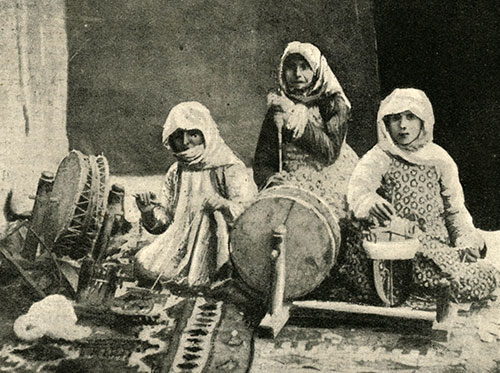 | |
| Collection of Maggie Land Blanck, 2012, Illustrated London News Oct 12, 1895 ARMENIAN PEASANT WOMEN WEAVING TURKISH CARPETS | |
| Lucy Arevian Hagopian Azarian Abraham Azarian Other Azarians The Genocide The Village of Perkinik near Sivas Sivas Constantinople Connection to Related Pages |
| Other Websites on Armenian Life before 1915 |
| houshamadyan |
| If you have any suggestions,
corrections, information, copies of documents, or photos that you would like to
share with this
page, please contact me at
maggie@maggieblanck.com
|
| Please feel free to link to this web page. |
| ©Maggie Land Blanck - page created May 2008 - Latest update, May 2016 |