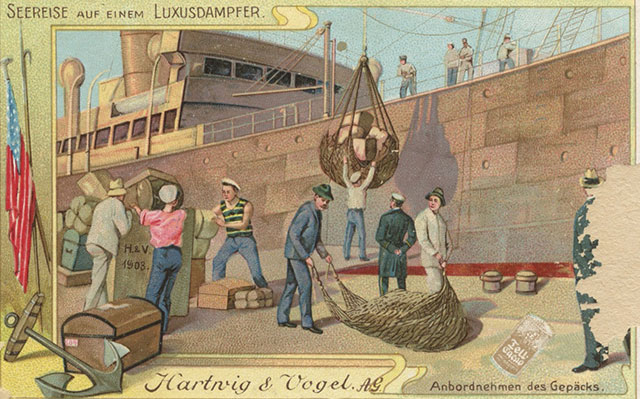
| Stevedores, Dock workers and Longshoremen | |
| HOME - Occupations - Fritz Kettler - Hannah Peters - Johann Bernard Petermann | |
|
|
|
Collection Maggie Land
Blanck, June 2012
| |
|
Dockworkers, Longshoremen, and Stevedores
Two of my ancestors worked the docks in Red Hook, Brooklyn and Hoboken, New Jersey. Fritz Kettler, born Freisland c 1862, was a longshoreman in Red Hook, Brooklyn and Hoboken, New Jersey between 1886 and his death in 1896. Fritz Kettler Johann Berend Peterman was born in Ganderkessee, Germany in 1843. He spent a number of years at sea in the German Merchant Marines before immigrating to America. He was a longshoreman, stevedore and dock forman in Red Hook, Brooklyn and Hoboken, New Jersey between 1887 and 1905. Berend Petermann In the days before container shipping, stevedores worked inside the ship, packing and securing the merchandise. Dock workers and longshoreman worked on the docks moving merchandise from the ship to the docks and vice verse. The port of New York, which included the docks in Brooklyn and Hoboken, was one of the busiest ports in the world in the mid to late 1800s and early 1900s when Johann Bernard Petermann, Fritz Kettler and Johannus Jensen (the first and second husbands respectively of Hannah Peters) worked on the docks in Brooklyn and Hoboken.
Longshoremen were said to be stalwart, with brawny arms, broad chests, and sturdy limbs. In the summer their faces were bronzed from the outdoor work.
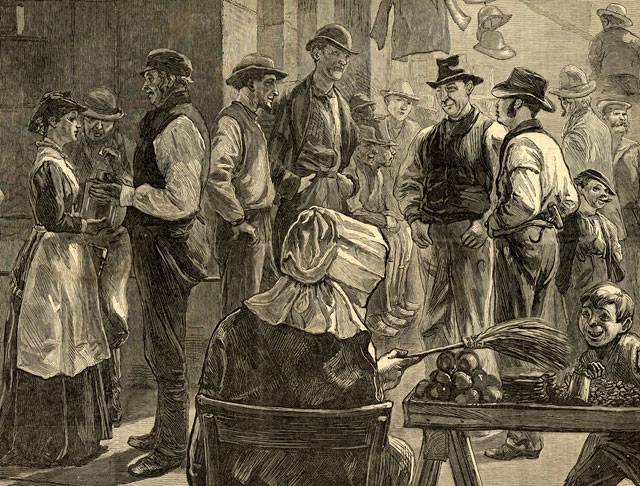
Many of the men who worked the docks in the New York harbor in the late 1880s to early 1900s were recently arrived immigrants. In June 1888 the superintendent of the Pinto stores at the Atlantic Basin in Red Hook Brooklyn claimed that times were bad for the shipping trade. "the fierce sun was pouring down an intense heat on the unruffled surface of the water; from end to end it was almost unbroken by a hull, save two barks, two barkentines and a solitary canaller. Sitting in listless groups wherever there was a little shade or a fresh breeze were hundreds of swarthy, sunbrowned 'longshoremen, able and willing to work' but here was none to be had."Only twelve men were working whereas at that time of year the normal employment would have been fifty to a hundred. The reasons were unclear but for one thing due to sugar trust tariffs more sugar was being delivered to New Jersey than Brooklyn.
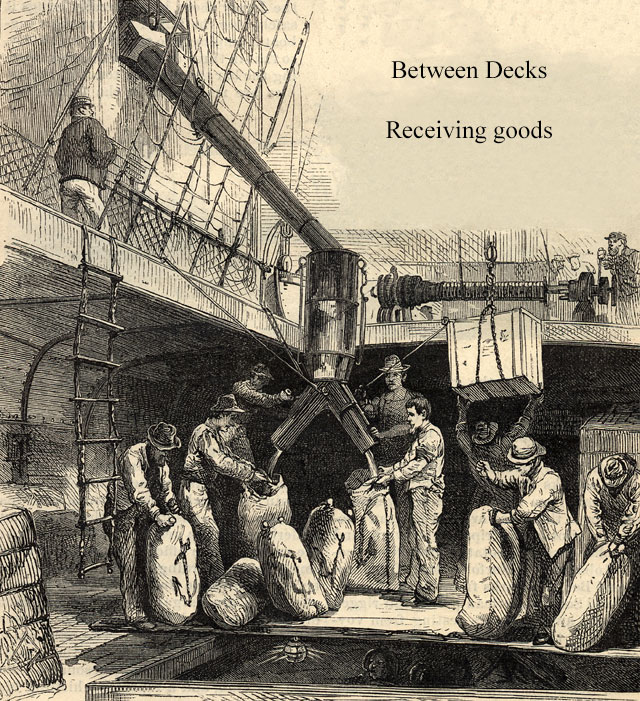
UnloadingThe Survey, Volume 36 By Edward Thomas Devine, Paul Underwood Kellogg, Charity Organization Society of the City of New York, Survey Associates review by George McPherson Hunter of The Longshoreman by Charles B Barnes gives the following impressions of dock workers:"The unloading, once begun, proceeds rapidly, as any men being employed as can work together conveniently, and the freight being hoisted out by means of tackle suspended from the yard-arm, and operated by steam or horse power. Usually, as fast as it is discharged, the cargo is sent to warehouses near by, and assorted for the owners."Longshoremen"The longshore-men are among the most ignorant and brutal of men. Their work is very laborious, but requires little skill; their surroundings and associations are all such as tend to degrade them; their pay is smaller than that of almost any other class of workmen, and their prejudices are easily excited. It thus happens that debauchery and murderous fighting are constant among them; extensive strikes against reduction of wages or some fancied imposition are of frequent occurrence; and some of the bloodiest riots New York has ever seen originated among them. Intemperate and brutal in every respect, yet hard workers, and consequently muscular, no class of men gives the police so much trouble as the longshore-men."Several pages later the tone changes from the contempt of the previous paragraph to one of awe at the ability of the longshoremen to move heavy cargo."The ease with which exceedingly heavy bodies are handled by the stevedore's men is remarkable. The hatchways are often just large enough to let the package through, and frequently the space between decks is so circumscribed that the men have hardly room to move; yet by skillfully landing the hogshead, or boxed piano, or granite monument, or huge piece of machinery, as it is lowered to them by the tackle, by bringing it up and twisting it over with iron bars, pulling it with cotton hooks, and pushing it with brawny hands and shoulders, sitting down four or five in a row, against a bulkhead shoving with their feet, they slowly work the unwieldily mass into its corner, and brace it firmly by wedges; until its successor is placed." "Every human tied that has broken on the shores of America has left its mark on the dock-laboring class. Indeed, it is no more than sober truth that the history of emigration could be written inductively from the water-front.......Dangerous Work In 1875 John Ryan age 25 was severely injured in the spine when a bag of sugar fell on him at the pinto stores.
| |
 | |
| Collection of Maggie Land Blanck
| |
| On South Street, New York- "Longshoremen Waiting For A Job Harper's Weekly August 13, 1881 | |
 | |
| Collection of Maggie Land Blanck
| |
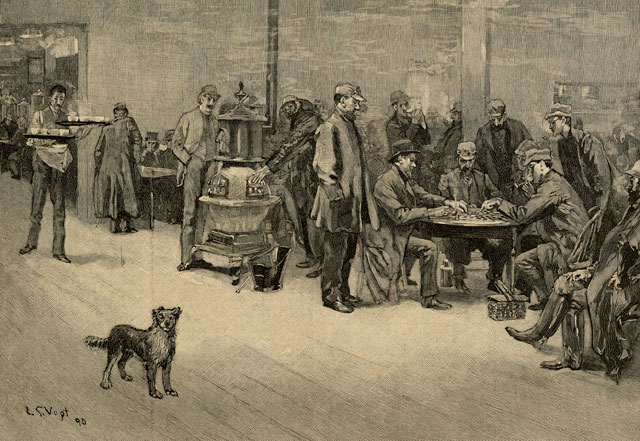
| A Longshoremen's Retreat, Brooklyn. --- Drawn by L. C. Vogt, 1890 | |
 | |
| Print collection of Maggie Land Blanck
| |
| Harper's
Weekly September, 1877 Longshore-men | |
 | |
| Print collection of Maggie Land Blanck
| |
| Harper's
Weekly September, 1877
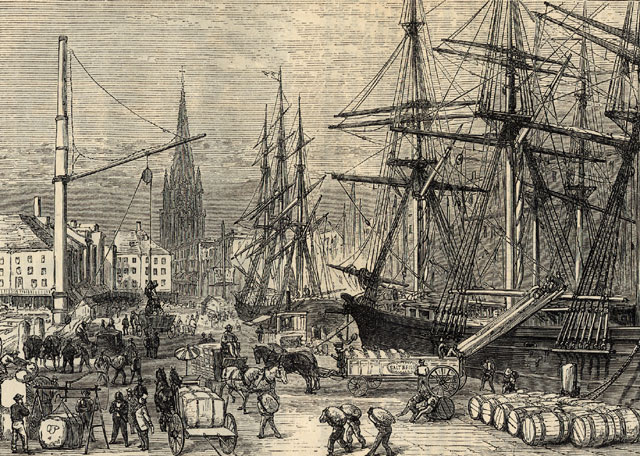
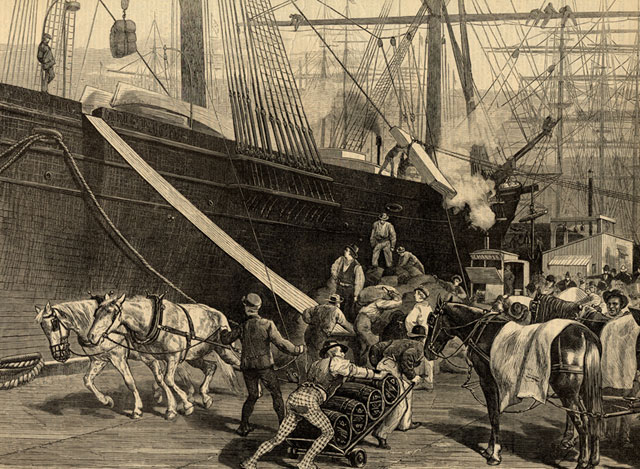
Loading and Unloading, Pier No. 6, East River | |
 | |
| Collection of Maggie Land Blanck
| |
| Scene On A New
York Dock --- Stevedores Unloading A Ship--- [drawn by I. P. Pransinikoff] Harper's Weekly July 14, 1877 | |
 | |
| Print collection of Maggie Land Blanck
| |
| Harper's Weekly September, 1877 | |
 | |
| Print collection of Maggie Land Blanck
| |
Harper's
Weekly September, 1877
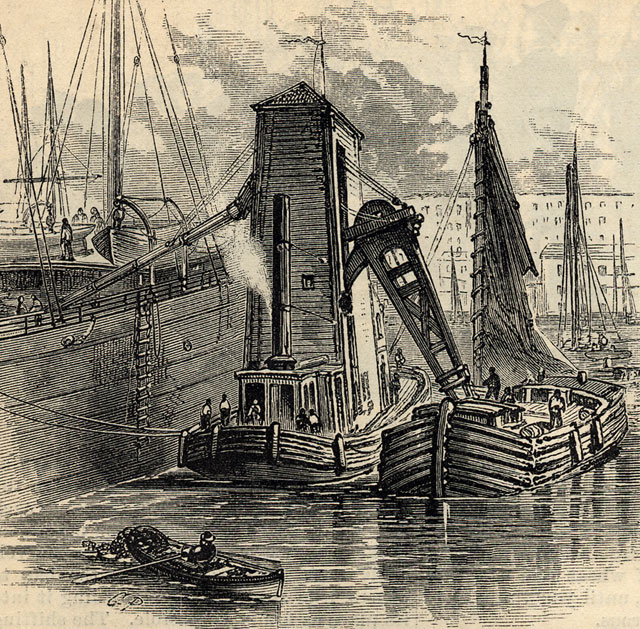
"A word about the lighters. They are broad, blunt-nosed, sloop-rigged boats, all deck except a little hole of a cabin, and used about the harbor for transporting merchandise to and from vessels at anchorage, or from wharf to wharf. They are thoroughly ill-looking, always in the way, and only to be excused for existence on the score of the great usefulness. The lighters are on the rivers what the carts are on the streets." | |
 | |
| Print collection of Maggie Land Blanck
| |
| Harper's
Weekly September, 1877
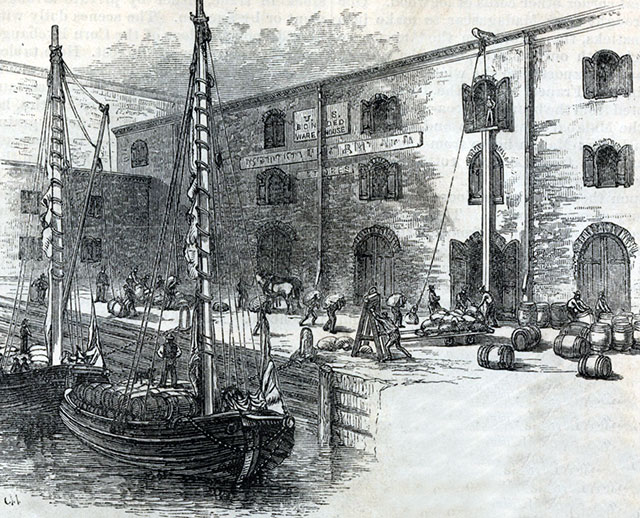
Loading From A Floating Elevator | |
 |
|
|
Harper's
Weekly September, 1877
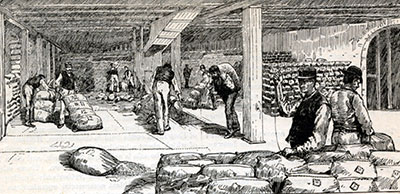
United States Bonded Warehouse | |
 |
|
| Print collection of Maggie Land Blanck
| |
|
Publication and Date Unknown
A COFFEE WAREHOUSE | |
 | |
| Print collection of Maggie Land Blanck
| |
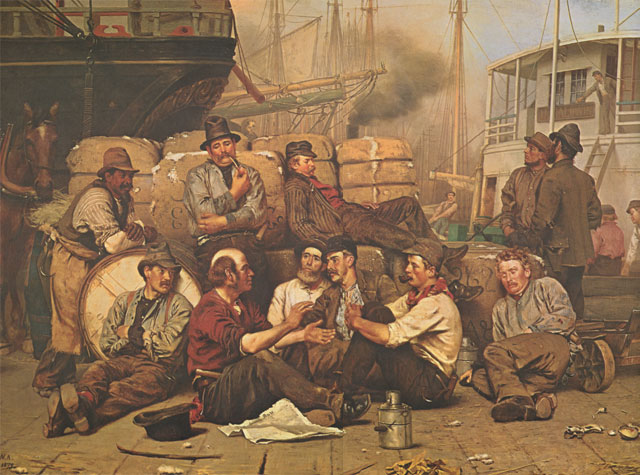
| THE LONGSHOREMAN'S NOON by John George
Brown (1831-1913) From back: "The scene could be any northern American dock, perhaps one of the Brooklyn docks" | |
 | |
| Print collection of Maggie Land Blanck
| |
| Harper's
Weekly September, 1877
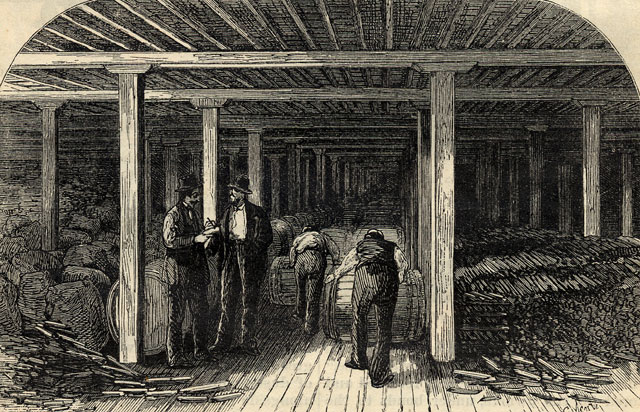
Interior of Bonded-Warehouse | |
 |
|
| Collection of Maggie Land Blanck, Harper's Weekly November 15, 1873
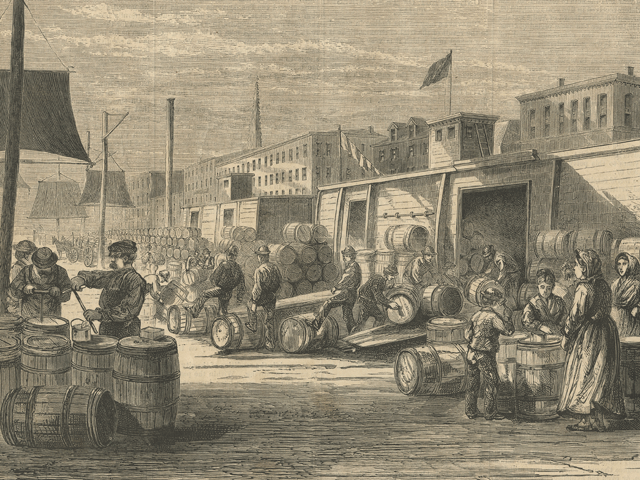
SCENE ON THE GREAT FLOUR DOCKS, COENTIES SLIP, EAST RIVER, NEW YORK
Coenties Slip was located in lower Manhattan. Unfortunately, the accompanying article was not included with this image. However, I believe that the men with the T shaped devises on the left are inspecting the flour. There were laws regulating the quality or grade of the flour to insure that it would make a decent bread. The barrels were inspected to determine that they were constructed according to regulations to protect the flour from moisture and bugs. They barrels were also weighed. I do not know why there are women and children on the dock. They appear to be working at something and may be helpers of the flour inspectors. | |
 |
|
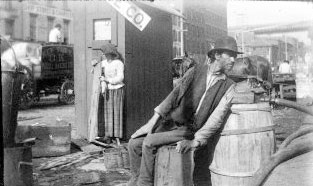
| Brooklyn Museum Public Library, Brooklyn Collection, George Bradford Brainerd (America 1845-1887), June 2012 Longshoreman, Brooklyn | |
 |
|
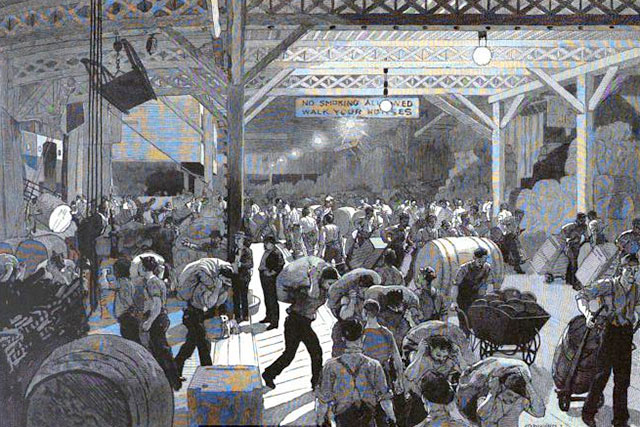
| Ocean steamships: a popular account of their construction, development, management and appliances (Google eBook), French Ensor Chadwick, Albert Edward Seaton, William Henry Rideing, John H. Gould, James Douglas Jerrold Kelley, Ridgely Hunt, June 2012 Loading and Unloading, Coastline Seamen by Eugene Light | |
 |
|
| The Brooklyn Press, Sunday August 11, 1895 | |
 |
|
|
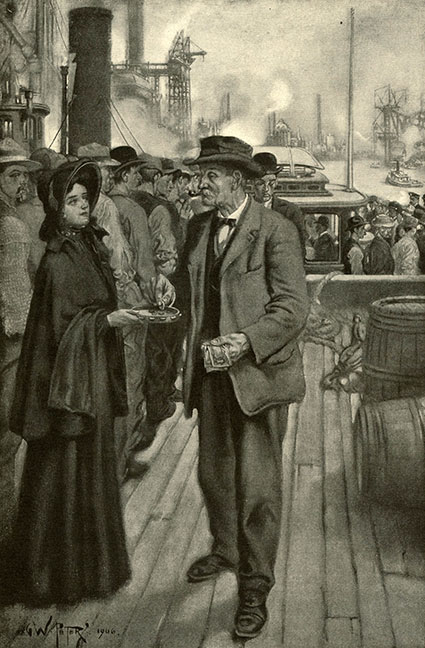
The Working Man's Pay Day in New York Pictures by G. W. Peter*, 1908**, Century Magazine Jan 1908, collection Maggie Land
Blanck, June 2012
PAY-DAY DOCK EMPLOYEES AT TWENTY-EIGHTH STREET AND THE EAST RIVER
This is a very interesting scene - on the left are the men lined up to board the pay boat -
out of his meager wage the gentleman is donating some change to help those less fortunate than himself.
*George W. Peters America artist 1855-1955
**Another scene in this series is called "Pay Day for Italian Laborers at the Excavation in
west Thirty-Third Street for the New Pennsylvania Station. The old Pennsylvania Station was completed in 1910.
| |
 | |
| Photo Maggie Land Blanck, 2012
| |
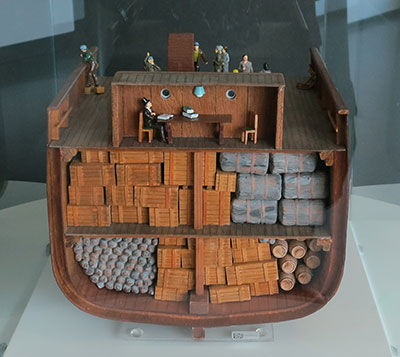
| This model at the Deutsches Schiffahrtsmuseum in Bremerhaven shows
how various commodities were crated and packed. Distribution of weight was very important for the
stability of the ship.
| |
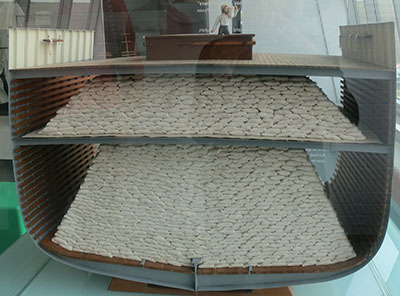 | |
| Photo Maggie Land Blanck, 2012
| |
| This model at the Deutsches Schiffahrtsmuseum in Bremerhaven shows
how sacks were stacked onboard a ship.
| |
| If you have any suggestions, corrections, information, copies of documents, or photos that you would like to share with this page, please contact me at maggie@maggieblanck.com | |
| HOME |
| Occupations |
| Fritz Kettler |
| Hannah Peters |
| Johann Bernard Petermann |
| Brooklyn |
| The Waterfront Red Hook, Brooklyn |
| Hoboken |
| Please feel free to link to this web page. You may use images on this web page provided that you give proper acknowledgement to this web page and include the same acknowledgments that I have made to the provenance of the image. Please be judicious. Please don't use all the images. You may quote my original text from this web page and use any cited quotes on this web page provided you give proper acknowledgement to this web page and include the same acknowledgments that I have made to the provenance of the information. Please do not cut and paste the whole page. You may NOT make use any of the images or information on this web page for your personal profit. You may NOT claim any content of this web page as your original idea. Thanks, Maggie |
| Copyright by Maggie Land Blanck - This page was created in 2004 - Latest update, January 2015 |