|
| Mathias Langan - Byrnes - Photos of Mohorra - WALSH, LANGAN AND RELATED FAMILIES - HOME | ||
| Village and Parish of Shrule | ||
|
Shrule is both a village and parish in County Mayo, Ireland just north of the Galway border. Maggie Langan and her mother, Penelope Byrne, were born in the townland of Mochara in Shrule Parish and baptized in the Roman Catholic Church in Shrule Village. Shrule Parish townlands include: Ballisnahyny, Ballycurrin Demesne*, Ballynalty, Brodullagh North, Brodullagh South, Bunnafollistran, Cahernabrock, Cloghmoyne, Cloonbanaun, Commons, Cullagh, Glasvally, Gortatober, Gortbrack, Islands in Lough Corrib, Kinlough, Mocollagan, Mocorha, Mounthenry, Moyne, Rooaunalaghta, Toorard.
*Demesne, pronounced di mayn [main], was an estate occupied by the owner rather than being rented out.
| ||
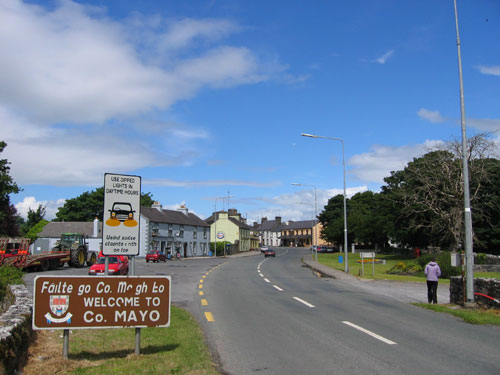 | ||
| Entering Shrule Village and County Mayo from Galway, via Tuam. | ||
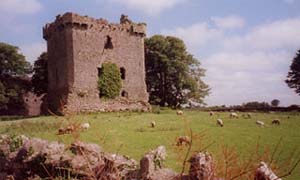
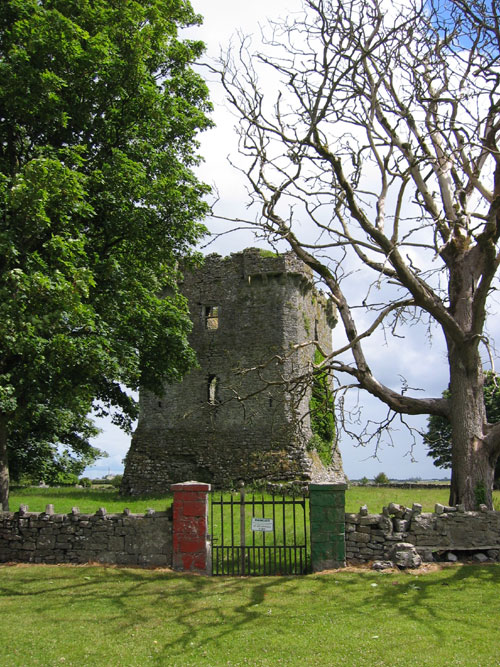
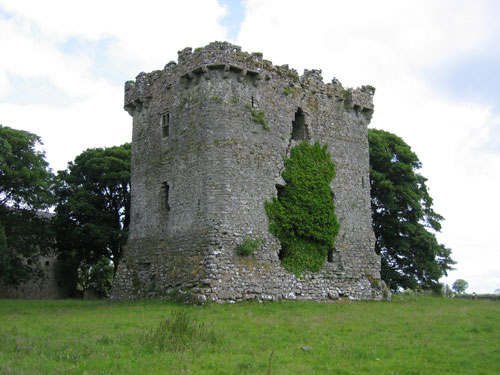
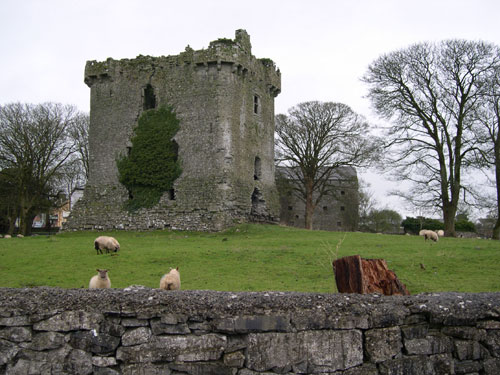
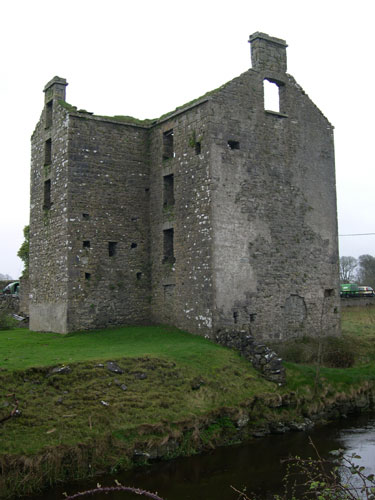
| The tower which is the only remaining part of "Shrule Castle" a manor granted by Richard
DeBurgo to his son John in 1308.
| |
 | ||
| Photos taken by Maggie Blanck June 2004. | ||
 |
|||
| Photo by Ed Land, March 2005 | |||
 |
|||
| Photo by Ed Land, March 2005 | |||
 |
|||
| Photo by Ed Land, March 2005 | |||
| ||
| Photos taken by Maggie Blanck June 2004. | ||
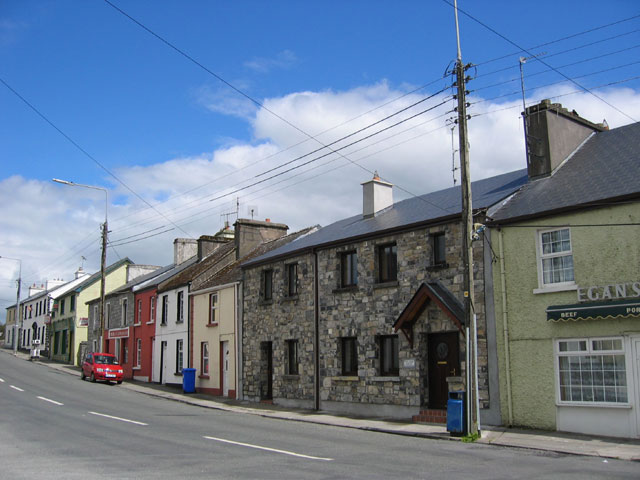
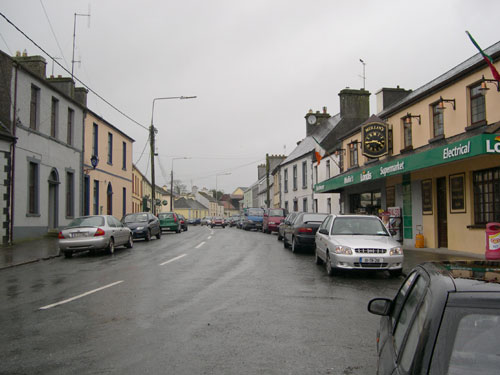
| Main Street Shrule Village, looking north | ||
 |
|||
| Photo by Ed Land, March 2005 | |||
| ||
| Photos taken by Maggie Blanck June 2004. | ||
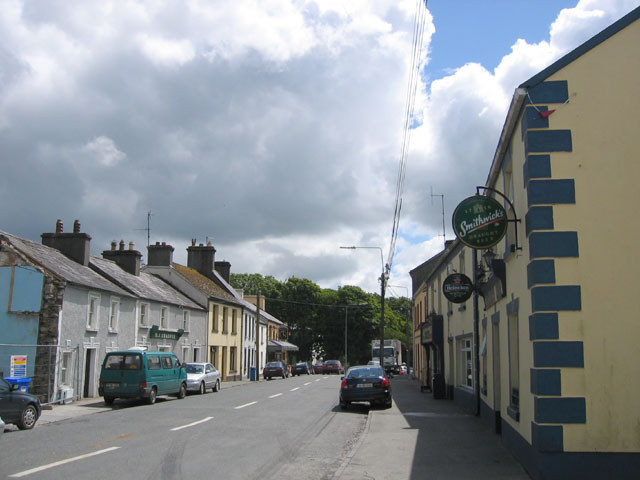
| Main Street Shrule Village, looking south back towards the Galway border. | ||
| ||
| Photos taken by Maggie Blanck June 2004. | ||
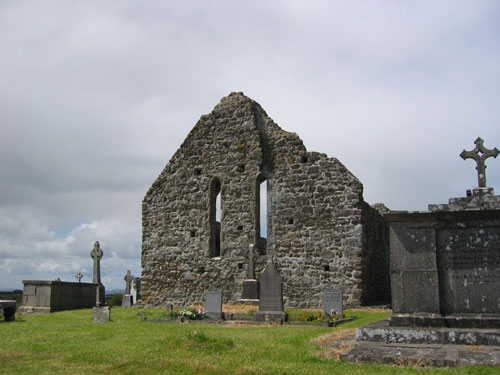
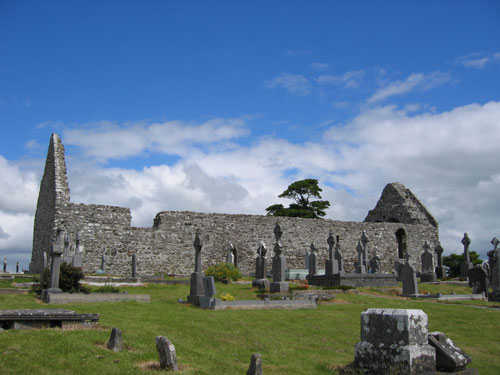
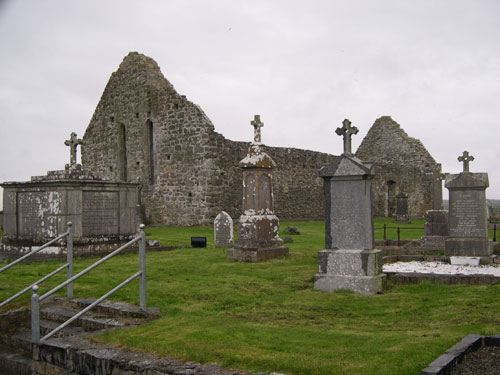
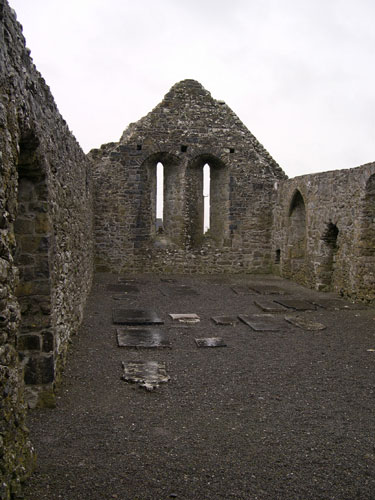
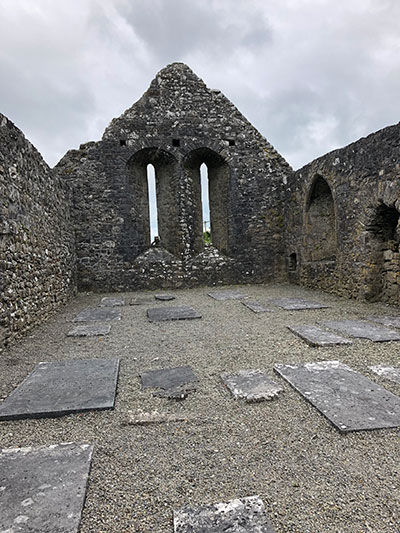
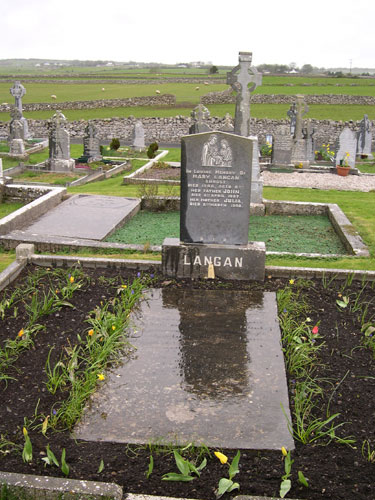
| Graveyard and ruins of old church, Shrule. To see more pictures of the graveyard and the Byrne tombstone in particular, go to Byrne Tombstone now or at the bottom of the page. | ||
| ||
| Photos taken by Maggie Blanck June 2004. | ||
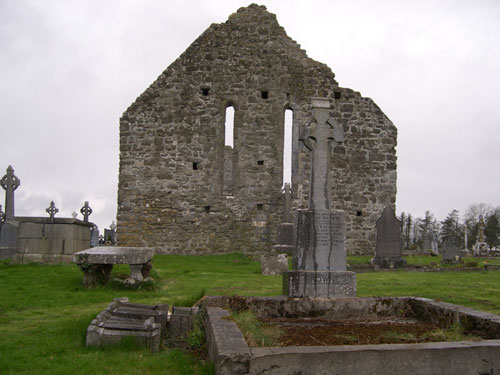
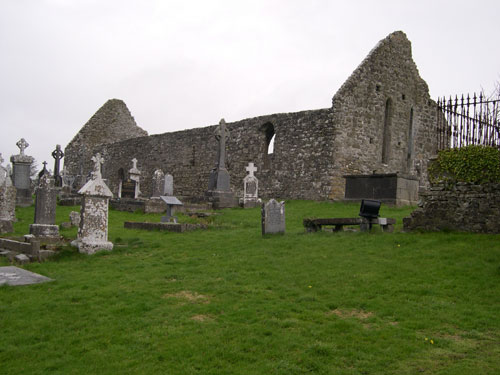
| Another view of the graveyard and ruins of the old church, Shrule. | ||
 |
|
| Photo by Ed Land, March 2005 | |
 |
|
| Photo by Ed Land, March 2005 | |
 |
|
| Photo by Ed Land, March 2005 | |
 |
|
| Photo by Ed Land, March 2005 | |
 |
|
| Photo by Paul Herdman July 2019 | |
 |
|
| Photo by Ed Land, March 2005 | |
|
Population of Shrule in 1833 The Parish of Shrule contained 4,167 inhabitants. (Ireland Population: Abstract of Answers and Returns Under the Population, 1833)
Shrule in 1835 Fair Days Easter Monday, July 26 and November 11 (An improved topographical and historical Hibernian gazetteer; to which is ... By G. Hansbrow) Description of Shrule in 1837 Shrule parish includes the townland of Mochara, where Maggie Langan and her brother, Martin, were born. Their grandmother, Penelope Byrne, was listed in Mochara in the 1856 Griffith. There were also Langans in Houndswood, Kinlough, Ramolin, and the Town of Shrule. However, I don't know if they were related to Matthias Langan. The following descriptions of Shrule is from "A Topographic Dictionary of Ireland" by Samuel Lewis, written in 1837
"Shrule, or Shruel, a parish, in the barony of Kilmaine, count of Mayo, and province of Connaught, 3 _ miles (N) from Headford, on the road from Galway to Westport; containing 4167 inhabitants, of which number, 507 are in the village. This parish is situated on the river Blackwater, which running through the village separates the counties of Mayo and Galway: comprises 8959 statute acres, as applotted under the tithe act. The land is of good quality, and chiefly under tillage; the system of agriculture is much improved and the wheat produced here is considered to be the best in the country: the waste land is bog, which might be easily reclaimed and converted into good pasture. Limestone of excellent quality is found in abundance and quarried for agricultural purposes and for building. The principal seats are Dalgan Park, the residence of P. Kirwan, Esq., a spacious mansion of hewn limestone, in the Grecian style, with a noble hall supported on lofty Corinthian columns and lighted by a finely proportioned dome; Riverview, of M.J. Hunt, Esq.; and Glen Corrib, of A Brown, Esq.; Shruel, of R. Golden Esq.; Ballycurrin Castle, of P. Lynch, Esq.; and Houndswood of M. D'Arcy, Esq. The village contains 16(?) houses, many of which are neatly built, and the (?) of the climate is such as to render it a desirable residence for invalids. To the rear of Riverview is a hamlet called Gurtloygraph, in which are many instances of longevity. An extensive brewery is carried on, and there are large corn-mills, the property of R. Golden Esq. A market for corn is held here every Thursday, which is abundantly supplied; and there are fairs on Easter-Monday, July 26th and Nov. 11th. A constabulary police force is stationed in the village, and petty sessions are held on alternate Thursdays.The following are definitions of some of the terms that might be unfamiliar. All of the terms connected with the church refer to the Church of Ireland (Protestant).
These descriptions were written before the Great Famine of 1845-8 and therefore describe Shrule before the potato crop rotted and about two million four hundred thousand people in Ireland either died from hunger and disease or emigrated from Ireland.
Shrule 1859
The Guardian, known also as The Manchester Guardian, November 5th, 1859. BIGAMY. — At the Liverpool Police Court, yesterday, a respectable-looking woman, named Bridget Mooney, was committed for trial on a charge of bigamy. It was proved that about 19 years ago the prisoner married a man named Patrick Lanagan, who is yet alive, at a place called Shrull in Galway, and that in 1855 she married her second husband, Mr. Mooney, an outfitter, residing in Kent Square, Liverpool." Shared by John Doherty January 2008 Description of Shrule in 1875
Shrule is a town in the same district, also under the Dean of Tuam. There is no record that any Protestant worship was celebrated in this place since 1641, the year so marked in the annals of Ireland by rebellion and bloodshed, when the Bishop of Killaloe and sixty Protestants were attacked and most of them cruelly massacred. Since that time this town has been proverbial for the wicked character of its inhabitants, and for their bigotry and intolerance. The name Shrule means in Irish, "a river of blood." A Mission commenced here could not escape very determined and open resistance. The Dean licensed a school-room in Shrule for regular morning service, and with thankfulness he was permitted to see an increasingly large attendance. The school children were also gathered for instruction, and the Readers of God's Word were welcomed by many of the people. These efforts were not long continued unopposed. The priests were horrified that so Catholic a town as Shrule should be exposed to such teaching. In order to get rid of the Agents the shopkeepers were forbidden to sell them any provisions or fuel; this not succeeding, they were hooted, and subjected to every kind of insult, even the water they drank being made unfit for use. The windows of the Mission House were broken, and on Sunday those who attended Divine Service had to make their way through a mob of several hundreds, who hooted and threatened them. At length it became necessary for the Rector to resort to the secular power, and to memorialize the Lord Lieutenant for protection. Upon this an additional number of police were sent down, and several ringleaders were bailed to stand their trial at the Quarter Sessions. A violent letter from the priests of Headford appeared in the Roman Catholic paper afterwards, misrepresenting the whole case, and espousing the cause of the rioters. What was the result of all this affray? Firmness united with kindness always prevails; the Dean was in no way intimidated. The service was continued, and many of the people met the Readers, and begged of, them in God's name to persevere, adding that they hoped the time would soon come, when they could send their children to school and openly and freely converse with them. Shrule 1864
"Shrule, a small town situated on the Blackwater, possessing the ruins of an abbey, a massive-towered castle, and the notoriety of as foul a massacre as was ever perpetrated in Christendom. In 1641 Sir Henry Bingham, with a number of Protestant gentry and 15 clergymen (among whom was the Bishop of Killala), arrived at Shrule from Castlebar (which he had been obliged to surrender from want of provisions), under promise of safe escort from Lord Mayo and the R. C. Bishop of Tuam. Notwithstanding this promise, they were handed over at Shrule Bridge to the keeping of a relation of Lord Mayo, one Edmund Burke, "a notorious rebel and bitter papist, the man who not long before, having taken the Bishop of Killala prisoner, wanted to fasten him to the Sow (a battering engine), with which he was attempting to beat down the walls of Castlebar, in order that the besieged in firing might shoot their own prelate." - Otway. The unfortunate Protestants were attacked by him in the most ferocious manner: some were shot, others were piked, others cast into the river; in all 65 were slaughtered.
Famine in Shrule
"About three or four hundred of the most destitute families of this division have crawled to Ballinrobe (a distance of 10 or 12 miles) every Friday for the last month" Shrule 1870 John Walsh a Shrule shopkeeper was fired at while returning home from the market. He was badly injured but the money he was carrying was not taken. Fenian or agrarian sentiments were suspected. John Walsh died of his wounds. (Philadelphia Inquirer) The Irish Times of January 10, 1870 reported on the incident. The shotting occurred within a half mile of Tuam. John Walsh was a dealer in eggs and reportedly did not own any land. However, it was rumored that he had been in "treaty" for some land from which a tenant had recently been evicted. Local opinion rejected the notion it was a land issue and suggested Walsh's offend "lay in his dealings as an egg merchant." He was accused of buying up all the eggs around Tuam and exporting them to England, selling them at a higher price than he could get locally. The day he was shot he had raised the price of his eggs to 1s 6d per dozen. While buying the eggs from the local farmers and cottiers he supplied them with guano and manure. He was said to be a "good man" not hard on those in his debt. While driving home from the market in his jaunting cart with two neighbors and a servant he was fired upon. a man approached and deliberately and pointedly shot Walsh in the stomach. His companions fled. The assassin "retreated at his leisure." Walsh died a day or two after the incident. "John Walsh, publican and general dealer, of Shrule, county Mayo, was proceeding home from the market of Tuam on the evening of New Year's Day, when, on the Galway road, between six and seven o'clock, the night being very dark, he was fired at and severely wounded, a ball having entered his stomach, from the effects of which he lingered, and died. In his dying declaration he stated that he did not suspect any person, and he assigned no motive for the outrage. At the time the shot was fired he was sitting on the right side of the car, driving, two men on the other side, and one on the well. Two of these men were relatives of Walsh, and got off the car and walked home, leaving Walsh and his man, Michael Lanigan, to proceed without them. Lanigan's information was taken. The two other men, Patrick and John Bohan, were arrested and held to bail, but never brought to trial. In conjecturing a motive for this deed, it is thought that a jealousy might have been created amengst other dealers, as Walsh was in the habit of giving better prices for eggs, etc, and monopolizing the trade, or that he did not accommodate his friends with money; but nothing certain has been ascertained. (Accounts and Papers of the House of Commons By Great Britain. Parliament. House of Commons) Shrule 1879 The murder of a bailiff name Lynsky on the property of J. D. Meldon Esq. near Shurle was reported and then retracted and it was stated that Lynsky had died of excess drinking. (Waterford News).
Shrule 1920 October 28 1920 Houses in Shrule, County Mayo bruned The Struggle of the irish People - United States Congressional serial set, Issue 7932 On the 28th October 1920 at Shrule, County Mayo, Mrs Kelleghan "was dragged form her house, that after shooting her husband they ordered her to point tout the houses of the local Sinn Feiners" and when she refused they murdered her. Great Britain House of Commons.
Dalgan Park
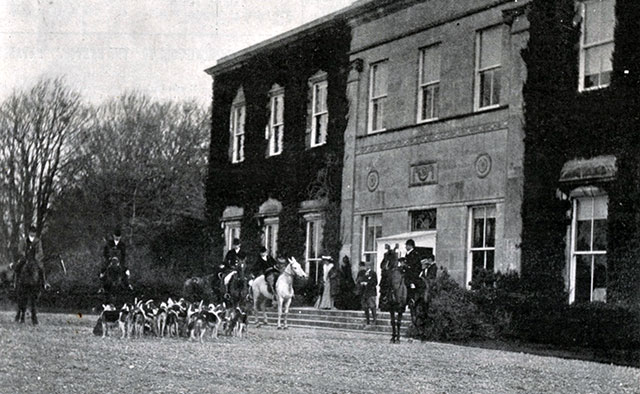
1906, The Sketch - The Future Homes of the New Actress-Peeresses Dalgan Park, Shrule, Taum, Ireland, the Residence of the Lord and Lady De Clifford Lord de Clifford (Jack Southwell Russell) married the actress Eva Carrington in 1906. He died in 1909 after a car accident in England. The estate was inherited by his two year old son, Edward Southwell Russell. In 1840 Dalgan Park was part of the estate of Patrick Kirwain.
"In 1853 the entire estate of Patrick Kirwan was sold in the Encumbered Estates' Court for £48,300. The purchaser was the Duke of Bedford on behalf or in trust for Lady de Clifford. The Kirwan family moved to Gelston Castle in Scotland."John Russell married Sophia Southwell-Clifford-Crossmaker in 1822. She was the granddaughter of Lord de Clifford and inherited the title of Lady Clifford in 1833. Their son Edward was born in 1824. He inherited the estate and the title. His, son, also Edward born circa 1855 parceled the land and sold large portions of the estate. The Russells were primarily absentee land lords. 1862: "With the exception of the demesnes of Castle Hacket, the residence of Mr. Denis Kirwan, and of Dalgan House, near Shrule, the property, by recent purchase of Lady, De Clifford, the country is almost destitute of trees." (The West of Ireland: Its Existing Condition and Prospect, Part 2, Part 2 By Henry Coulter) | |
Ancient History of the Area: Thanks to Matt McLaughlin, March 2013 for telling me about this site. See also Historical Ballinrobe
| |
| RELATED PAGES | |||
| The Byrne of Mohorra | |||
| Maggie Langan Walsh , born in Mochara in 1875 | |||
| Mathias Langan , the husband of Penelope Byrne, and the father of Maggie Langan. | |||
| Photos of Mohorra | |||
| The Townland of Mochara, some tidbits. | |||
| Mochara a survey form the 1901 and 1911 Censuses and the Griffith Tax Valuation | |||
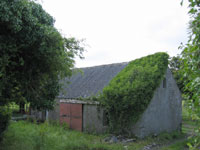 |
To see photos of the Byrne cottage in Mohorra, Shrule Parish, click on the cottage.
|
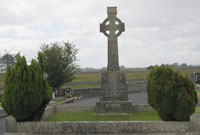 |
To see photos of the Byrne Tombstone in Shrule Parish, click on the tombstone.
|
| If you have any suggestions, corrections, information, copies of documents, or photos that you would like to share with this page, please contact me at maggie@maggieblanck.com |
| ©Maggie Land Blanck - Page created in 2004 - Latest update, September 2019 |
| WALSH/LANGAN/ INTRODUCTION
| |
| HOME
| |
| RETURN TO TOP OF PAGE | |