|
Lands in Wakefield
The first certain ancestor with the surname, Land, was John Land,
the father of Charles Land, who was baptized in All Saints Church in Wakefield in 1767.
There are Land records in the parish from the 1730s.
John Land, the father of Law Land lived in Wakefield for a period in the mid 1800s.
Wakefield was a town, a township, a parish, and a district in the West Riding of Yorkshire.
The town (now city) is situated on the side of an "eminence" sloping to the river Calder
nine miles south/east of Leeds. The river was made navigable in 1698.
The parish contained the townships of Horbury, Stanley-with-Wrenthorpe, and
Alverthorpe-with-Thornes.
Wakefield dates from Roman times and was listed in the Doomsday Book in 1086.
Wakefield was the scene of a "celebrated" battle in December 1459 between the Yorkist
and the Lancastians and was the
scene of fighting in the civil wars between 1642 and 1649.
The woolen trade was extensive in Wakefield by the time of Henry VIII (1485-1509).
All Saints, the principle church, was erected in the time of Henry III (1216-1272).
However, from repeated repairs and alterations it underwent, little of the original remaines.
St John's church was built in 1791.
The Wakefield district comprised the sub-districts of Wakefield, Horbury, Stanley,
Alverthorpe, Ardsley, Outon, Sandal, and Bretton. Alverthorpe, a village in the township of
Alverthorpe with Thornes, was a woolen manufacturing center. John Land lived in Alverthorpe with
Thornes in 1849.
Horbury, a large village in the Chapelry of Wakefield, was also a woolen manufacturing center. Some
of the earliest records for the name, Land, come from Horbury.
Ardsley East and Ardsley West (Woodkirk) parishes were formed from what
had formerly been part of Wakefield parish. William Law lived in West Ardsley circa 1840.
Wakefield in the Doomsday Book
There was a "Manor" in Wakefield at the time of Doomsday Survey in 1086. Wakefield Manor is
mentioned in Doomsday as follows:
"In Wachfeld, with its nine Berewics, namely:-Sandala, Sorbe, Werla,
Fesbe, Wadesurde, Crumbetonseton, Miclei, Langfeld, and Stanesfelt,
there are sixty carucats and three oxgangs, and the third part of an oxgang to be taxed.
Thirty ploughs may till these lands. This Manor was in the demense of King Edward the
confessor. There are now in the King's hands four villanes, and three priests, two churches,
seven sokemen, and sixteen bordars. They together have sixteen ploughs. Wood pasture, six
miles long and four broad. Value in Edward's time 6 (pounds), at present 15 (pounds).
Notes:
- A sokeman was a person who had the right to hold a local court of justice
and receive fees and fines.
- Edward the Confessor ruled from 1042 to 1066.
The City of Wakefield Official Handbook
The City of Wakefield Official Handbook 1947.
The information in this section is primarily taken from this pamphlet.
Danish and Saxon Influence
Wakefield may have been the Viking capital of the area in the days of the Norsemen.
Numerous place names have Danish origins thorpe being an Old Norse word for village.
Saxons were also in the area as indicated by the place name Pledick
- Plecga's wick [homestead of Plecga] - called Plegwyk in 1309.
Norman Influence
The town apparently takes it's name from a Norman chieftain named Waca.
Wacanfeld was the center of a large manor belonging to King Edward the Confessor (1003-1066).
In 1204 the town was granted a charter to hold a fair on "the eve, the feast and the morrow"
of the
parish saint's day - that being
All Saint's Day.
Note:
The right to hold a fair was a significant privilege.
Mediaeval fairs were a combination of religious feast and business trading.
Fairs were an important source of income for a town. People arrived
from near and far; rich and poor, noble and base born, tinkers, tailors and beggars were among the crowds.
Tolls were exacted from the merchants who came to show their wares.
Cloth, dairy products, hay, iron, poultry, vegetables and salt were among the items sold.
Luxury items and foreign goods were also available.
There was no lack of entertainment during the fair. Jesters, tumblers, jugglers,
musicians
performed.
Ale and bread and other foods were available for refreshments.
Trade guilds performed mystery plays.
Archers competed for prizes.
Cloth weaving is believed to have arrived in the area during Norman times.
Records from 1250 mention cloth dyers. By 1308 there was a wool market in Wakefield.
By the late 1300s Wakefield was the largest cloth producing center in the West Riding.
The church of All Saints was dedicated in 1329.
This event was commemorated by a statue of
archbishop William Melton who consecrated the church. Much of the original building was later torn down
in the mid 1400s and rebuilt.
By 1385 Wakefield had four main streets: Kirkgate, Warrengate, Westgate, and Northgate.
By 1500 Wakefield was the largest city in the area.
Tudor Period
In the 1500s most of the houses were constructed of wood.
See the images of Six Chimneys at
Images of Old Wakefield
The English Civil War
During the reign of Charles I England suffered civil war between the
Parliamentarians and the Royalist. The conflicts lasted from 1642 to 1651.
The town of Wakefeild was captured by the Parliamentarians under Sir Thomas Fairfax in May 1643.
Many prisoners and the city was plundered.
The castle at Sandal was in the hands of the Royalists and fell to the
Parliamentarians in September 1645.
See The Parish Records Wakefield below for the death records of some soldiers between 1642 and 1644.
The Aire and Calder Canal
The Calder Canal, completed in 1701, was part of the system of the Aire and Calder canals that
connected Leeds and Wakefield to the seaports at York and Humber.
Navigation by water was very important in the days before trains and
motorized vehicles. At a time when the roads were very bad or nonexistent,
these canals systems allowed commerce with the rest
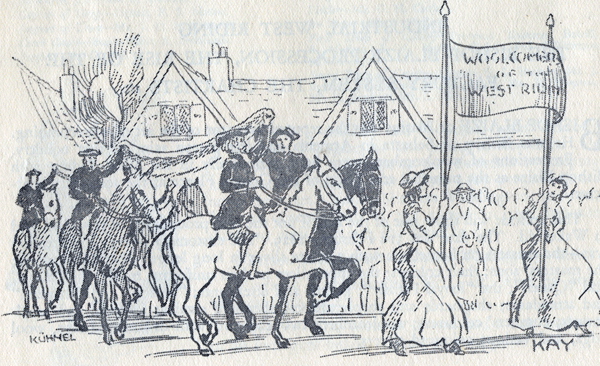
of England and the world. The canals were essential to the development of the wool cloth trade in the West Riding of
Yorkshire.
Wakefield in 1720
Daniel Defoe visited the town in 1720 and wrote in a
Tour through the whole island of Great Britain:
"a large handsome, rich, clothing town, full of people and full of trade," and adds,
"Wakefield is a clean, large, well-built town, very populous and very rich:
here is
a very large church, and well filled it is, for here are very few Dissenters;
the steeple is a very fine spire, and by far the highest in all this country, except that at Sheffield.
They tell us there are more people also than in the city of York, and yet
is is no corporate town, and the highest
magistrate, as I understand, a constable. A great trade is carried in the woolen
cloths of this country, of which
large quantities are exported as well as made use of ay home."
See more from Defoe under The Town of Wakefield below.
Wakefield in the 1800s
The town was noted to be "generally clean" and the buildings "good". Cloth manufactures were numerous.
The cloth was sold at Huddersfield.
The West Riding Court House was built in 1806 at the top of Wood Street.
Cholera ravaged Wakefield in 1832.
Wakefield faded as a cloth-producing center and
developed into a agricultural center by the mid 1800s.
The grain market was so large that the Corn Exchange was built at the top of Westgate
in 1838.
Before 1847 the general market was held in the Bull Ring, Cross Square, around the
Market Cross and in the streets of Northgate. A special Act of June 1847 established the general market
between Brook and Teall Streets.
Wakefield became a municipal borough in 1848>
In 1865 the Industrial Exhibition was held in Tammy Hall in Wakefield.
In 1866 the Market Cross was pulled down to open up the Cross Square.
In 1867 the Great Northern Railway company built a station at the foot of Westgate.
The railroad bridge across Westgate was constructed at the same time.
The town hall was built in 1800.
The Town of Wakefield
Several old histories and gazettes written between 1759 and the early 1900s mention Wakefield.
- In 1759, Andrew Brice of Bristol, printer, said that Wakefield was a large well built
town famed for its cloth trade. He further said:
"The town consists principally of three great streets centering near the church"
"Friday market, for woolen cloth, is like that at Leeds, but not so very considerable."
-
1769 Daniel de Foe
called Wakefield a large town which:
"consists chiefly of three great streets which meet in a center near the church,
where might be found a spacious market place; but by reason of the great number of
inhabitants it is so crowded with buildings that there is only a small area round the
Market Cross, which is a very elegant building, being an open colonnade of the Doric order
supporting a dome, to which you ascend by an open circular pair of stairs in the center of
the building. This brings you to a room which receives light from the turret on the top, and
may be called the town hall, for here they transact all their public business. The church is a
very large and lofty Gothic building, the body of which was repaired in the year 1724, but
the spire (which is one of the highest in the county) remains in the same state it was.
From the bridge you have an agreeable view to the south east where by the side of the river,
rises a hill covered with wood at about a mile distance. This joins to an open moor or common
called Heath Moor, upon which are several gentlemen's seats, very pleasantly situated"
He further says:
"A great trade is carried on in the woolen cloths of this country, of which large
quantities are exported as well as made use of at home"
- In 1802 John Housman said "that the increasing population is distinguished by
the numbers of new houses and cottages placed on the side of the road"
and that the streets were generally clean with "flagged walks on each side, the buildings in
good shape."
- The 1822 Baine's History etc of Yorkshire said"
"The streets are for the most part regular, handsome, and spacious, and the houses,
which are principally of brick, are well built, large, and lofty."
They added that the market area was crowded and "incommodious"
- In 1832 there was an outbreak of cholera in Wakefield.
- The History and Topography of the Parish of Wakefield and its
Environs by John Hewitt Vol 1 1862 includes the following information abour Wakefield:
- The parish registers indicate that the plague raged in Wakefield from August to
January 1625. The total number of deaths being 130. The greatest number of deaths
in a day was 6. The first death of de peste was August 8, 1625 and the last
burial was on January 17 1626.
- There was a separate register for the births of children of "Dissenters" in and near
Wakefield from part of the year 1696 to part of the year 1708.
- On January 12, 1845 there was such a thick fog
in Wakefield that the gas lights were of no use.
This indicates that there was gas lighting on
at least some streets by that date.
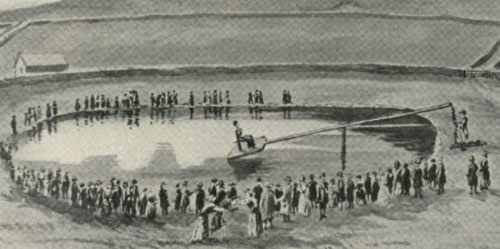
- Being a "scold" was apparently a highly undesirable trait. There are fairly
frequent entries in the area court records of women being punished for being a "scold".
Hewitt says,
"The ancient Dunking Stool, that most singular contrivance of our forefathers, for
the punishment of Female Scolds, consisted of a chair or stool, in or on which the angry
lady was tightly strapped: and this chair being securely fastened with an iron or wooden-pin
to one end of a long pole. She was in that position (the pole being hoisted perpendicularly)
carried aloft at a considerable altitude above the heads of her tormentors, to the nearest
shore of the Calder: and, when arrived there, the pole was placed horizontally across a
large trestle standing alongside the river, and thus suspended to her great chagrin, she
was swinging to and fro in mid-air over the water, and the next moment, by means
of the people's moving this pole upwards and downwards, in th manner of what is called
in Wakefield, "A ranty-pole," the Dunking Stool was consequently also moved downwards
and upwards and the "Scolding woman was repeatedly immersed overheat in the water,
in order to cool down her hot temperament: after which, when the operators thought
she had had a sufficient number of plunges, they liberated her form the stool, and thus,
whilst in a most pitiful plight- dripping wet- ashamed,
and undoubtedly, humbled, she became th laughing stock of the spectators, as well as
a suitable, but rather unenviable subject of butts, scorns, and sneers of her facetious
neighbors, whose merriment on the occasion seemed almost unbounded."
"Previous to the Scolds being immersed in the river, they were, whilst fastened in
the "Stool," paraded on men's shoulders through the principal parts of the town"
"The Ducking Stool of Wakefield was the property of the town, and regularly kept in repair
at the expense of the rate-payers. Long after is disuse it was kept in existence and
carefully repaired several times in the reigns of George II and George III."
Note: - George III reigned 1760-1820
There is still a chain attached to the wall of the parish church in Wakefield where "scolds"
were punished by being "neck" cuffed to the wall.
-
"The Poor Law Union of Wakefield" included the following townships:
Wakefield, Horbury, Alverthorpe-with-Thornes, Stanley-cum-Wrenthorpe, Sharlestone,
Sandal-Magna, Flockton, Oulton-with Woodlesford, Emley, Gigglestone, Chevet,
Bretton-West, Crofton, Woodchurch, Lofthouse-cum-Carlton, and East Ardsley.
- In 1723 some statistical data was collected on the population in order to determine
if there was a need to build a larger church. "An attempt to count everyone in the township
with the exception of the people who lived in Horbury" resulted the the following:
Westgate and Brookbank-------Families.....324, souls.....1656, communicants.....1004
Northgate----------------------------Families.....217, souls.....1044, communicants......649
Kirkgat--------------------------------Families.....343, souls.....1470, communicants......928
-
The Imperial Gazetteer of England
and Wales by John Marius Wilson, published in 1870 and
available on microfiche through LDS, gave the following discription of Wakefield.
Wakefield, is a town, a township and a parish in Yorkshire.
"The town is on the river Calder, nine miles South-south-east of Leeds. Wakefield dates to
Roman times and was known in the Doomsday book as Waehefeld. It had both
Saxon and Norman settlements. Wakefield was a major woollen manufacturing
center in the time of Henry VIII. In the mid 1600s before the civil war (1642-49), the West Riding was flurishing.
Trade was steady and the people as a whole were living in relative comfort.
The population was very sparse. Clusters of houses situated on the sides of the main
roads were surrounded by green fields and woods. Many of the areas inhabitants
were involved in the dual occupations of farming and cloth making."
"Although still a manufacturing center in 1870 it had been
surpassed by other cities. Population in 1851 was 22, 065."
- Sisson (1824)
- The Church and the Vicarage
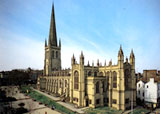
The church of All Saints or All Hallows is located in the old centre of the town of
Wakefield near the old Market Place at the juncture of the three principal streets,
Kirkgate, Westgate and Northgate. The church was consecrated the Parish
Church of Wakefield on "the 4th of the Ides of August in 1329". In 1349 the vicarage
of Wakefield was ordained to consist of a mansion, "with houses sufficient" built at the
costs of the Dean and College of St Stephens Westminster. In addition "the vicar shall
have all kind of oblations offered in the Church on principal festivals and on other days
and times of the year." The tithes to the vicarage included:
"tithes of line, hemp, albi calves, lambs, fowls, pigs, bees, wax, honey, pullain, pigeons,
brood-geese and swans, as well in their bodies as in money··.Also, of fruits and herbs:
and of hay of gardens and crofts of the whole parish. Likewise of mills then built or to be
built afterwards·.And all ablations and small tithes in whatsoever thing consisting and
belonging to the said church; together with the tithe of wool, when it ought to be paid
in money, but not in fleece. Also, he shall have the whole altarage of the church
and peter-pence and the due and customary pennies for the consecrated bread of
the parishioners, together with all oblations and obventions in espousals, purifications
of women and children, baptisms and the wax candles in the exequies and sepultures
of the dead."
In turn the Dean and College of St Stephens Westminster received from parish of Wakefield and
other local parishes.
"appropriated to their own use, the lands, meadows and rents of their farm,
perquisites
of their court, and all the tithes of garbs and hay, and of wool of the whole parish. Also,
shall have the portions of garbs and hay of the chapel of Horbury, and Heton in the
parish of Dewsbury. Likewise the portions of Thithes of garbs and hay of the demesne*
lands in the Parish of Sandal, to the Church of Wakefield appertaining. Also the tithe-herbage
of the woods and parks and fallen wood; of iron and coal mines within the Parish of Wakefield."
*Demesne, pronounced di mayn [main],
was an estate occupied by the owner rather than being rented out.
The Vicar of Wakefield's obligation to the Archbishop of York was to
"pay the procuration due to the Archbishop or Archdeacon, of the place
accustomary, synodals and peter-pence: and shall find one Chaplain in the church of
Wakefield and another in the chapel of Horbury, and lights and lamps as well in
church as chapel. Also shall (as oft as need requires) repair the chancels of the church of
Wakefield and chapel of Horbury, and find books and vestments for the same, and washings."
The Dean and College of St Stephen's had the obligation
"(if need require) build the said chancels of the church and chapel, and provide anew
books and vestments thereof. And as for the papal and regal demands, when they occur,
and the procuration of the Cardinal's and Pope's legates and ministers, when they shall be
entirely laid upon the church of Wakefield, the said Dean and College shall be obliged to
bear."
- The Parish Registers:
"The registers of this church do not go very far back, the early ones having been
destroyed or lost. Those which remain are evidently copies, being for a great
number of successive years in the same hand and written with the same ink. Besides
the unusual entries, they contain several memoranda on different subjects connected
with the civil as well as the ecclesiastical affairs of the town, a circumstance not
unusual in early documents of this description. They commence in 1613."
"The plague which extended its ravages to most parts of the kingdom,
prevailed here in this year and the next. From the Register, its devastations seem to
have commenced in August 1625, and to have ended in Jan. 1626. During that period there
are entries of more than 130 persons, eash of whom is distinguished as having died
'per pestem' or 'de peste'." "1630. In the Register of this year there are two licenses signed by Mr Lister, then
vicar, authorizing the persons therein name, to eat meat in Lent and on all other
fasting and fish days"
Sisson includes a copy of one of the licenses which allowed Alice Lister, the wife of
Richard Lister "by reason of her olde age and many years and stubborne and long
continued sicknesse" to break the fast. "1645. In August the plague again made its appearance and continued
in the town for twelve months, during which period above 200 of its victims were buried
in this Church; besides others who died in the neighbourhood, and were buried where
they died."
- History of Wakefield and District Fielding and McInnes (19?), available on LDS
microfiche
#6342243.
- The great manor of Wakefield belonged to the king before the Norman Conquest
and covered an area about thirty miles long and twelve miles wide along the Calder valley.
- They list the population of Wakefield as follows:
- 1723..... in the town, 4,170: in the
parish excluding Horbury, 6,300
- 1801.....8,134
- 1811.....8,593
- 1821.....10,764
- 1831.....12,232
- 1841.....14,754
- In the reign of Henry VIII Wakefield was the largest and most populous and most flourishing town in the area. It was double the size of Leeds and Bradford.
- They quote "Leland" who descibed Wakefield in 1538 Leland as follows,
"Wakefield upon Calder is a very quick market town and meately large; well
served of flesh and fish, both from the sea and by rivers, whereof divers be thereabout at
hand; so that all victuals is very good cheap there. A right honest man shall fare
well for two-pence a meal. In the town is but one chief church. There is a chapel
beside where was wont to be anachoreta in media urbe, unde aliquando inventa foecunda.
There is also a chapel of our Landy on Calder bridge wont to be celebrated
a pereginis a forow length or more out of the town be seen dikes and bulwarks and
monticulus egestae terrae indicium turris specularis, whereby appeareth that there
hath been a castle. The Warrens Earls of Surry, as I read, were once lords of this town.
It standeth now all by clothing. These things I especially noted in Wakefield---- the fair bridge
of stone of nine arches under the which runneth the river of Calder; and on the east
side of this bridge is a right goodly chapel of our Lady and two cantuarie priests
founded in it, of the foundation of the townsmen as some say; but the Dukes of York
were taken as founder for obtaining the mortmain. I heard one say that a servant of King
Edward's (the forth) father, or else of the Earl of Rutland, brother to King Edward the
forth, was a great doer of it. There was a sore battle fought in the south fields by this
bridge; and in the flight of the Duke of York's party, either the Duke himself or his son,
the Earl of Rutland, was slain a little above the bars beyond the bridge going up into the
town of Wakefield, that standeth full fairly upon a clyving ground. At this place is set
up a cross in reimemoriam. The common saying is there that the Earl would have
taken there a poor woman's house for succour, and she for fear shut the door and
straight the Earl was killed. The Lord Clifford for killing of men at this battle was
called the Butcher. The principal church that now is in Wakefield is but of a new work;
but it is exceedingly fair and large. Some think that wereas now is a chapel of ease
at the other end of the town was once the old parish church. The vicarage at the east
end of the church garth is large and fair. It was the parsonage house not very many
years since; for he that now liveth is the forth of fifth vicar that hath been there.
Afore the impropriation of this benefice to St Stephan's College at Westminster,
the parsonage was a great living, in so much that one of the Earls Warrens, Lords of
Wakefield and much of the country thereabout, did give the parsonage to a son or
near kinsman of his and he made the most part of the house where the vicarage now is.
A quarter of a mile without Wakefield appeareth a hill of earth cast up, where some
say that one of Earls Warrens began to build, and as fast as he builded violence
of wind defaced the work. This is like a fable. Some say that it was nothing but a
windmill hill. The place is now called Lo-hill. The town of Wakefield stretcheth out all
in length by east and west, and hath a fair area for a market place. The building of
the town is meatly fair; most of timber but some of stone. All the whole profit of the
town standeth by coarse drapery. There be few towns in the inward parts of Yorkshire
that hath a fairer site or soil about it. There be plenty of veins of sea coal in the quarters
about Wakefield"
|