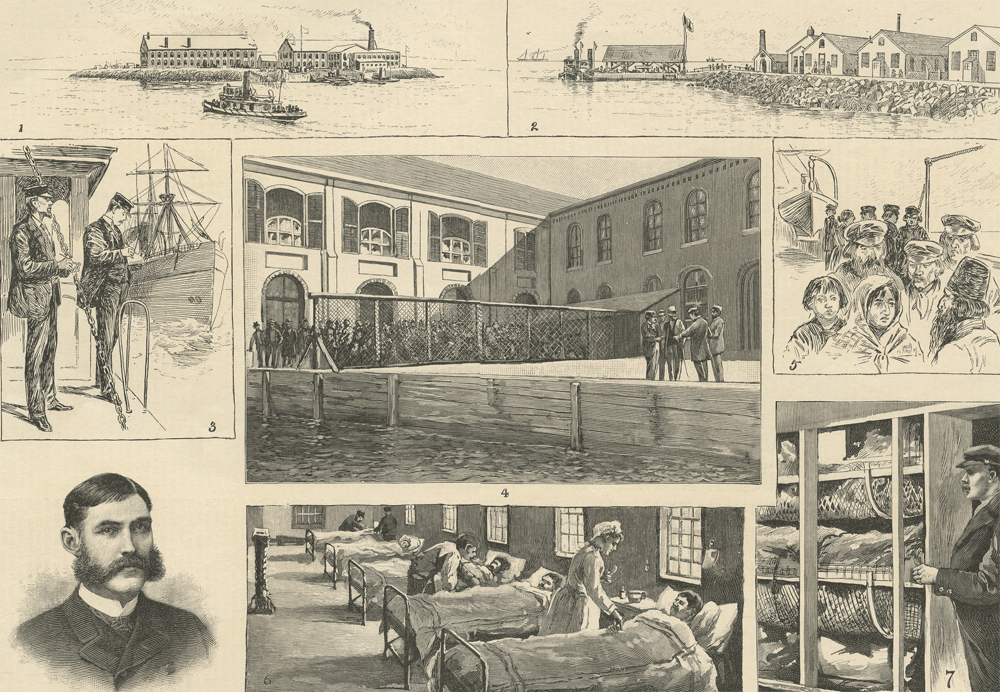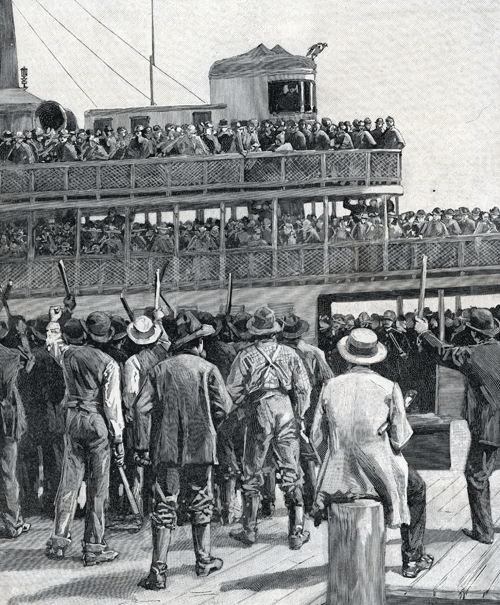
THE MOB AT FIRE ISLAND PREVENTING THE LANDING OF THE "NORMANNIA" PASSENGERS
Harpers Weekly, September 24, 1892
First Supplementary Report Of The Advisory Committee New-York, October 4, 1892.
"The Medical Advisory Committee of the Chamber of Commerce was organized on Saturday, September 10, 1892, and consisted of Drs. Stephen Smith, A. Jacohi, E. G. Jankway, A. L. Loomis, R. H. Derby, Allan Mclane Hamilton and T. Mitchell PrudDen. To their number was subsequently added Dr. H. M. Biggs."The committee approached the Health Officer at Quarantine and offered their services in case of emergency. The Health Officer seemed to feel everything was under control.
Excerpts from the First Supplementary Report Of The Advisory Committee New-York, October 4, 1892.
7b the Special Committee of the Chamber of Commerce of the State of New-York
At this time the "Moravia," the " Normannia," the "Rugia," the" Wyoming" and the "Scandia" were at anchor at the Lower Quarantine. All these were thought to be infected ships, and all had their passengers on board save the steerage passengers of the " Normannia " and " Rugia," which had been transferred to Hoffman Island. The cabin passengers of the "Normannia" had been transferred on the preceding day to the "Stonington.".........
On Monday the second attempt was being made to land the "Normannia" passengers at Fire Island. The "New-Hampshire" was anchored in the Lower Bay, and it was believed that the cabin passengers of the " Rugia" would be transferred either to this ship or to the "Stonington," as soon as she should be cleaned and made ready. We felt it unwise at this moment in any way to detract the attention of the Health Officer from the fulfillment of these most imperative duties to the "Normannia" and "Rugia" cabin passengers.
.........
The Committee urged upon the Health Officer at this interview the importance of the immediate removal of passengers from infected ships. This he stated to be his purpose, and he furthermore explained that it had been his intention to transfer the " Rugia" passengers to the " New-Hampshire " that day, but that the sea in the Lower Bay was running too high to permit of its being safely done. (September 13) .........
(Wednesday, September 14th) We recommend that a bacteriologist shall be appointed who shall be freed from all other imperative duties, in order that he may be able to attend promptly to the bacterial examinations so frequently necessary under existing conditions, upon the promptitude and certainty of whose results often depend the personal welfare and the lives of hundreds of persons." The recommendation No. 2 was made in view of the fact, that the " Wyoming," with all her passengers, was still in detention at Lower Quarantine, where she was sent on account of the suspicious nature of certain deaths which had occurred on board after she had passed Quarantine, as we were informed, five days before.
Since under ordinary conditions the biological examination should show within three, or at the utmost four days, with great certainty whether suspicious deaths were or were not due to Asiatic cholera, and yet no definite report seemed to have been received, it seemed possible to the Committee that the physicians at Swinburne Island, where the bacterial work was done, might be so busy as to be unable to attend to all the duties of the situation. In any event, it seemed wise to secure in the fullest measure wise counsel in such an important matter.
.........
(Thursday, September 15th) In company with the Health Officer, the Committee now visited Hoffman Islam. We found Hoffman Island greatly overcrowded with the steerage passengers of the " Normannia" and the " Rugia," with parts of their crew. We found an incomplete separation of the people into two groups by a fence, which divides the island into two parts. The drinking water, which is brought to the island by boat, is stored in several cisterns beneath that part of the asphalted surface of the island on which the detained people are kept. The mouths of these cisterns are protected with iron covers, which are furnished with padlocks. One of these covers, about which the "suspects" were closely grouped, was unlocked, and could have been raised by any of them, exposing the water. Another of the covers was so worn that several openings were found, through which, at any time, infected material from the clothing or persons of the detained passengers could easily have fallen and dangerously polluted the water supply.
We found that the only dining-room on the island for the Quarantined persons was in that part fenced off on the south side. This was wholly inadequate, in the opinion of those in charge, and in the opinion of the Committee for the accommodation even of the people in this group.
We found that the only laundry on the island for the use of detained persons was also on the south side. Part of the floor of this laundry was flooded with water, and the number of set tubs was wholly inadequate to the needs of the large number of persons confined in this precinct. We found that the faucets from which drinking water was drawn were set so low and so near to a long trough or sink beneath, into which refuse, food, etc., was occasionally thrown, as to suggest the possibility of dangerous contamination of the water as it was drawn.
We found a wholly inadequate privy accommodation on both sides of the island, but new structures were building on both sides.
While the condition of affairs on the south side of the island was extremely unsatisfactory, owing to its overcrowding, and the lack of a sufficient number of employees, and the other neglected conditions just described, the northern side was in a state so deplorable and unsanitary that it is difficult for your Committee to describe it in temperate language. In the first place, as there was no dining-room, the detained persons, over four hundred in number, as we were informed, received their food directly from the, distributing vessels brought from the kitchen, and were obliged to eat it either on the asphalted pavement outside, or in the dormitory crowded with cols, bedding, and such of their effects as they had been permitted to retain. Under these circumstances it is not strange, considering the class of people so largely represented among those here confined, that we should have been informed that it was a practice among many of them, which the authorities could not prevent, to stow away unused portions of food among their bedding or about their clothes.
So far as we could learn, there was absolutely no place for the large number of persons confined on this side of the island to wash their clothing, except by standing on the rocks bordering the island and using the sea water. Inasmuch as until the day of our inspection the ptivy accommodations had been wholly inadequate, these rocky borders of the island were in a most filthy condition. Further, since the privies, both old and new, discharged directly into the water close to the shore, it is evident that aside from the utter lack of proper facilities for washing, these people were forced, if they made any attempt at cleanliness at all, to do so under conditions which were always filthy and disgusting, and might at any moment be fraught with danger of fresh infection. In other words, between four and five hundred persons were obliged, as we were informed, to wash their clothing, if they washed it at all, on a rocky shore a few hundred feet long, directly upon which, or in the water within a few feet of which, all the excrement of these hundreds of people was deposited.
Your Committee saw one of the "suspects" coming from the rocks, close beside one of these privies, whose refuse fell into the sea water within a few feet of the shore, bringing a garment washed in this water up to the area for drying. In view of this condition of affairs it is interesting to note that new cases of cholera continued to appear among the passengers and crew of the "Normannia " and " Kugia," as we were informed, for several days after their isolation on the island. One case, which was pronounced cholera, did, in fact, occur among the people whose sanitary condition we have just described after their transfer to the camp at Sandy Hook.
In this connection, as will be seen later in this report, it is worthy of note that after the correction of the most glaring of these sanitary enormities, not a single case of cholera occurred among the "Scandia " passengers, whio after removal from their ship remained eight days under observation here, and up to this date we have not been informed of anv cases occurring among the " Bohemia" passengers after their removal to the island from the ship.
We were informed by the Superintendent of the island that the inside and the floors of the dormitory buildings on the north side had not been thoroughly washed either with or without disinfectants since the passengers had been placed there several days before. The observations of the Committee gave them no grounds for doubting this statement of the Superintendent.
When illness occurred the person was removed from his bed and the immediate surroundings were treated with sublimate. But a thorough washing, or disinfection of the whole region, was impracticable, it was stated, on account of the dampness of the situation, and the danger that the passengers would take cold. We found that there was actually no available suitable room to which a person suddenly attacked with cholera, or any other suspicious illness, could be removed pending his transfer to the hospital on Swinburne Island. The room which had been used for this purpose was now partly occupied as a storage room for cleansed emigrants' clothing and bedding. Moreover, the adjoining sulphuric acid disinfecting chamber was found to be in communication with this room by cracks in the wall, so that the fumes of the disinfectant, if the chamber were employed, would prevent the occupancy of the temporary isolation room. In fact, such persons had been temporarily placed in a hallway in one of the buildings while awaiting removal.
........
The Committee, accompanied by the Health Officer, now visited the "Stonington," which, through the generosity of Mr. Pierpont Morgan, had been placed at the service of the Health Officer in the great emergency. Neither the "Stonington" nor the "New Hampshire " had up to this time been thoroughly inspected, he said, by the Health Officer. Our visit to the "Stonington" was made three days after she had been vacated for the second time by the "Normannia's" passengers. We found on board a policeman, & colored steward, one or two mechanics and a few miscellaneous persons, who seemed to be without function, as they were without facilities for work. The dishes last used by the "Normannia's" passengers were piled in heaps on the floor unwashed; meat in the refrigerator was spoiling and offensive; heaps of table and bed linen were piled or scattered about. Several passengers' trunks were lying about the cabin.
Life preservers, marked "Normannia," were also seen in the cabin. There was, it was said, only about a gallon of water left on board. There had been no water for washing the dishes, and no service under orders, either to wash the dishes, or in any other way to clean up the ship.